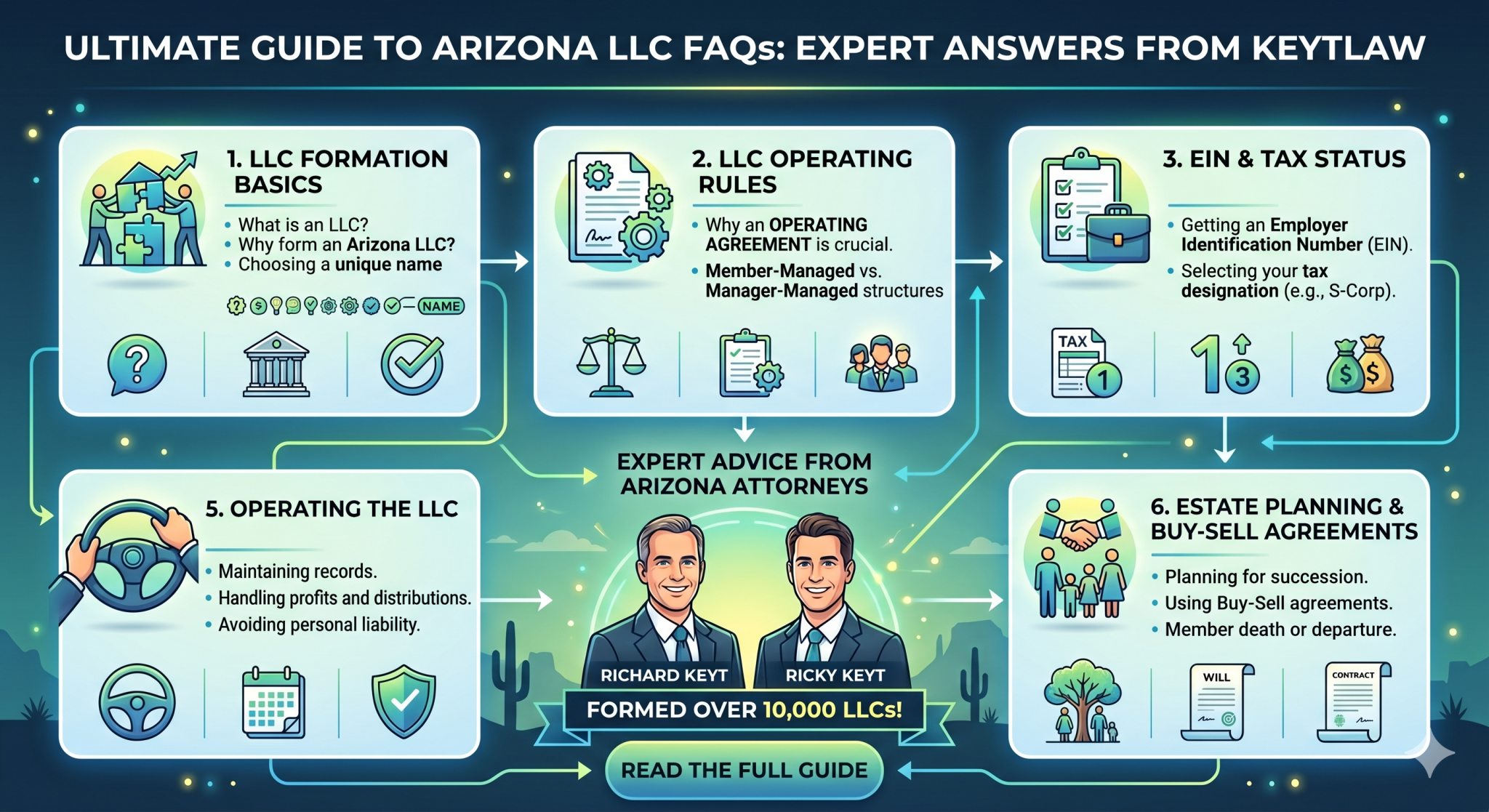
Arizona LLC Frequently Asked Questions

About the Authors: This Arizona LLC guide is authored by Richard Keyt (Rick) and his son and law partner, Richard C. Keyt (Ricky), a former CPA.  As Arizona LLC attorneys with KEYTLaw, LLC in Scottsdale, Arizona, Rick and Ricky have formed more than 10,000 Arizona LLCs since 2001.


Have a specific question about forming or operating an LLC?  Book a Free Office, Phone or Zoom Consultation | Call Rick: 480-664-7478 or Ricky: 480-664-7472 |  Email: [email protected] / [email protected].  To hire us to form an LLC today submit our LLC formation questionnaire.

Created on July 12, 2026 | Last Updated July 12, 2026

Arizona LLCs

An Arizona LLC (Limited Liability Company) is a legal business entity formed under Arizona Revised Statutes Title 29 that provides personal liability protection for its owners (members) along with pass-through taxation. Unlike most states, Arizona does not require LLCs to file annual reports or pay ongoing annual state fees.


We form LLCs and get them approved by the Arizona Corporation Commission the same day we receive your LLC formation questionnaire and payment.

Top 10 Most Common Arizona LLC Questions

How much does it cost to form an Arizona LLC?


The Arizona Corporation Commission charges a $50 filing fee for regular processing or $85 for expedited processing of your Articles of Organization. If you hire KEYTLaw to form your LLC, our packages start at $497 for the Bronze package, which includes drafting and filing the Articles of Organization. Our Silver package ($897) adds a custom Operating Agreement, an EIN, and our 170-page Arizona LLC Operations Manual.


How long does it take to form an Arizona LLC?


When KEYTLaw is hired and paid, we get your Articles of Organization approved the same day. Regular ACC processing without expediting takes about 30 days, expedited paper filing takes 5-7 days, and expedited online filing can be approved in as little as 10 minutes.


Does an Arizona LLC need a Statutory Agent?


Yes. Every Arizona LLC must designate a Statutory Agent, also called a Registered Agent, to receive official legal and state documents on the LLC’s behalf. The agent must maintain a physical street address in Arizona (not a PO Box) and be available to accept legal notices and forward them promptly to the LLC.


Does Arizona require LLCs to file an annual report or pay an annual fee?


No. Unlike most states, Arizona does not require LLCs to file an annual report or pay an annual renewal fee. Once your LLC is approved, it stays in good standing indefinitely with no recurring state fees, which makes Arizona one of the most affordable states for maintaining a business entity.


Do I need an Operating Agreement for my Arizona LLC?


Arizona law does not legally require an LLC to have an Operating Agreement, but operating without one is risky. Without a signed agreement, your LLC defaults to Arizona’s statutory rules, which split profits and voting power equally among members regardless of how much each member actually contributed or owns. A custom Operating Agreement overrides these defaults and gives you legal proof of ownership that banks, title companies, and courts require.


How is an Arizona LLC taxed?


The IRS does not have a separate tax category for LLCs. By default, a single-member LLC is taxed as a disregarded entity (like a sole proprietorship), and a multi-member LLC is taxed as a partnership. LLC owners can also elect to have the LLC taxed as an S corporation or C corporation if that classification produces a better tax outcome for their situation.


Can a minor own an interest in an Arizona LLC?


Yes. Arizona law has no minimum age requirement for LLC members, so a child under 18 can legally own a membership interest. However, because minors cannot enter into binding contracts, they cannot sign agreements or open bank accounts for the LLC. An adult manager, parent, guardian, or trust typically needs to handle the LLC’s legal and financial obligations on the minor’s behalf.


What happens to my Arizona LLC if I die without a plan?


Without proper planning, your LLC membership interest does not automatically pass to your loved ones. It must go through Arizona probate unless the value of your personal property is under $200,000, and your heirs may inherit only an economic interest with no voting or management rights. Transferring your LLC interest into a revocable living trust, or holding it as community property with right of survivorship for married couples, allows the interest to pass automatically and avoid probate.


How do I add or remove a member from my Arizona LLC?


Adding or removing a member requires three steps: signing a written Assignment of Membership Interest to transfer ownership, updating the LLC’s Operating Agreement to reflect the new membership structure, and filing an Amendment to the Articles of Organization with the Arizona Corporation Commission. Skipping any of these steps can leave your LLC’s ownership records legally unclear.


How do I dissolve or terminate an Arizona LLC?


Terminating an Arizona LLC is a two-phase process: first winding up the business by paying debts and distributing remaining assets in the order required by law, then filing Articles of Termination with the Arizona Corporation Commission. The tax consequences of dissolving depend on how the IRS classifies your LLC, so it’s worth reviewing both the legal and tax sides before you start the process.

LLC FAQ Table of Contents

Forming an Arizona LLC

What are Your Arizona LLC Formation Services?

KEYTLaw provides legal formation services for Arizona LLCs, getting Articles of Organization approved by the Arizona Corporation Commission (ACC) the same day you hire them. Their attorney-led process eliminates DIY filing errors while offering tiered packages tailored to different business needs. Every formation package includes lifetime free legal support for your LLC questions.

What Is In Your 3 LLC Formation Packages?

KEYTLaw offers three tiered formation options: Bronze ($497 for basic ACC filing), Silver ($897 for a custom Operating Agreement, EIN, and Operations Manual), and Gold ($1,397). The Gold package creates a confidential revocable living trust to keep your personal home address and name completely off public state records.

What are an Arizona LLC’s Members, Managers & Statutory Agents?

Learn the crucial differences between the three core roles in an Arizona LLC: Members (the owners), Managers (the decision-makers who run daily operations), and Statutory Agent (the designated recipient for lawsuits and government correspondence). This guide explains how to properly assign and manage each role under Arizona law to protect your business and maintain legal compliance.

What is an Arizona Statutory Agent & Its Requirements?

Every Arizona LLC must continuously maintain a statutory agent with a physical street address in Arizona to receive official legal notices and government correspondence. The statutory agent must be an Arizona resident or authorized business entity accessible during normal business hours. You can officially change your agent anytime by filing a Statement of Change with the ACC.  See Arizona Revised Statutes Section 29-3115.

How Do I Open a Bank Account for an LLC?

To open a business bank account for an Arizona LLC, banks require your approved Articles of Organization, an IRS-issued Employer Identification Number (EIN), and a signed Operating Agreement. Financial institutions mandate these documents to verify company identity and confirm which members have legal authority to access and manage company funds.

What are Arizona LLC Bank Account Rules?

An Arizona LLC must deposit all business income into a single dedicated bank account opened under its exact legal name and employer identification number (EIN). Keeping LLC funds completely separate from personal or third-party money prevents “commingling”—the leading reason Arizona courts pierce the corporate veil and hold members personally liable for business debts. This FAQ explains the legal, tax, and accounting risks of commingling and why maintaining one clean business account is critical for liability protection.

How Can I Get an EIN for an LLC?

An Employer Identification Number (EIN) is a mandatory nine-digit federal tax ID issued by the IRS for an Arizona LLC to open a bank account, hire employees, and file taxes. Single-member and multi-member LLCs apply online through the IRS website after the ACC approves their Articles of Organization.

What are the 4 Ways the IRS Taxes LLCs?

The IRS does not recognize an LLC as a separate tax entity, defaulting single-member LLCs to sole proprietorship taxation and multi-member LLCs to partnership taxation. To optimize tax liability and minimize self-employment taxes, LLC owners can formally elect S corporation or C corporation tax status by filing IRS Form 2553 or 8832.

How is an LLC Taxed as an S Corp?

An LLC can elect S corporation taxation by filing IRS Form 2553, which can significantly reduce an active owner’s self-employment taxes. Under this structure, members receive a reasonable W-2 salary while remaining profits pass through free of payroll taxes. However, owners must weigh these tax savings against increased payroll and administrative compliance costs.

What is the Difference Between Community Property and Separate Property LLC Ownership?

Under Arizona community property laws, ownership interests in an LLC acquired during marriage generally belong equally to both spouses, regardless of whose name appears on state filings. Classifying an interest as separate property requires explicit legal documentation, such as a spousal waiver or prenuptial agreement, impacting asset protection and estate planning.

How Do I Make My AZ LLC My Sole & Separate Property?

Because Arizona is a community property state, an LLC formed during marriage is legally presumed to be owned jointly by both spouses per Arizona Revised Statutes Section 25-211. To make the LLC your sole and separate property, the non-owner spouse must sign a formal Spousal Disclaimer or Consent. This written document protects the spouse who owns the interest as separate property from future marital property division or divorce disputes.  See the definition of separate property in Arizona Revised Statutes Section 25-213.

Can a Child Under 18 Own an Interest in an Arizona LLC?

Arizona law imposes no minimum age limit, allowing minors under age 18 to legally own a membership interest in an LLC. However, because minors cannot execute legally binding contracts, they cannot sign bank agreements or management documents. An adult manager, parent, or trust must manage company legal and financial obligations on their behalf.

What is California’s $800 LLC Tax?


This FAQ explains how California’s $800 minimum annual franchise tax applies to Arizona LLCs and other out-of-state LLCs owned by California residents. Forming an LLC in Arizona does not avoid California’s annual tax if you live in or conduct business within California; such businesses must register as a foreign LLC with the California Secretary of State and pay the $800 tax. Read on to learn the rules, the foreign registration process, and the specific conditions under which a California resident can legally own and operate an Arizona LLC without triggering the $800 California franchise tax.

Operating & Managing an Arizona LLC

How Do I Fund an Arizona LLC: Capital Contribution or Loan?

Owners can fund an LLC through equity capital contributions, which increase their tax basis and capital accounts, or through member loans that establish them as priority creditors during dissolution. Member loans legally require a written promissory note with a fixed repayment schedule and an interest rate meeting IRS Applicable Federal Rate standards.

How Do I Loan Money to My Arizona LLC?

Arizona law allows an LLC member to loan money to their LLC, provided specific legal and tax requirements are met to prevent the IRS from recharacterizing the loan as a capital contribution. This FAQ explains the rules for drafting a formal promissory note, securing the loan with a UCC lien or deed of trust, setting an IRS-compliant interest rate (Applicable Federal Rate), obtaining proper member approval, and understanding repayment priority upon dissolution or default.

How  are LLC Profits, Votes & Distributions Determined?

  • The “Equal Shares” Trap: Under A.R.S. § 29-3404.A and § 29-3102.12, an Arizona LLC without an operating agreement must allocate profits and distributions in equal shares among members, not by capital contributions or ownership percentage.

  • Disproportionate Impact: Under state default rules, a two-member LLC where one person puts in 90% of the money and the other puts in 10% will still be forced to divide profits and payouts 50/50.

  • The Solution: To override Arizona’s default equal-share rule and protect each member’s financial investment, the LLC must adopt a custom, ALLCA-compliant operating agreement that explicitly defines profit and distribution allocations.

How Does Arizona LLC Law Allocate LLC Profits Without an Operating? Agreement?

Under the current Arizona LLC Act (A.R.S. § 29-3404(A) and § 29-3102(12)), if a multi-member LLC operates without a written operating agreement, all profits, losses, and cash distributions must be allocated in equal shares among all members—regardless of who contributed more capital or what the verbal ownership agreement was. Because members also face “phantom income” tax liabilities on these equally allocated profits without a legal right to force a cash payout, operating without a custom written operating agreement exposes partners to severe financial distortion. This FAQ breaks down Arizona’s equal-split statutory defaults and details how a properly drafted operating agreement overrides them to protect individual member investments.

19 Arizona LLC Operating Agreement FAQs

While Arizona law does not strictly require an LLC Operating Agreement, operating without one defaults your business to rigid state statutes that divide profits and voting power equally among members. A custom written Operating Agreement establishes tailored governance, prevents ownership disputes, and provides essential legal proof required by banks and courts.

5 Essential Business Insurance Policies for AZ LLCs

Forming an Arizona LLC protects your personal assets from business debts and lawsuits, but it does not protect the assets owned by the LLC (such as bank accounts, equipment, and inventory), nor does it shield members from personal liability for their own wrongful or negligent acts. Proper business insurance works as a necessary first layer of armor alongside your LLC’s legal shield to fully protect your business.

Arizona Business Insurance for LLCs: What You Need to Know


While an Arizona LLC protects members’ personal assets from company liabilities, it does not protect the assets owned by the LLC or cover members for their own wrongful acts. To fully protect the business, an operating LLC should obtain: (1) Commercial General Liability ($1M occurrence / $2M aggregate minimum), (2) Commercial Property Insurance at replacement cost, (3) Workers’ Compensation (mandatory under Arizona law for any LLC with employees), (4) Commercial Auto Insurance ($1M limit), and (5) a Commercial Umbrella Policy ($1M+). Depending on industry risks, businesses may also need professional liability (E&O), cyber liability, business interruption, and employment practices coverage. Crucial Rule: The LLC itself must be listed as the named insured on every policy—a common mistake is leaving existing insurance in the owner’s individual name after forming the LLC.


Essential Insurance Policies Every Operating AZ LLC Should Consider:


  • Commercial General Liability (CGL): The foundation policy covering bodily injury and property damage (recommended minimum: $1,000,000 per occurrence / $2,000,000 aggregate).

  • Commercial Property Insurance: Covers business property, equipment, and inventory at full replacement cost.

  • Workers’ Compensation Insurance: Mandatory under Arizona law if your LLC has one or more employees (even part-time).

  • Commercial Auto Insurance: Required if the business owns vehicles or employees drive for work purposes (recommended minimum: $1,000,000 combined single limit).

  • Commercial Umbrella Policy: Provides an extra layer of coverage ($1,000,000 to $5,000,000+) over existing liability policies.

  • Specialized Coverages: Depending on your operations, you may also need Professional Liability (E&O), Cyber Liability, Business Interruption, or Employment Practices Liability Insurance (EPLI).

Does an Arizona LLC Have to File a Report or Pay a Fee?

  • No Annual Reports or State Fees: Once approved by the Arizona Corporation Commission (ACC), an Arizona LLC owes zero ongoing annual filing fees or annual reports to the state to keep its active status.

  • State-by-State Advantage: Arizona is one of the most business-friendly states in the country compared to states that charge businesses hundreds of dollars in recurring annual maintenance fees.

  • Ongoing Good Standing Requirements: While annual reports are not required, this FAQ details what is required after formation to remain in good standing, such as continuously maintaining a registered statutory agent with a valid physical address in Arizona.

How to Get a Trade Name / DBA in Arizona

An Arizona Trade Name, or “Doing Business As” (DBA), allows an LLC to legally operate under a public brand name different from its official legal entity name. Registered with the Arizona Secretary of State and valid for five years, a DBA provides public notice but does not grant exclusive trademark ownership rights.

How to Amend an Arizona LLC’s Articles of Organization

  • When Required: Mandatory when changing an LLC’s name, adding/removing members, or updating managers.

  • Deadline & Law: Must be filed with the Arizona Corporation Commission (ACC) within 30 days of the change per A.R.S. § 29-3202 to avoid potential administrative dissolution.

  • ACC Fees: $25 standard filing fee, or $60 for expedited processing.

  • KEYTLaw Flat Fee: $255 complete service (includes preparation, filing, and the $60 ACC expedited filing fee).

How to Change, Replace, or Resign an Arizona Statutory Agent

  • Changing an Agent (A.R.S. § 29-3116): The four-step procedure for an Arizona LLC to change or replace its statutory agent, including required written consent from the new agent.

  • Agent Resignation (A.R.S. § 29-3117): How a statutory agent can resign unilaterally without the LLC’s permission, required notice elements, and the 31-day window before resignation takes effect.

  • Consequences & Reinstatement (A.R.S. § 29-3708 & § 29-3709): The severe penalties—including administrative dissolution—an LLC faces if a replacement agent is not appointed within 60 days of resignation, and how to apply for reinstatement.

How Do I Make a Gift of My Arizona LLC Interest?

Gifting an Arizona LLC membership interest requires coordinating legal and tax formalities:


  • Check the Operating Agreement: Determine if member consent is required and whether the recipient receives full voting membership or only economic (distribution) rights.

  • Execute Legal Documentation: Complete a written Assignment of Membership Interest and file any necessary amendments with the Arizona Corporation Commission (ACC).

  • Manage Tax Implications: While no immediate income tax is triggered, gifts exceeding the annual federal exclusion ($18,000 per recipient in 2024) require filing IRS Form 709.

  • Single-Member LLC Warning: Gifting an interest in a single-member LLC automatically converts it into a multi-member LLC, changing its federal tax default status from a disregarded entity to a partnership.

LLC Owners: How to Legally Hire & Pay Your Child

Arizona LLC owners can legally hire their minor children to shift business income to a lower tax bracket and reduce payroll taxes. To comply with IRS guidelines and maximize tax benefits, business owners must follow these core rules:

  • Legitimate Work: The child must perform actual, age-appropriate, and necessary duties for the business.

  • Reasonable Compensation: Pay must be reasonable and reflect market rates for the specific services performed.

  • Tax Savings: Hiring a child under 18 through a parent-owned single-member LLC can legally reduce income taxes and exempt the wages from Social Security, Medicare (FICA), and federal unemployment (FUTA) taxes

What Happens to Your Arizona LLC When You Die?

Without proper estate planning, LLC membership interest  of an Arizona resident does not automatically transfer to the deceased’s loved ones and must go through Arizona probate if the deceased’s personal property exceeds $200,000. Heirs may only inherit an economic interest without management or voting rights unless a living trust owns the membership interest.

Adding, Removing & Protecting LLC Members

How Do I Prove Membership of an Arizona LLC

Under the Arizona Limited Liability Company Act (A.R.S. §§ 29-3101 et seq.), Arizona LLC membership is created and proven by a private agreement rather than public filings with the Arizona Corporation Commission. A written Operating Agreement is the primary legal proof of ownership required by banks, title companies, lenders, and courts, while membership certificates, capital contribution records, and tax returns serve as supporting evidence.

How to Add or Remove a Member of an Arizona LLC

Adding or removing an LLC member requires executing a written Assignment of Membership Interest to legally transfer ownership and obtaining unanimous consent from existing members. You must also update your Operating Agreement and file an Articles of Amendment with the Arizona Corporation Commission (if the LLC is member managed or if it is manager managed and if the member change involves a member who owns more than 19% of the LLC.  This ensures state records reflect the new ownership structure.  See Arizona Revised Statutes Section 29-3202.

How Members of an LLC Pay Themselves

Arizona LLC owners pay themselves in one of two ways depending on how the LLC is taxed. By default, a single-member LLC owner takes distributions by transferring money from the business bank account to a personal account—no payroll or W-2 is required, but all net profit is subject to a 15.3% self-employment tax plus federal and Arizona income tax. Once annual net business profit consistently exceeds $40,000 to $50,000, owners can elect S-Corporation taxation (via IRS Forms 2553 and 8832) to split their income between a reasonable W-2 salary and FICA-free distributions, which can save thousands of dollars a year in self-employment taxes.

Arizona LLC Meetings: Rules, Minutes & Requirements

What this FAQ covers:


  • State Law vs. Asset Protection: Arizona statute does not require annual LLC meetings, but lack of documentation increases the risk of “piercing the corporate veil.”

  • Operating Agreement Traps: Why generic, non-custom operating agreements that mandate annual meetings can legally backfire if you fail to hold them.

  • Single-Member LLCs: How to use simple written consents (“Action by Consent”) instead of formal meetings to document major company decisions.

  • Meeting Minutes: What topics should be recorded and how often members should meet to maintain limited liability protection.

Arizona LLC Member Disputes: Guide to an LLC Divorce

A legal guide to handling an “LLC divorce” and member disputes under the Arizona Limited Liability Company Act when no buy-sell agreement exists.


  • Voluntary Dissociation: Explains how an Arizona LLC member can withdraw at will, losing voting and management control to become a mere economic transferee without guaranteeing a buyout.

  • Involuntary Member Removal: Outlines the strict legal limitations and narrow statutory requirements for forcing a co-member out of an LLC.

  • Dispute Resolution & Valuation: Compares out-of-court options like negotiated buyouts, selling the business, mediation, arbitration, and binding neutral appraisals to resolve valuation deadlocks.

  • Judicial Dissolution: Analyzes the risks, extreme costs, and business value destruction of asking an Arizona judge to force an LLC termination or fair-value buyout as a last resort.

Resolving Arizona LLC Member Disputes: 6 Legal Options

When Arizona LLC members disagree on management, operations, or funding, they have six legal pathways for resolution: direct negotiation, mediation, binding arbitration, a member buyout, voluntary termination, or court-ordered judicial dissolution under A.R.S. § 29-3708. An LLC’s operating agreement ultimately controls which dispute resolution methods are available and whether members can be compelled to contribute capital or submit to mandatory arbitration

Buy-Sell Agreements for Multi-Member LLCs

An LLC Buy-Sell Agreement is a crucial governance contract for multi-member LLCs.  It dictates what happens to a member’s ownership interest during triggering events like death, disability, divorce, or retirement. This agreement establishes clear valuation methodologies and buyout terms to ensure a seamless transition of control while preventing unwanted outsiders or spouses from gaining ownership.

Transferring Real Estate & Property to an Arizona LLC

Why an Arizona LLC Should Own Your Rental Property

Owning Arizona rental property in your personal name exposes your home, savings, and other assets to tenant lawsuits. This guide explains how transferring your rental real estate into an Arizona LLC builds a legal wall of personal asset and charging order protection. It covers the six key benefits of LLC ownership, potential risks (such as due-on-sale clauses and homestead exemption rules), and the exact four-step process to transfer your property—including forming the LLC, opening a bank account, recording a deed, and updating leases and insurance.

How to Transfer Rental Property to an AZ LLC (Includes Notice Letter to Tenant)

Transferring Arizona rental property to an LLC is a vital asset-protection strategy, but the transfer is only the first step. This FAQ guide explains the mandatory legal and administrative tasks an Arizona LLC must complete immediately after acquiring tenanted real estate to comply with Arizona landlord-tenant law and preserve limited liability protection. Key steps include recording the deed with the County Recorder, sending formal written notice and new rent payment instructions to existing tenants, transferring security deposits to a dedicated LLC bank account, updating property insurance policies into the LLC’s name, and updating Arizona Transaction Privilege Tax (TPT) and local business registrations.

AZ LLC Landlord Guide: Required Tenant Rules & Notices

When an Arizona LLC acquires rental property subject to an existing lease, the lease continues automatically with the LLC as the new landlord. The LLC must promptly send the tenant a written change-of-ownership notice identifying the new landlord and manager, updating rent payment instructions, confirming that existing lease terms remain unchanged, and clarifying who holds the security deposit.

How to Insure Rental Property Transferred to an LLC

Transferring a rental property deed to an Arizona LLC can void your personal homeowner’s policy, creating a critical coverage gap that leaves you personally exposed. To maintain full legal and financial asset protection, you must replace your personal insurance with a landlord (dwelling fire) policy issued in the LLC’s name, add yourself personally as an “additional insured,” secure LLC liability coverage, and consider a commercial umbrella policy. This guide outlines the 5 essential insurance steps every Arizona rental property owner must take when deeding real estate to an LLC.

An Arizona LLC that owns rental property needs both the LLC and insurance because they protect against different risks: the LLC shields the members’ personal assets from the LLC’s liabilities, but it does not protect the rental property itself or protect a member from liability for the member’s own acts. A real estate LLC should carry four coverages — (1) a landlord/commercial property policy at replacement cost, (2) commercial general liability of at least $1,000,000 per occurrence, (3) loss of rents coverage equal to at least 12 months of rental income, and (4) a $1M–$5M umbrella policy sized to the property’s equity and the members’ net worth. The LLC must be the named insured on every policy; the most common (and costly) mistake investors make is deeding property to an LLC while leaving the insurance in the individual owner’s name, which can cause a claim denial.

How to Transfer Land to an LLC & Avoid a Due on Sale


Can a lender call your loan if you transfer mortgaged real estate to an Arizona LLC? Generally, no. Most residential mortgages are protected under federal servicing guidelines:


  • Fannie Mae & Freddie Mac Exemptions: Fannie Mae (Section D1-4.1-02) and Freddie Mac (Section 8406.4(b)) prohibit lenders from enforcing a due-on-sale clause when transferring 1–4 unit residential property to an LLC.

  • Key Requirements: To qualify, the mortgage must typically be at least 12 months old, the property cannot be transferred to a third party, and the original borrower must remain the managing member or majority owner of the LLC.

  • Portfolio Loan Exceptions: While federal agency-backed loans allow LLC transfers, borrowers with private or bank-held “portfolio loans” should review their specific mortgage terms or plan for refinancing before transferring title.

Does Transferring Land to LLC Trigger a Due on Sale Clause?

In most cases, transferring mortgaged Arizona real estate to an LLC you control will not trigger a lender’s due-on-sale clause or risk loan acceleration. Federal guidelines under both Fannie Mae and Freddie Mac expressly permit property owners to transfer mortgaged real estate owned over one year into an LLC for asset protection without lender enforcement, provided specific conditions—such as borrower control or majority ownership—are met.

Dissolving & Closing an Arizona LLC

Terminate an Arizona LLC: Step-by-Step Guide


This comprehensive guide on how to legally dissolve and terminate an Arizona LLC pursuant to Arizona Revised Statutes Sections 29-3701 and 29-3702. Key topics include:


  • Dissolution & Member Voting: The required member vote to initiate dissolution and how your LLC’s Operating Agreement alters Arizona default rules.

  • The Winding-Up Process: Step-by-step requirements for liquidating assets, discharging company liabilities and creditor claims, and distributing remaining assets to members in the legally required order.

  • Articles of Termination: Instructions on how to complete, sign, and file the Articles of Termination with the Arizona Corporation Commission (ACC), including the $35 filing fee.  See the AOT instructions.

  • Post-Termination Status: The limited legal purposes and liabilities for which an Arizona LLC continues to exist after the ACC accepts the Articles of Termination.

Federal Tax Consequences of Terminating an AZ LLC

This FAQ explains the federal income tax consequences of dissolving and liquidating an Arizona LLC based on its IRS tax classification (disregarded entity, partnership, C corporation, or S corporation). It covers key rules under Subchapter K for LLCs taxed as partnerships—including gain or loss recognition on liquidating distributions, asset basis calculations, and the “hot assets” rule under IRC Section 751—as well as the double-taxation risks for C corporations and final IRS tax return filing requirements.

Hire Us to Form an Arizona LLC or PLLC


Call, email or text Richard Keyt, father

Direct phone: 480-664-7478

Email: [email protected]

Call, email or text Richard C. Keyt, son

Direct phone: 480-664-7472

Email: [email protected]