
Multi-Member LLC Buy-Sell Agreement FAQs
By Arizona LLC attorneys Richard Keyt (480-664-7478 & rk@keytlaw.com) and his son Richard C. Keyt (480-664-7472 & rck@keytlaw.com). We have formed over 10,000 LLCs and have 432 five-star reviews on Google, Facebook & Birdeye. Book a free office, phone or Zoom consultation.
Read our 40+ LLC Frequently Asked Questions Articles.
Buy Sell Agreement FAQs
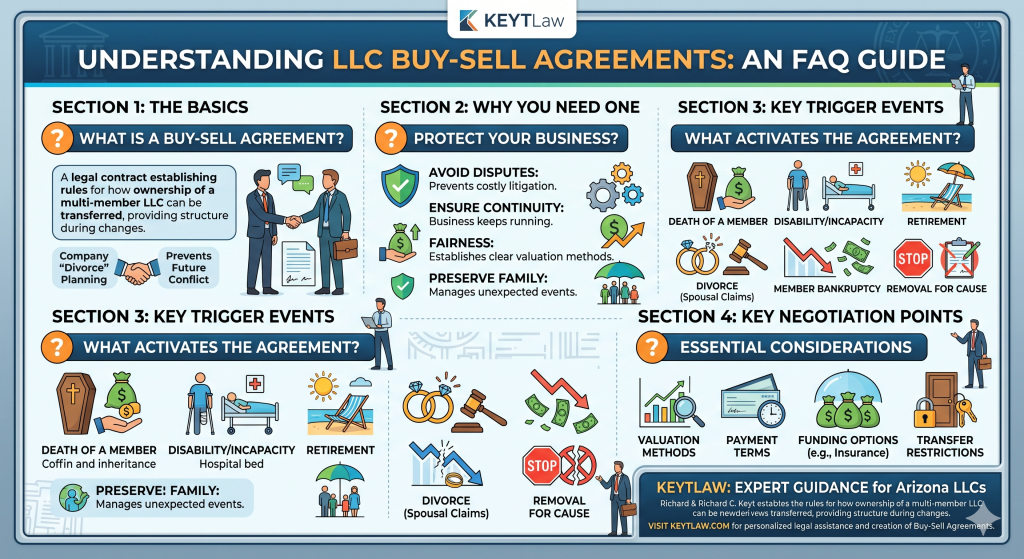
Every multi-member LLC needs an exit plan before it needs one. A buy-sell agreement is a signed contract among the LLC’s members that spells out, in advance, who can buy a member’s ownership interest when death, divorce, disability, bankruptcy, retirement, or a dispute forces a change — and at what price and on what terms. Without one, co-owners can be legally stuck with each other, or with a deceased member’s estate, indefinitely. Below, Arizona LLC attorneys Richard Keyt and Richard C. Keyt — who have formed more than 10,000 Arizona LLCs since 1979 — answer the questions clients ask most about how buy-sell agreements work, what they cost, and why every multi-member LLC should have one.
Going into business with a partner is a lot like getting married. Everyone is optimistic on day one, but more than half of all new businesses fail or reach a point where one or more members want a “company divorce.” A buy-sell agreement is the prenuptial agreement for LLC owners. It decides in advance what happens to a member’s ownership when that member dies, becomes disabled, gets divorced, files bankruptcy, retires or simply wants out.
Below are plain-English answers to the questions Arizona LLC members ask us most often about buy-sell agreements.
Buy-Sell Agreement Basics
What is an LLC buy-sell agreement?
A buy-sell agreement is a binding contract among the LLC and its members that creates a mechanism for the orderly acquisition of a member’s membership interest when a specified “triggering event” happens. It spells out which events allow (or require) the company or the remaining members to buy a departing member’s interest, how the price is set, and how the price is paid.
What questions does a good buy-sell agreement answer?
Every well-drafted buy-sell agreement answers four questions:
- When? Which triggering events start a buyout.
- Who? Whether the LLC buys the interest (entity redemption) or the remaining members buy it (cross-purchase).
- How much? Whether the price is set by a stated value, a formula or an appraisal.
- How? Whether the price is paid with life insurance, disability insurance, installment payments or company reserves.
Is a buy-sell agreement required by Arizona law?
No. But Arizona law provides no automatic buyout. If the members do not create a buyout mechanism by written agreement, none exists. State law does not require anyone to buy a departing member’s interest and does not set a price.
Doesn’t my Operating Agreement already cover this?
Usually not. Most Operating Agreements restrict transfers of membership interests, but they do not require anyone to buy an interest and do not set a price or payment terms. A buy-sell agreement is a separate, detailed document that creates a complete buyout system.
Which LLCs should have a buy-sell agreement?
Every multi-member LLC should have one, except an LLC owned only by a husband and wife. Single-member LLCs and husband-and-wife LLCs do not need a buy-sell agreement. Those owners should address what happens to the LLC through estate planning, such as a revocable living trust that owns the LLC.
When should the members sign a buy-sell agreement?
When the LLC is formed, while everyone still gets along. Members rarely sign one later. Once a dispute, death or divorce happens, the members’ interests are no longer aligned and agreeing on terms becomes difficult or impossible.
What can happen if our LLC doesn’t have one?
Two real client stories show the risk. Bob and Mike each owned 50% of an LLC. Bob died without a will, and his half passed to his estate. When a buyer offered to purchase the LLC, the sale collapsed because nobody had authority to sell Bob’s half. His surviving significant other never received her share of the value.
In another case, members formed an LLC in 1994 but never put buy-sell provisions in writing. When disagreements erupted in 2002, the owners could not even agree on who owned what percentage of the company. The result was expensive litigation in Superior Court.
Triggering Events
What is a triggering event?
A triggering event is something that happens to a member, or something a member does, that gives the LLC or the other members the right or the obligation to buy that member’s interest at the price and on the terms stated in the buy-sell agreement.
What are the most common triggering events?
The members choose which events apply to their company. The 19 triggering events we most often include are:
- Any event the members want. Custom triggers unique to the business.
- Bankruptcy of a member. Otherwise the bankruptcy trustee can step into the member’s shoes.
- Death of a member. This buyout can be funded with life insurance.
- Divorce. When a member’s ex-spouse would receive part of the membership interest.
- Felony conviction. Lets the company remove an undesirable partner.
- Unauthorized transfer. A member sells or gives away an interest without the required approval.
- Default under the Operating Agreement. A member fails to meet contractual obligations.
- Failure to contribute. A member does not provide promised money or property.
- Termination of employment. For members who also work for the company.
- Loss of a professional license. Important for physicians and other licensed professionals.
- Drag-along right. A majority member can force minority members to join in a sale.
- Tag-along right. Minority members can join a majority member’s sale on the same terms.
- Disability. A member becomes permanently unable to work in the business.
- Retirement. A planned exit from the business.
- Incompetence. A member loses mental capacity and needs a conservator.
- False filings. A member files unauthorized amendments with the Arizona Corporation Commission.
- Charging order. A member’s judgment creditor obtains a charging order against the member’s distributions.
- Dispute resolution violation. A member goes to court instead of following the agreed dispute resolution process.
- Unauthorized bank account changes. A member adds or removes signers without approval.
Can we add triggering events that aren’t on the list?
Yes. The members can add any event that matters to their business. The list above is a starting point, not a limit.
Why does divorce matter if my spouse isn’t a member?
Arizona is a community property state. A divorce or death can put a spouse or ex-spouse in the position of owning part of a membership interest. That is why spouses of members should sign a consent to the buy-sell agreement, so a divorce or death does not put an unwanted spouse in the company.
Who Buys and Whether They Must
What is the difference between an entity redemption and a cross-purchase agreement?
In an entity redemption, the LLC buys the departing member’s interest. In a cross-purchase, the remaining members buy it personally. Some agreements let the LLC or the members buy, or both.
| Entity Redemption | Cross-Purchase |
|---|---|
| The LLC buys the interest. | The remaining members buy the interest. |
| The LLC owns one life insurance policy on each member. | Each member owns a policy on every other member. |
| Easier to administer when there are several members. | The number of policies grows quickly as membership grows. |
| The remaining members do not receive a new cost basis. | Buying members receive a cost basis equal to the price they pay. |
Is the buyout mandatory or optional?
The members decide, event by event. In a mandatory buyout the buyer must buy and the seller must sell. Mandatory buyouts are typical for death and termination of employment. In an optional buyout the buyer may buy but is not required to. Optional buyouts are useful for bankruptcy, felony conviction and unauthorized transfers, where the company may prefer to keep its cash.
What is a put right?
A put right lets a departing or retiring member force the company to buy the member’s interest. It gives an exiting member a guaranteed way to cash out instead of being stuck owning part of a company he or she no longer runs.
Valuing a Member’s Interest
How is the price of a member’s interest determined?
There are four common methods:
- Stated value. The members agree on the LLC’s value in advance. If the LLC is worth $100,000, a 40% interest is worth $40,000. The value must be updated regularly or it becomes stale.
- Formula. The price is calculated with a formula, such as average net profits for the last three years multiplied by three, or two times book value.
- Future appraisal. The seller and the company choose an appraiser together. If they can’t agree, each picks an appraiser and the two values are averaged. If the two appraisals differ by more than 15%, a third appraiser is used.
- Single appraiser (select now, value now). The company hires one appraiser now, and the same appraiser updates the value when a triggering event happens.
Which valuation method is most popular?
Appraisal. More than 95% of the buy-sell agreements Richard Keyt has prepared use an appraisal method. Stated values tend to go out of date because members forget to update them, and formulas can produce unfair results when the business changes.
Paying for the Buyout
How do the buyers pay for a member’s interest?
A buyout agreement with no money behind it is only a promise. The common funding sources are:
- Life insurance. The most efficient way to fund a buyout at death.
- Disability insurance. Funds the buyout of a permanently disabled member.
- Installment payments. A down payment plus a promissory note paid over several years with interest.
- Company reserves or a sinking fund. Cash the LLC sets aside over time.
Are there tax rules for life insurance that funds a buyout?
Yes. When the LLC owns a policy on a member, the rules of IRC §101(j) can require written notice to and consent from the insured member before the policy is issued in order to keep the death benefit income tax free. Get the notice and consent signed before the policy is issued.
Arizona Law and Tax Issues
What happens to a member’s interest under Arizona law when a member dies?
Under A.R.S. §29-3602, a member who dies is dissociated from the LLC. The member loses member status, but the economic interest does not disappear. It continues as a transferable interest under A.R.S. §29-3603. Nothing in the statute requires the LLC or the other members to buy it.
What rights do a deceased member’s heirs have without a buy-sell agreement?
Very limited ones. Under A.R.S. §29-3502, a transferee generally receives only the right to distributions, with no right to participate in management. The heirs are stuck owning part of a company they can’t control, and the surviving members are stuck with partners they never chose. Neither side has a way out.
Can the members write their own buyout rules?
Yes. A.R.S. §29-3105 gives members broad freedom to set the rules of their company by agreement. A buy-sell agreement uses that freedom to create the buyout mechanism state law does not provide.
What happens if the members are deadlocked and there is no buy-sell agreement?
The members may end up in court. Arizona law offers judicial dissolution as a remedy in some deadlock situations under A.R.S. §29-3701. Dissolution ends the company. A buy-sell agreement gives the members a way to separate while keeping the business alive.
Are there income tax issues when the LLC buys out a member?
Yes. When the LLC buys a departing member’s interest, an election under IRC §754 may adjust the basis of the LLC’s assets. Whether the LLC or the members buy the interest also affects the remaining members’ cost basis, as shown in the table above. Talk to your CPA before choosing a structure.
Common Mistakes
What are the most common buy-sell agreement mistakes?
- Waiting to sign the agreement until a conflict has already started.
- Failing to update a stated value.
- Having no way to fund the buyout.
- Letting the buy-sell agreement contradict the Operating Agreement.
- Not having spouses sign a consent.
- Not coordinating the agreement with each member’s estate plan.
- Never reviewing the agreement after significant changes in the business.
Cost and How to Hire Us
How much does KEYTLaw charge to prepare a buy-sell agreement?
We charge a flat fee:
- $1,294 for an LLC formed within the last 90 days, or when we prepare the LLC’s Operating Agreement at the same time.
- $1,994 for all other Arizona LLCs.
Each fee includes up to one hour of attorney time for consultation, modifications and custom provisions. Additional time is billed at $295 per hour.
How does the process work?
- Complete our online Buy Sell Agreement Questionnaire.
- Pay the fee online with the $1,294 order form or the $1,994 order form, by credit card over the phone, or by check.
- Within 3 to 5 business days you receive the draft agreement and a letter of explanation.
- The members review the draft and mark any changes.
- Attorney Richard C. Keyt revises the agreement and sends the final version.
- The members sign, and digital signatures can be arranged.
Do you charge to answer questions about buy-sell agreements?
No. We do not charge to answer your initial questions about LLCs or buy-sell agreements. Call, email or complete the questionnaire.
Arizona LLC attorneys Richard Keyt and his son, attorney and former CPA Richard C. Keyt, have formed 10,000+ Arizona LLCs and have prepared buy-sell agreements for Arizona LLC members for decades.
To hire us to prepare your LLC’s buy-sell agreement, submit our online Buy Sell Agreement Questionnaire. Questions? Call Richard Keyt at 480-664-7478 or email rk@keytlaw.com, or call Richard C. Keyt at 480-664-7472 or email rck@keytlaw.com.
Learn more in our articles Arizona LLC Buy-Sell Agreements and 19 Buy-Sell Agreement Triggering Events, and visit our Arizona LLC Center.
This FAQ is general information only and is not legal or tax advice. Reading it does not create an attorney-client relationship. © 2026 KEYTLaw, LLC.
We want to form your Arizona LLC or PLLC
- To get free answers to your LLC questions call Arizona LLC attorneys Richard Keyt (480-664-7478 & rk@keytlaw.com) or his son Richard C. Keyt (480-664-7472 & rck@keytlaw.com).
- 60+ articles about Forming & Operating Arizona LLCs
- Book a free office, phone or Zoom video meeting to get answers to your LLC questions
- See the contents & prices of our 3 LLC formation packages
- Submit our LLC formation questionnaire to hire us to form your AZ LLC today
Updated September 16, 2026
Questions? Book a free meeting or call or email one of our Arizona estate planning attorneys. We don't charge to talk to people.
Call, email or text Richard Keyt, father
Direct phone: 480-664-7478
Email: rk@keytlaw.com
Call, email or text Richard C. Keyt, son
Direct phone: 480-664-7472
Email: rck@keytlaw.com