
FAQ: How to Transfer Rental Property to an LLC
By Arizona LLC attorneys Richard Keyt (480-664-7478 & rk@keytlaw.com) and his son Richard C. Keyt (480-664-7472 & rck@keytlaw.com). We have formed over 10,000 LLCs and have 432 five-star reviews on Google, Facebook & Birdeye. Book a free office, phone or Zoom consultation.
FAQ Summary
After you transfer Arizona rental property into an LLC, the LLC becomes the landlord and inherits a set of legal duties that must be handled promptly. This FAQ guide from Arizona LLC attorneys Richard Keyt and former CPA Richard C. Keyt explains every post-transfer step: recording the deed, notifying existing tenants in writing (with a ready-to-use sample notice letter), transferring and separately holding security deposits, reissuing insurance in the LLC’s name, obtaining city rental licenses and an Arizona TPT license, keeping the LLC compliant, and preserving the liability protection that makes an LLC worth using. Includes a printable post-transfer checklist.
Read our 40+ LLC Frequently Asked Questions Articles.
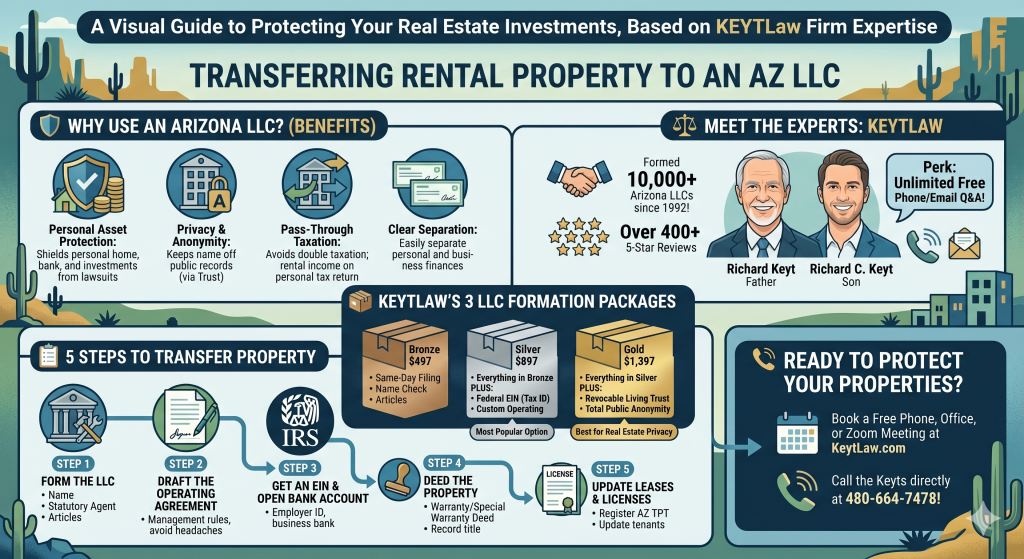
Arizona LLC Rental Property Transfer:
What Your LLC Must Do After Acquiring Rented Real Estate
By Richard Keyt & Richard C. Keyt | KEYTLaw, LLC | Arizona LLC & Real Estate Attorneys | 480-664-7478
So you (or the prior owner) have transferred Arizona real estate that has one or more existing tenants into your Arizona LLC. Congratulations — that is a smart asset-protection move. But the transfer is only the beginning. Your LLC now has legal duties to those tenants, obligations to local and state government, and internal housekeeping tasks that must be completed promptly. This FAQ article walks through everything your LLC needs to know and do.
Part 1: Understanding the Transfer
QWhat does it mean to "assign" or "transfer" real property into an LLC?
When an individual owner (the "assignor" or "transferor") deeds rental property to an Arizona LLC, the LLC becomes the new owner of record. The deed must be recorded with the county recorder in the county where the property is located. Once recorded, the LLC — not the individual — is the landlord for all purposes. The existing leases, tenant obligations, and security deposits follow the property to the new owner unless the leases say otherwise.
QDoes the transfer automatically make the LLC the new landlord?
Yes, under Arizona law and standard landlord-tenant principles, when title passes to the LLC, the LLC steps into the shoes of the prior landlord. The tenants' lease rights are not extinguished. The LLC acquires the property subject to existing leases. However, tenants must be formally notified of the change so they know where to pay rent, who to contact for repairs, and who holds their security deposit.
QWhat law governs residential rental property in Arizona?
The Arizona Residential Landlord and Tenant Act (A.R.S. Title 33, Chapter 10) governs most residential rental property. For non-residential (commercial) property, A.R.S. Title 33, Chapter 3 applies. These statutes impose duties on "landlords," and your LLC is now the landlord.
Part 2: Immediate Steps After the Transfer
QWhat is the first thing the LLC must do after acquiring the rented property?
Record the deed. This is the single most important step. The deed transferring title to the LLC must be recorded with the county recorder where the property is located. Recording is what gives the public — and your tenants — constructive notice that the LLC now owns the property. Do not skip or delay this step.
QWhat are the most critical tasks the LLC must complete immediately after the transfer?
Here is a prioritized checklist of the most important immediate tasks:
- Record the deed conveying title to the LLC with the county recorder
- Notify all existing tenants in writing of the change of ownership, the LLC's name, address, and rent payment instructions
- Transfer the tenants' security deposits to the LLC's bank account and update any written acknowledgment of deposit custody
- Open a dedicated LLC bank account for rent collections if one does not already exist
- Notify your property insurer to add or reissue the policy in the LLC's name
- Provide the LLC's name and address to the County Assessor for property tax purposes
- If the property is in a city or county that requires a rental license or residential rental registration, apply for or transfer that license into the LLC's name
- Update your Arizona transaction privilege tax (TPT) registration if you collect rent subject to TPT
QDoes Arizona require the LLC to notify the county assessor of the transfer?
Yes. Arizona law (A.R.S. § 42-15104) requires that a change of ownership be reported to the county assessor within 60 days of the transfer date. Most counties accomplish this automatically when the deed is recorded, but you should confirm with your county assessor's office. Property taxes will continue to be billed and will need to be paid by the LLC once ownership transfers.
QWhat about the Affidavit of Legal Value (Form 82162)?
When you record a deed in Arizona, you generally must file an Affidavit of Legal Value (ADOT Form 82162) with the county recorder at the same time. There are exceptions — including transfers to a revocable trust or certain LLC transfers where no money changes hands — but your attorney or escrow officer will determine whether the affidavit is required for your specific transfer.
Part 3: Notifying Existing Tenants
QIs the LLC legally required to notify existing tenants of the change of ownership?
Yes. A.R.S. § 33-1322 requires that the landlord (now the LLC) disclose in writing to each tenant: (1) the name and address of the person authorized to manage the premises; and (2) the name and address of the owner or agent authorized to receive notices and demands. This disclosure must be made at the commencement of a tenancy — but when ownership transfers mid-tenancy, the new landlord (the LLC) should provide updated notice promptly. Failure to make this disclosure does not invalidate the tenancy but can expose the LLC to liability for noncompliance.
QWhat must the tenant notice letter include?
The notice should include all of the following:
- The full legal name of the LLC (e.g., "Keyt Properties, LLC, an Arizona limited liability company")
- The LLC's mailing address for rent payments
- The LLC's mailing address for legal notices (may be the same)
- The name and contact information of the property manager, if different from the LLC
- Effective date of the change of ownership
- Instructions for where to send rent going forward
- Confirmation that the tenant's security deposit has been transferred to the LLC's custody
- Assurance that the existing lease remains in full force and effect
QShould the LLC send the notice letter by certified mail?
Yes. Always send the notice by both first-class mail and certified mail, return receipt requested. Keep a copy of the letter and retain the certified mail receipt and green card when it is returned. This creates a paper trail proving the tenant received the notice. If you also have the tenant's email address, send a copy by email as well and retain that email for your records.
QCan the LLC email the notice to the tenant instead?
You may email a copy, but email alone is not recommended. Arizona landlord-tenant statutes contemplate written notices delivered by mail or hand delivery. Email is appropriate as a supplement, not a substitute, unless your lease expressly provides that notices may be sent by email and specifies the tenant's email address.
Part 4: Sample Tenant Notice Letter
Below is a sample notice letter your LLC can customize and send to each existing tenant. Replace all bracketed placeholders [ ] with your actual information before sending. Have your attorney review the letter before you send it.
- This sample letter is provided for informational purposes only. It does not constitute legal advice.
- Every tenancy is different. Have your attorney review this letter before sending it to any tenant.
- Arizona landlord-tenant law changes. Verify current requirements with a licensed Arizona attorney.
- KEYTLaw attorneys Richard Keyt and Richard C. Keyt can assist you. Call 480-664-7478.
Part 5: Security Deposits
QWhat must the LLC do with the prior owner's security deposits?
The prior owner must transfer the security deposits to the LLC at or before the closing of the transfer. Arizona law (A.R.S. § 33-1321) requires that the landlord hold the security deposit on behalf of the tenant and account for it at the end of the tenancy. The LLC must maintain the deposits in a separate account. Best practice: maintain a separate LLC bank account — or a designated sub-account — solely for security deposit funds. Never comingle security deposits with operating funds.
QMust the LLC notify tenants that their deposits have been transferred?
Yes. The sample letter above includes this notification. You should confirm the specific dollar amount of the deposit in your letter. This avoids future disputes about the amount held. If the prior owner improperly withheld or spent any portion of a deposit before the transfer, the LLC should address that issue with the prior owner before completing the transfer — because once the LLC accepts the property, it may be held responsible for returning the full deposit at the end of the tenancy.
QWhat if the prior owner did not maintain the deposits separately?
This is a common problem. Before you close the transfer into the LLC, require the prior owner to document and transfer all security deposits. If the prior owner cannot produce the full deposit funds, negotiate an escrow holdback or a credit against the purchase/transfer price equal to the deposit amounts. Do not let the LLC inherit a security deposit shortfall — that shortfall becomes the LLC's problem at move-out time.
Part 6: Insurance
QDoes the LLC need to update the property insurance?
Yes — this is urgent. Once title transfers to the LLC, the prior owner's insurance policy may not cover losses because the LLC is now the owner, not the named insured. Contact your insurance agent immediately to reissue or endorse the policy with the LLC as the named insured. Until the insurance is updated, the LLC's property may be uninsured or inadequately covered.
QWhat types of insurance should the LLC carry?
At a minimum, the LLC should carry:
- Property (hazard) insurance covering the building and improvements
- Landlord liability insurance (general liability naming the LLC as insured)
- Loss-of-rent / business interruption coverage
- If applicable: flood insurance (especially in FEMA flood zones) and earthquake coverage
Require your tenants to maintain renter's insurance as well — your LLC's policy does not cover tenants' personal property.
Part 7: Business Licenses and Tax Registrations
QDoes the LLC need a rental license or permit?
Many Arizona cities require landlords to obtain a residential rental license or register their rental property. This requirement varies by city. Phoenix, Tempe, Scottsdale, Mesa, Chandler, Gilbert, Peoria, Glendale, and Tucson all have rental registration or licensing requirements. Because the LLC is now the landlord, the prior owner's license is no longer valid — you must apply for or transfer the license into the LLC's name. Check with the city or county where the property is located.
QWhat is Arizona Transaction Privilege Tax (TPT) and does it apply to rental income?
Arizona's Transaction Privilege Tax (TPT) — often called a "sales tax" — applies to residential rental income in most Arizona cities. The Arizona Department of Revenue (ADOR) and the applicable city levy a combined TPT rate on gross residential rental income. The prior owner should have been collecting and remitting TPT. When the LLC becomes the landlord, it must obtain its own Arizona TPT license through ADOR's AZTaxes.gov portal and begin reporting and remitting TPT on rental income. Failure to register and remit TPT can result in penalties and interest.
QDoes TPT apply to commercial rental property?
Yes. Arizona also levies TPT on commercial rental income. The applicable tax rates and categories differ from residential. The LLC must register for commercial rental TPT if it is not already registered.
Part 8: Ongoing LLC Compliance
QWhat ongoing compliance obligations does the LLC have as a landlord?
In addition to the one-time post-transfer tasks, the LLC has ongoing obligations including:
- File the LLC's Arizona Annual Report with the Arizona Corporation Commission each year
- Pay property taxes (or ensure the mortgage servicer pays them from escrow)
- Report and remit TPT monthly or quarterly as required by ADOR
- Maintain adequate insurance at all times
- Keep a separate LLC bank account and do not commingle personal and LLC funds
- Maintain a registered agent in Arizona (required by law for all Arizona LLCs)
- Comply with all applicable landlord-tenant laws for lease renewals, notice periods, and security deposit accounting
QShould the LLC have an Operating Agreement that addresses rental property?
Yes. Your LLC's Operating Agreement should address how the LLC will manage the rental property, how income and expenses will be allocated among members, who has authority to sign leases on behalf of the LLC, and how decisions about the property will be made. If the LLC has multiple members, a well-drafted Operating Agreement is essential to avoid disputes. Richard Keyt and Richard C. Keyt at KEYTLaw can help you draft or update your LLC's Operating Agreement.
QCan the LLC sign new leases with tenants?
Absolutely. Once the transfer is complete, the LLC — acting through its authorized manager or member — is the party that signs all future leases, lease renewals, and amendments. The signature block on a lease should read, for example: "[LLC NAME], an Arizona limited liability company, by: [Authorized Signatory Name], its [Manager / Member]." Never sign a lease in your personal name if the property is owned by the LLC.
Part 9: Maintaining the Liability Protections of the LLC
QThe whole point of using an LLC is to protect me personally. What must I do to preserve that protection?
An LLC's liability protection can be lost if a court "pierces the corporate veil" — meaning it disregards the LLC and holds the members personally liable. To reduce that risk:
- Always act in the LLC's name, not your personal name, when dealing with tenants, contractors, and third parties
- Sign all leases, contracts, and correspondence as an authorized agent of the LLC
- Keep separate bank accounts for the LLC — never mix personal and LLC funds
- Document major LLC decisions in writing (resolutions or Operating Agreement provisions)
- Make sure the LLC is properly formed and its annual reports are current with the Arizona Corporation Commission
- Never personally guarantee LLC obligations unless absolutely necessary
QShould I have a separate LLC for each rental property?
Many attorneys — including the attorneys at KEYTLaw — recommend holding each rental property in a separate LLC. The reason is straightforward: if a tenant or guest is injured at one property and obtains a judgment, only the assets of that single LLC are at risk. If all properties are in one LLC, a judgment creditor can potentially reach all of them. Whether separate LLCs make sense for you depends on the number of properties, their values, and the cost/benefit of maintaining multiple entities.
Part 10: Summary Checklist
Use this checklist to track your post-transfer tasks. Print it out and check each item off as you complete it.
- Record the deed conveying title to the LLC with the county recorder
- File Affidavit of Legal Value (Form 82162) if required
- Report change of ownership to the county assessor within 60 days
- Collect / confirm transfer of all security deposits from the prior owner
- Open (or confirm) a dedicated LLC bank account for rental income
- Deposit security deposits into a separate LLC account — never comingle
- Update (or reissue) property insurance in the LLC's name — do this immediately
- Register for (or transfer) city/county rental license in the LLC's name
- Register for Arizona TPT license on AZTaxes.gov if not already registered
- Send written Notice of Change of Ownership letter to each tenant
- Send notice by certified mail, return receipt requested; retain all receipts
- Update Operating Agreement if needed to address rental property management
- Confirm LLC annual report is current with the Arizona Corporation Commission
- Confirm registered agent information is current
- Review existing leases for any provisions triggered by change of ownership
- Engage property manager (if applicable) and execute management agreement in the LLC's name
Need Help With Your Arizona LLC or Rental Property?
Richard Keyt and Richard C. Keyt have formed more than 10,000 Arizona LLCs. They can help you form an LLC, transfer real estate into an LLC, draft an Operating Agreement, or advise on landlord-tenant compliance.
Schedule a Consultation 📞 480-664-7478We want to form your Arizona LLC or PLLC
- To get free answers to your LLC questions call Arizona LLC attorneys Richard Keyt (480-664-7478 & rk@keytlaw.com) or his son Richard C. Keyt (480-664-7472 & rck@keytlaw.com).
- 60+ articles about Forming & Operating Arizona LLCs
- Book a free office, phone or Zoom video meeting to get answers to your LLC questions
- See the contents & prices of our 3 LLC formation packages
- Submit our LLC formation questionnaire to hire us to form your AZ LLC today
See the Contents of Our Estate Plan
To protect your most valuable assets—your loved ones— read our article that describes the 36 documents and services you will get if you hire us to prepare your comprehensive estate plan with a revocable living trust or watch our video about the documents and services.
Questions? Book a free meeting or call or email one of our Arizona estate planning attorneys. We don't charge to talk to people.
Call, email or text Richard Keyt, father
Direct phone: 480-664-7478
Email: rk@keytlaw.com
Call, email or text Richard C. Keyt, son
Direct phone: 480-664-7472
Email: rck@keytlaw.com