
Resolving Arizona LLC Member
Disputes: 6 Legal Options
By Arizona LLC attorneys Richard Keyt (480-664-7478 & rk@keytlaw.com) and his son Richard C. Keyt (480-664-7472 & rck@keytlaw.com). We have formed over 10,000 LLCs and have 432 five-star reviews on Google, Facebook & Birdeye. Book a free office, phone or Zoom consultation.
FAQ Summary
Arizona LLC members who cannot agree on operations, management, or funding have six legal options: direct negotiation, mediation, binding arbitration, a member buyout, voluntary termination of the LLC, or court-ordered judicial termination. The operating agreement controls which options are available and in what order members must pursue them. A member cannot be forced to contribute additional capital to the LLC unless the operating agreement expressly requires it. Voluntary termination requires member agreement and avoids court involvement; judicial termination under A.R.S. § 29-3708 requires a lawsuit and is a last resort. A well-drafted operating agreement with a mandatory arbitration clause, a buy-sell provision, and a deadlock-breaking mechanism can prevent most member disputes from ever reaching a courtroom.
Read our 40+ LLC Frequently Asked Questions Articles.
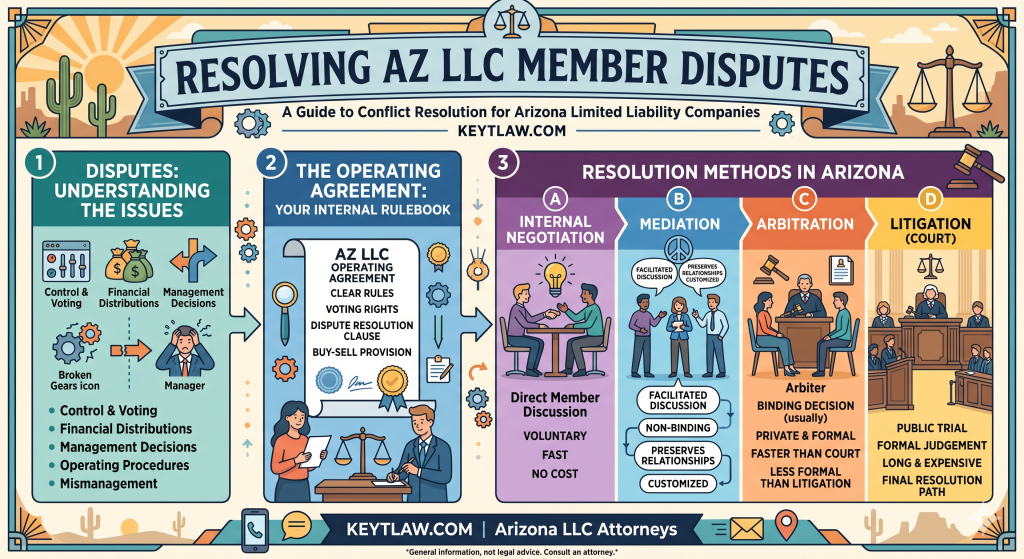
When Arizona LLC Members Cannot Agree: Your Legal Options
A comprehensive guide by Arizona LLC attorney Richard Keyt explaining what happens — and what members can do — when an LLC reaches an impasse over management, operations, or funding, including voluntary dissolution, court-ordered termination, and arbitration.
Quick Answer: When Arizona LLC members cannot agree on operations, funding, or the direction of the business, they have six main options: (1) direct negotiation, (2) mediation, (3) arbitration, (4) a buyout of one member's interest, (5) voluntary termination (dissolution) of the LLC by member agreement, or (6) judicial termination — a court-ordered dissolution filed as a lawsuit under A.R.S. § 29-3708. The right path depends on what the operating agreement says and how serious the impasse has become. This article by Arizona LLC attorney Richard Keyt, who has formed more than 10,000 Arizona LLCs, explains each option in plain language.
Why Member Disputes Happen in Arizona LLCs
An Arizona LLC brings two or more people together around a shared business purpose. When the business is running smoothly, differences of opinion are manageable. But when the business hits a rough patch — revenue drops, a major decision divides members, one member stops contributing time or money, or personal relationships break down — disagreements can escalate quickly into a full deadlock.
The most common flashpoints I see in multi-member Arizona LLCs include:
- Members disagree about the strategic direction of the business
- One member refuses to contribute additional capital the business needs to survive
- Members disagree about whether to take on debt or bring in outside investors
- A member stops working in the business but refuses to sell their interest
- Members disagree about distributions — when to pay them and how much
- One member believes another is mismanaging the business or taking money improperly
- A manager-managed LLC's manager makes decisions the members did not authorize
How these disputes get resolved — or whether they destroy the business — depends largely on how well the LLC's operating agreement was drafted in the first place.
The Operating Agreement Is the Starting Point
Before exploring your legal options, you must read your operating agreement carefully. The operating agreement is the contract that governs the LLC and the relationship among its members. It controls voting rights, management authority, distribution rights, buyout rights, and — critically — how disputes are to be resolved.
A well-drafted operating agreement will include provisions that address member deadlocks directly: a dispute resolution clause requiring mediation and then binding arbitration, a buy-sell (buyout) provision giving members a mechanism to buy each other out when agreement is impossible, and clear voting thresholds so that no single member can hold the LLC hostage by refusing to act.
Warning: Many Arizona LLCs are formed with generic, one-size-fits-all operating agreements — or none at all. These LLCs rely entirely on Arizona's default LLC statutes when disputes arise. Without customized dispute resolution and buyout provisions, members are often forced into expensive litigation that could have been avoided with a well-drafted operating agreement from the start.
Six Options When Arizona LLC Members Cannot Agree
When a deadlock develops, members have six broad options. They are listed here from least to most disruptive. In most situations, the best outcome comes from exhausting options 1 through 4 before moving to options 5 or 6.
Direct Negotiation
Members talk it out — with or without their attorneys present — and reach a written agreement without outside help.
Mediation
A neutral mediator helps members communicate and negotiate. The mediator cannot impose a decision — both sides must agree.
Arbitration
A private arbitrator hears both sides and issues a binding decision. Faster, cheaper, and more private than a court trial.
Member Buyout
One member buys out the other using the price formula and terms in the operating agreement or as negotiated between the parties.
Voluntary Termination
Members vote to dissolve the LLC, wind up its affairs, pay creditors, and distribute remaining assets — without court involvement.
Judicial Termination
A member files a lawsuit asking the court to order dissolution. This is a last resort — expensive, adversarial, and public.
Option 1: Direct Negotiation
Direct negotiation sounds simple, but it requires goodwill on both sides. When members can sit down — ideally with their attorneys present — and reach a written resolution to their disagreement, it avoids the cost and delay of formal legal proceedings. Any agreement reached should be documented in a written amendment to the operating agreement or a separate written settlement agreement signed by all parties.
Direct negotiation works best early in a dispute, before positions harden and emotions run high. If the operating agreement is clear about voting rights and decision-making authority, one member may simply be outvoted, which eliminates the deadlock without any formal process. Problems arise when the operating agreement gives each member equal voting rights with no tiebreaker mechanism — a 50/50 ownership split with no deadlock provision is one of the most dangerous structures in business law.
Option 2: Mediation
Mediation is a voluntary, confidential process in which a neutral third-party mediator — often an attorney or retired judge with business law experience — helps the members communicate and negotiate toward a resolution. The mediator does not decide anything. The mediator's job is to help each side understand the other's perspective, identify areas of common ground, and guide the parties toward a mutually acceptable agreement.
Mediation is confidential, which means statements made during mediation generally cannot be used in court later. It is significantly faster and cheaper than arbitration or litigation. Many operating agreements require members to attempt mediation before filing for arbitration or going to court.
If mediation succeeds, the parties sign a written settlement agreement that resolves their dispute. If mediation fails — if the parties simply cannot reach an agreement — they proceed to arbitration or court.
Option 3: Arbitration
Arbitration is a private dispute resolution process in which one or more neutral arbitrators hear both sides and issue a binding decision called an arbitration award. Unlike mediation, the arbitrator decides the outcome. Unlike a court trial, arbitration is private, typically faster, and generally less expensive because discovery is limited and there are no juries.
If the LLC's operating agreement contains a mandatory arbitration clause, members are contractually required to resolve their disputes through arbitration rather than through the courts. A judge will enforce a mandatory arbitration clause and dismiss a lawsuit filed in violation of it.
The parties typically agree on the arbitration rules (the American Arbitration Association's Commercial Arbitration Rules and the JAMS rules are widely used), the number of arbitrators (one arbitrator for smaller disputes, three for larger ones), and the location of the arbitration. The arbitrator's decision is almost always final and binding — arbitration awards can only be overturned on very limited grounds, such as fraud or corruption by the arbitrator.
Practice Tip: If your operating agreement does not currently include a mandatory arbitration clause, the members can amend the operating agreement to add one at any time — if all members agree to the amendment. Once a dispute has already begun, getting all members to agree on an arbitration clause becomes much harder, because any member who believes litigation gives them an advantage will resist agreeing to arbitrate.
Option 4: Buyout of a Member's Interest
When the real problem is not the business but the relationship between the members — when the business is viable but the members simply cannot work together — the cleanest solution is often for one member to buy out the other.
A buyout agreement (sometimes called a buy-sell agreement) in the operating agreement establishes the mechanism and price formula for buying out a member's interest. Common buyout triggering events include deadlock, a member's desire to exit, a member's death or disability, a member's bankruptcy, and a member's conviction of a crime. The buyout price formula might be the LLC's appraised fair market value, a multiple of earnings, book value, or a price agreed upon by the parties or determined by an independent appraiser.
One of the most effective buyout mechanisms for two-member LLCs is the "shotgun" or "Texas Shootout" provision. Under this mechanism, one member names a price at which they would buy or sell. The other member must then either sell their interest at that price or buy the first member's interest at that same price. This mechanism incentivizes fair pricing because the member who names the price does not know whether they will end up as the buyer or the seller.
If the operating agreement does not include a buyout provision, the members can still negotiate a buyout. The parties hire a business appraiser, agree on a value for the LLC, and one member pays the other for their interest. This requires cooperation that may not be available when the relationship has broken down completely.
Option 5: Voluntary Termination (Dissolution)
When the members decide — or enough of them vote — that the LLC should cease to exist, they can dissolve the LLC voluntarily without going to court. Under Arizona's LLC Act (A.R.S. § 29-3701), an Arizona LLC may be dissolved voluntarily by:
- A vote or written consent of the members as specified in the operating agreement, or
- If the operating agreement is silent on the required vote, by consent of a majority of the members
Once the members vote or consent to dissolve the LLC, the LLC enters a winding-up period. During wind-up, the LLC:
- Completes any unfinished business and collects amounts owed to it
- Notifies known creditors of the dissolution
- Pays or makes adequate provision for all known creditors and claims
- Pays all taxes, fees, and government obligations
- Distributes remaining assets to members in proportion to their distribution rights
- Files Articles of Termination with the Arizona Corporation Commission
Voluntary termination is faster, cheaper, and more private than judicial termination. It puts the members in control of the wind-up process. The critical requirement is that enough members agree — voluntary termination is not available if the members who oppose dissolution have the votes to block it.
Important: Even during voluntary termination, the LLC's fiduciary duties to members remain in force throughout the winding-up period. Members who control the wind-up process must not use that control to benefit themselves at the expense of other members.
Option 6: Judicial Termination (Court-Ordered Dissolution)
When members cannot agree to dissolve the LLC voluntarily and the deadlock is so severe that the LLC cannot function, one or more members may file a lawsuit in Arizona Superior Court asking the court to order the LLC dissolved. This is called judicial termination or judicial dissolution.
Judicial termination is governed by A.R.S. § 29-3708. Under that statute, an Arizona court may dissolve an LLC if a member establishes any of the following grounds:
- The members or managers are deadlocked, the deadlock cannot be broken, and irreparable injury to the LLC is threatened or being suffered as a result of the deadlock
- The managers or those in control of the LLC have acted, are acting, or will act in a manner that is illegal, oppressive, or fraudulent
- The members are so divided that they have failed to elect successors for management positions for a period including at least two consecutive annual meeting dates
- The LLC's assets are being misapplied or wasted
Courts treat judicial termination as a last resort. A member seeking judicial dissolution must be prepared to prove their case with evidence and must typically show that lesser remedies — such as mediation, arbitration, or a buyout — either have been attempted and failed, or are not available. A court may, instead of ordering dissolution, appoint a provisional director or manager, impose a buyout remedy, or craft another equitable solution that does not require dissolving the LLC.
Warning: Judicial termination is expensive, adversarial, and public. Court records are public records. A lawsuit to dissolve your LLC will be visible to your clients, competitors, and the general public. The legal fees in contested LLC dissolution cases can easily reach tens of thousands of dollars or more. Judicial termination should only be pursued after all other options have been exhausted.
Voluntary vs. Judicial Termination: A Side-by-Side Comparison
| Factor | Voluntary Termination | Judicial Termination |
|---|---|---|
| Requires member agreement? | Yes — majority or more | No — one member can file |
| Court involvement? | No | Yes — Superior Court |
| Cost | Low to moderate | High — litigation costs |
| Speed | Faster | Slower — months to years |
| Public record? | Limited (ACC filing) | Yes — full court record |
| Members control wind-up? | Yes | Partially — court supervises |
| Available when one member blocks dissolution? | No | Yes — if grounds are met |
| Best used when | Members agree to end the business | Deadlock, oppression, or waste prevents voluntary action |
Can Members Be Forced to Contribute Money to the LLC?
One of the most common disputes I see is when the LLC needs additional capital and one member refuses to contribute. The answer under Arizona law is straightforward: a member cannot be forced to contribute money to the LLC unless the operating agreement expressly requires it.
If a member promised a specific capital contribution in the operating agreement and then refuses to make that contribution, the LLC and the other members can sue for breach of contract. But if the operating agreement does not require additional contributions — or is silent on the issue — no member can be legally compelled to put more money into the LLC simply because the business needs it.
When the LLC needs funding and members cannot agree on how to provide it, the available options include:
- The LLC borrows money from a bank, lender, or from members who are willing to lend (member loans are distinct from capital contributions)
- The LLC admits new members who contribute capital in exchange for a membership interest
- The LLC cuts expenses, defers projects, or otherwise reduces its need for capital
- The members agree to dissolve the LLC voluntarily if the business cannot continue without additional funding
What a Well-Drafted Operating Agreement Should Include
The single best investment any multi-member LLC can make is a carefully drafted operating agreement that addresses disputes before they happen. An operating agreement I draft for multi-member Arizona LLCs typically includes the following dispute-related provisions:
- Clear voting thresholds — specifying exactly what percentage of member votes is required for each category of decision, so deadlocks are avoided whenever possible
- A deadlock-breaking mechanism — such as a designated tiebreaker member, an independent manager with casting vote authority, or a mandatory arbitration process to break ties
- A mandatory mediation-then-arbitration clause — requiring members to attempt mediation first, and then binding arbitration, before filing any lawsuit
- A buy-sell (buyout) provision — establishing triggering events, the buyout price formula, payment terms, and the right-of-first-refusal mechanism so that a dissenting or departing member can be bought out without litigation
- Defined grounds and procedure for voluntary dissolution — specifying what vote is required, how notice is given, and how wind-up is managed
- Capital contribution provisions — stating clearly whether additional contributions are required, when, by how much, and what happens if a member fails to contribute
Frequently Asked Questions
What happens when Arizona LLC members cannot agree on how to operate the business?
When Arizona LLC members reach an impasse, they have several options depending on what the operating agreement says and how serious the disagreement is. Options include direct negotiation, mediation, arbitration, a buyout of one member's interest, voluntary dissolution of the LLC, or — as a last resort — filing a lawsuit asking a court to dissolve or judicially terminate the LLC.
Does the Arizona LLC operating agreement control how member disputes are resolved?
Yes. The operating agreement is the single most important document governing how member disputes are handled. A well-drafted operating agreement will include a dispute resolution clause specifying whether members must first attempt mediation, then arbitration, or may go directly to court. It will also include buyout or buy-sell provisions that establish a mechanism and price formula for buying out a dissenting or departing member. Without these provisions, members are left to negotiate or litigate under Arizona's default LLC statutes.
What is a buyout or buy-sell agreement in an LLC context?
A buy-sell agreement (also called a buyout agreement) is a provision in the operating agreement — or a separate agreement — that gives one or more members the right to purchase another member's LLC interest when a triggering event occurs. Deadlock and irreconcilable disagreement are common triggering events. The agreement sets out a price formula (appraised value, book value, a multiple of earnings, etc.) and payment terms so that a buyout can proceed without a lawsuit.
What is mediation and when should LLC members use it?
Mediation is a voluntary, confidential process in which a neutral third-party mediator helps the members communicate and negotiate toward a settlement. The mediator does not impose a decision — the members must agree on any resolution. Mediation is typically faster, cheaper, and more private than litigation. It works best when members are willing to talk but need a structured environment and a skilled neutral to help them reach common ground.
What is arbitration and how does it differ from mediation and litigation?
Arbitration is a private dispute resolution process in which a neutral arbitrator (or a panel of arbitrators) hears both sides and issues a binding decision. Unlike mediation, the arbitrator decides the outcome — the parties do not have to agree. Unlike litigation, arbitration is generally private, faster, and less expensive than a full court trial. If the operating agreement contains a mandatory arbitration clause, members must arbitrate their disputes rather than sue in court.
What is voluntary dissolution of an Arizona LLC?
Voluntary dissolution — called "termination" under Arizona law — occurs when the members themselves agree to wind up and dissolve the LLC without court intervention. Under A.R.S. § 29-3701, an Arizona LLC may be dissolved voluntarily by a vote or consent of the members as specified in the operating agreement, or if the operating agreement is silent, by a majority of the members. After the vote to dissolve, the LLC winds up its affairs, pays creditors, distributes remaining assets to members, and files Articles of Termination with the Arizona Corporation Commission.
What is judicial termination (court dissolution) of an Arizona LLC?
Judicial termination — sometimes called court-ordered dissolution — occurs when a court orders the LLC dissolved after a member files a lawsuit seeking dissolution. Under A.R.S. § 29-3708, a court may dissolve an Arizona LLC if the members are deadlocked and cannot agree on how to manage the company, the LLC's business cannot be conducted to the advantage of the members, managers are acting illegally or in a manner that is oppressive or unfairly prejudicial to one or more members, or the LLC's assets are being misapplied or wasted. Judicial termination is a last resort because it is expensive and disruptive.
What are the grounds for a court to judicially dissolve an Arizona LLC?
Under A.R.S. § 29-3708, a member may petition a court for judicial dissolution on several grounds: (1) the members or managers are deadlocked, cannot break the deadlock, and irreparable injury to the company is threatened or being suffered; (2) the managers or those in control have acted, are acting, or will act in a manner that is illegal, oppressive, or fraudulent; (3) the members are deadlocked and have failed to elect successors for a period that includes at least two consecutive annual meeting dates; or (4) the LLC's assets are being misapplied or wasted. Courts take these cases seriously and expect the petitioner to show that lesser remedies — such as buyout or mediation — could not resolve the dispute.
What is the difference between voluntary termination and judicial termination?
Voluntary termination requires the members to agree — or at least a required majority of them to vote — to wind up and close the LLC. It is controlled by the members and avoids court involvement. Judicial termination requires one or more members to file a lawsuit, present evidence to a judge, and persuade the court that dissolution is warranted under Arizona law. Judicial termination is adversarial, public, expensive, and time-consuming. Voluntary termination, when achievable, is always the faster, cheaper, and less damaging option.
What happens to the LLC's assets when it is dissolved?
Whether dissolved voluntarily or by court order, the LLC must wind up its affairs in a prescribed order. First, it pays or makes adequate provision for all known creditors and claims against the LLC. Second, it pays taxes and government obligations. Third, after all liabilities are satisfied, the remaining assets are distributed to members in accordance with their distribution rights under the operating agreement. If the operating agreement is silent, Arizona's default rules govern the distribution.
Can a member be forced to contribute more money to the LLC?
Generally, no. Under Arizona LLC law, members are not personally obligated to contribute additional capital to the LLC unless the operating agreement expressly requires it. A member who promised a capital contribution in the operating agreement can be held to that promise. But a member who made no such promise cannot be compelled by other members or by the LLC to put in more money. If the LLC needs funds and members cannot agree to contribute, the LLC may need to borrow money, admit new members who will contribute capital, or — if the business is no longer viable — wind down.
What is a mandatory arbitration clause in an LLC operating agreement?
A mandatory arbitration clause is a provision that requires members to resolve all disputes through arbitration rather than by filing a lawsuit in court. The clause typically specifies the arbitration rules (such as the American Arbitration Association rules or JAMS rules), the number of arbitrators, the location of the arbitration, and whether the arbitrator's decision will be binding. If the operating agreement includes a mandatory arbitration clause, a member who files a lawsuit in court can be ordered by the judge to arbitrate the dispute instead.
Is arbitration better than going to court for LLC member disputes?
Arbitration has significant advantages over litigation for LLC member disputes. Arbitration is private — there is no public court record. It is typically faster than court litigation, which can take years. It is usually less expensive because discovery is limited and there are no juries. The parties can choose an arbitrator with business or legal expertise relevant to their dispute. On the other hand, arbitration awards are very difficult to appeal even if the arbitrator makes a legal error, and the fees charged by the arbitrator can be substantial for complex disputes. Whether arbitration or litigation is better depends on the specific facts of each dispute.
What should an Arizona LLC operating agreement say about member disputes?
A well-drafted Arizona LLC operating agreement should address member disputes proactively by including: (1) a clear decision-making process specifying what votes are needed for which decisions; (2) a deadlock-breaking mechanism such as a tiebreaker vote, an independent manager, or an outside arbitrator; (3) a mandatory mediation-then-arbitration clause for disputes the members cannot resolve themselves; (4) a buy-sell or buyout provision giving any member the right to buy out another member in the event of a deadlock; and (5) clearly defined grounds and procedures for voluntary dissolution. These provisions can prevent costly litigation and give members a clear roadmap when disagreements arise.
What should I do if I am in a dispute with another member of my Arizona LLC?
If you are in a dispute with another LLC member, the first step is to read your operating agreement carefully to understand what it says about dispute resolution, voting rights, and buyout rights. Then consult an experienced Arizona LLC attorney before taking any formal action. An attorney can evaluate your operating agreement, advise you on your rights, help you negotiate or mediate a resolution, and — if necessary — represent you in arbitration or litigation. Acting without legal advice in a member dispute can waive important rights or create liability you did not anticipate.
Talk to an Arizona LLC Attorney
Richard Keyt has formed more than 10,000 Arizona LLCs and has helped Arizona LLC members navigate disputes, buyouts, and dissolutions. If your LLC members cannot agree — or if you want to make sure your operating agreement has the protections you need before a dispute arises — contact KEYTLaw today.
Schedule a Consultation Call 480-664-7478We want to form your Arizona LLC or PLLC
- To get free answers to your LLC questions call Arizona LLC attorneys Richard Keyt (480-664-7478 & rk@keytlaw.com) or his son Richard C. Keyt (480-664-7472 & rck@keytlaw.com).
- 60+ articles about Forming & Operating Arizona LLCs
- Book a free office, phone or Zoom video meeting to get answers to your LLC questions
- See the contents & prices of our 3 LLC formation packages
- Submit our LLC formation questionnaire to hire us to form your AZ LLC today
See the Contents of Our Estate Plan
To protect your most valuable assets—your loved ones— read our article that describes the 36 documents and services you will get if you hire us to prepare your comprehensive estate plan with a revocable living trust or watch our video about the documents and services.
Questions? Book a free meeting or call or email one of our Arizona estate planning attorneys. We don't charge to talk to people.
Call, email or text Richard Keyt, father
Direct phone: 480-664-7478
Email: rk@keytlaw.com
Call, email or text Richard C. Keyt, son
Direct phone: 480-664-7472
Email: rck@keytlaw.com