
Arizona LLC Members, Managers
& Statutory Agents Explained
By Arizona LLC attorneys Richard Keyt (480-664-7478 & rk@keytlaw.com) and his son Richard C. Keyt (480-664-7472 & rck@keytlaw.com). We have formed over 10,000 LLCs and have 432 five-star reviews on Google, Facebook & Birdeye. Book a free office, phone or Zoom consultation.
Every Arizona LLC involves three roles owners often confuse: the member who owns the company, the manager who runs it, and the statutory agent who receives lawsuit papers. This guide explains what each role is, how a person becomes each one, and the practical problems that arise for each — so you can make smart decisions before you file your Articles of Organization.
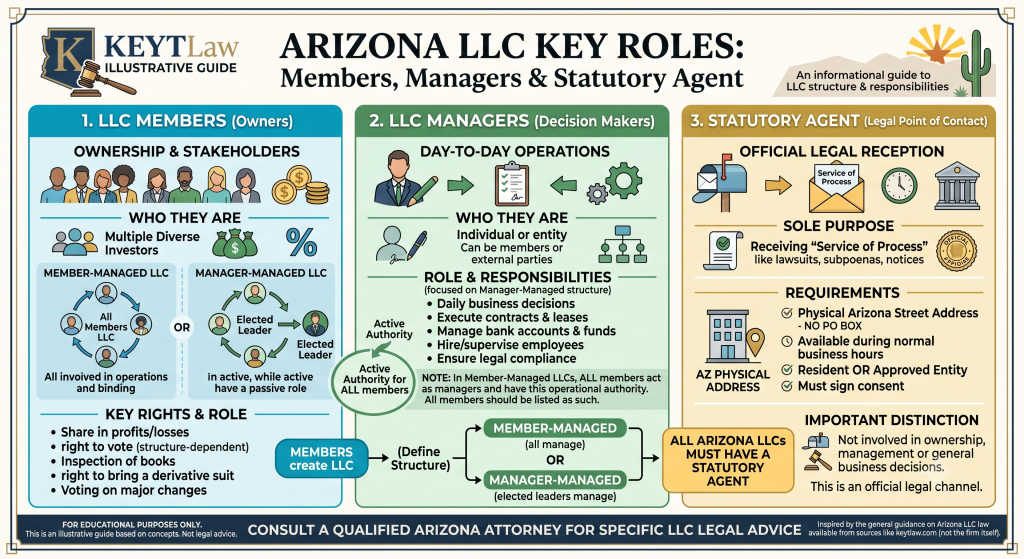
Every Arizona limited liability company involves three roles that new business owners routinely confuse: the member, the manager, and the statutory agent. They sound interchangeable, but they are not. One owns the company, one runs it, and one simply receives lawsuit papers. Mixing them up can cost you money, control, and in a worst case, the company itself.
This article explains what each role is, how a person becomes each one, and the practical problems that arise for each. The goal is to help you make smart decisions before you file your Articles of Organization with the Arizona Corporation Commission (ACC) — because the choices you make at formation are hard and sometimes expensive to unwind later.
What Is an Arizona LLC Member?
A member is an owner of the LLC. Membership is the LLC equivalent of being a shareholder in a corporation or a partner in a partnership. Members own the company, share in its profits and losses, and — unless the operating agreement says otherwise — have the right to vote on company matters. An LLC can have one member (a single-member LLC) or many members.
Arizona law treats a member's ownership as two conceptually separate bundles of rights: the economic rights (the right to receive distributions of money and property, called a “transferable interest”) and the governance rights (the right to vote, manage, and see company records). This distinction matters because a member can transfer the economic rights without transferring the right to participate in management or become a full member.
How to Become an LLC Member
Under the Arizona Limited Liability Company Act, a person becomes a member in one of these ways:
1. On formation. The people identified as the initial members when the LLC is created become members when the company is formed.
2. As the operating agreement provides. A well-drafted operating agreement sets the rules for admitting new members — for example, requiring a capital contribution and the consent of the existing members.
3. By consent of all existing members. If there is no operating agreement provision on point, Arizona's default rule requires the unanimous consent of the current members to admit a new one.
4. By acquiring an interest and being admitted. Someone who buys, inherits, or is gifted a membership interest does not automatically become a full member. They receive the economic rights (the transferable interest), but they do not gain voting or management rights, or the status of member, unless they are admitted under the operating agreement or by the other members.
Issues That Arise for Members
Limited liability is not automatic or absolute. The main reason to form an LLC is to shield the members' personal assets from the company's debts and lawsuits. But that shield can be lost. Members who sign a personal guarantee on a lease or loan are personally on the hook. Members who commit fraud, fail to respect the company as a separate entity, or fail to keep company and personal money separate risk having a court “pierce the veil” and hold them personally liable.
No pay for your own work — unless you plan for it. Arizona law states that a member of a member-managed LLC is not entitled to be paid for services performed for the company. If you expect to draw a salary or fee from your own LLC, your operating agreement must expressly authorize it. Without that language, a member who pays himself can face a claim from the other members.
Disputes and deadlocks. When two members each own 50%, or when several members disagree, the company can deadlock. A thoughtful operating agreement with buy-sell provisions, voting rules, and a tie-breaking mechanism prevents a disagreement from freezing or destroying the business.
Death, divorce, and transfer restrictions. Without planning, a member's interest can pass to an ex-spouse, an estate, or an unwanted third party. Membership interests should be tied to your estate plan, and the operating agreement should restrict transfers so you do not wake up with a stranger as your co-owner.
What Is an Arizona LLC Manager?
A manager is a person or entity that runs the day-to-day operations of a manager-managed LLC. A manager has the authority to sign contracts, open bank accounts, hire employees, and make ordinary business decisions on behalf of the company. Importantly, a manager does not have to be a member — you can hire a professional manager who owns no part of the company at all.
Member-Managed vs. Manager-Managed
Every Arizona LLC is one of two management types, and you choose which at formation:
Member-managed is the default. Every member has equal authority to run the business and bind the company. This works well when all the owners want a hands-on role.
Manager-managed concentrates day-to-day authority in one or more designated managers. Members become more like passive investors: they still vote on major structural decisions, but they step back from running the company. This structure fits LLCs with silent investors, or a single active owner who does not want every member signing contracts.
How to Become a Manager (and a Critical Trap)
Here is where many Arizona LLC owners get an unpleasant surprise. Naming a manager on the Articles of Organization is not enough to give that person actual management power.
Under current Arizona law, an LLC's management structure and its managers are governed by the operating agreement, not the ACC filing. If your Articles of Organization say the LLC is manager-managed and name John as the manager, John still holds no legal management authority unless the operating agreement names him as the manager. An LLC with no operating agreement that names a manager may effectively have no one with clear authority to act — a serious problem when a bank, buyer, or court asks who is in charge.
To properly become a manager, all of the following should be in place: (1) the LLC is designated manager-managed, (2) a written operating agreement names the manager and describes the manager's powers, and (3) the manager is chosen and, if needed, replaced by the vote of a majority in interest of the members, as Arizona law provides.
Issues That Arise for Managers
Managers owe fiduciary duties. A manager owes duties of loyalty and care to the company and its members, plus the obligation of good faith and fair dealing. A manager who self-deals, competes with the company, or acts recklessly can be held liable to the members.
Some decisions still require member approval. Even in a manager-managed LLC, a manager cannot single-handedly do everything. Major actions — amending the operating agreement, admitting a new member, selling the company, taking on debt outside the company's stated purpose, or converting the management type — require member consent, often unanimous. A good operating agreement spells out exactly which decisions the manager may make alone and which need a member vote.
Succession when the sole manager is gone. If you are the only manager of a manager-managed LLC and you die or become incapacitated, the company can be left with no one legally authorized to run it. The operating agreement should name a successor manager and a mechanism to appoint a replacement.
Removal and resignation. Members can generally replace a manager by majority-in-interest vote, and a manager may resign. Disputes over removal are common, which is another reason the operating agreement should state the removal and replacement rules clearly.
What Is an Arizona LLC Statutory Agent?
A statutory agent is the person or company an Arizona LLC designates to receive service of process (lawsuit papers, subpoenas) and official notices from the Arizona Corporation Commission. Most other states call this role the “registered agent” — in Arizona it means the same thing. Every Arizona LLC is required by law to designate and continuously maintain a statutory agent.
Do not confuse the statutory agent with a member or manager. The statutory agent has no ownership, no management authority, and no decision-making power. Its job is narrow: receive legal documents and forward them to the company. A member or manager can also serve as the statutory agent, but the roles are legally separate.
Who Can Be a Statutory Agent
Arizona law limits who qualifies. A statutory agent for an LLC must be one of the following, with a physical place of business or residence in Arizona: an individual who is an Arizona resident, an Arizona corporation or LLC, or a foreign corporation or LLC authorized to do business in Arizona. The agent must have a physical Arizona street address — a P.O. box, private mailbox, or mail-receiving service does not qualify, because someone must be physically present to accept legal papers during business hours. Note also that the LLC cannot serve as its own statutory agent.
How to Appoint (and Become) a Statutory Agent
You name your initial statutory agent in the Articles of Organization when you form the LLC. The appointment is not effective until the agent accepts it. If the agent personally signs the Articles of Organization, the acceptance is built in. Otherwise, the agent must sign and deliver a separate Statutory Agent Acceptance form to the ACC. To change your statutory agent later, you file a Statement of Change with the ACC (a small filing fee applies). A statutory agent who wants to quit files a Statement of Resignation, which becomes effective a set number of days after filing unless a replacement is appointed sooner.
Issues That Arise for Statutory Agents
Your address becomes public. The statutory agent's name and street address are part of the LLC's public record with the ACC. Owners who use their home address as the statutory agent address publish that home address to the world. Many owners hire a commercial statutory agent service to keep their personal address private.
You must be available during business hours. Because the agent receives lawsuit papers in person, someone must be reachable at the listed address during normal business hours. An owner who travels, works in the field, or is frequently away from the office may miss a critical delivery.
A missed lawsuit can be catastrophic. If the statutory agent fails to receive or forward a summons, the LLC may never learn it is being sued — and can lose by default judgment. A default judgment entered without the company's knowledge can devastate or bankrupt a business.
Lapse leads to dissolution. Arizona requires the LLC to keep a valid statutory agent on file at all times. Letting the statutory agent lapse for an extended period is one of the grounds the ACC uses to administratively dissolve the company. A dissolved LLC loses its authority to conduct business and its liability protection can be jeopardized. If you use a rental or business property as the agent address and later sell it, you must promptly file a change — otherwise your official mail goes to an address you no longer control.
Quick Comparison of the Three Roles
Member — owns the LLC; shares in profits; votes on company matters. There must be at least one.
Manager — runs a manager-managed LLC; may or may not be a member. Only exists if the LLC is manager-managed and the operating agreement names the manager.
Statutory Agent — receives lawsuit papers and state notices; no ownership or authority. Required for every LLC, and must have a physical Arizona address.
One person can hold all three roles at once. A single owner of a single-member LLC can be the sole member, the manager, and the statutory agent. But even then, understanding that these are three distinct legal roles — with three distinct sets of duties and risks — helps you run the company correctly and protect your liability shield.
Frequently Asked Questions
Does an Arizona LLC have to have a manager?
No. An LLC only has managers if it is manager-managed. Arizona LLCs are member-managed by default, meaning the members run the company and there are no managers at all.
Can a member also be the manager and the statutory agent?
Yes. One person can be a member, the manager, and the statutory agent of the same LLC. The roles are legally distinct, but nothing stops a single individual from filling all three.
Can my LLC be its own statutory agent?
No. An Arizona LLC cannot name itself as its own statutory agent. The agent must be a qualifying individual or a separate business entity with a physical Arizona address.
If I name a manager in my Articles of Organization, is that person legally the manager?
Not necessarily. Under current Arizona law, a named manager holds no actual management authority unless the LLC has an operating agreement that names that person as the manager. This is one of the most important reasons every Arizona LLC should have a written operating agreement.
What happens if I do not maintain a statutory agent?
The LLC can be administratively dissolved by the Arizona Corporation Commission. A dissolved LLC loses its authority to do business, and you may miss lawsuits served on the old agent, resulting in default judgments against the company.
Do members of an Arizona LLC have personal liability for company debts?
Generally no — that is the point of an LLC. But members can lose that protection by signing personal guarantees, committing fraud, or failing to treat the LLC as a separate entity. A well-drafted operating agreement and proper company recordkeeping help preserve the liability shield.
Get Your Arizona LLC Formed the Right Way
Arizona LLC attorneys Richard Keyt and his son, attorney and former CPA Richard C. Keyt, have formed 10,000+ Arizona LLCs. If you have questions call one of us or book a free office, phone or Zoom video consultation.
See the contents of our Bronze, Silver & Gold LLC packages.
To hire us to form an Arizona LLC or PLLC submit our online questionnaire at keytlaw.com/llcq, or call Richard Keyt at 480-664-7478 (email rk@keytlaw.com) or his son Richard C. Keyt at 480-664-7472 (rck@keytlaw.com).
We want to form your Arizona LLC or PLLC
- To get free answers to your LLC questions call Arizona LLC attorneys Richard Keyt (480-664-7478 & rk@keytlaw.com) or his son former CPA Richard C. Keyt (480-664-7472 & rck@keytlaw.com).
- 60+ articles about Forming & Operating Arizona LLCs
- Book a free office, phone or Zoom video consultation to get answers to your LLC questions
- See the contents & prices of our 3 LLC formation packages
- To hire us to form an LLC or PLLC within 24 hours submit our LLC formation questionnaire
Questions? Book a free meeting or call or email one of our Arizona estate planning attorneys. We don't charge to talk to people.
Call, email or text Richard Keyt, father
Direct phone: 480-664-7478
Email: rk@keytlaw.com
Call, email or text Richard C. Keyt, son
Direct phone: 480-664-7472
Email: rck@keytlaw.com