
Arizona LLC Bank Account Rules:
Avoid Commingling Funds
About the Authors: This Arizona LLC guide is authored by Richard Keyt (Rick) and his son and law partner, Richard C. Keyt (Ricky), a former CPA. As Arizona LLC attorneys with KEYTLaw, LLC in Scottsdale, Arizona, Rick and Ricky have formed more than 10,000 Arizona LLCs since 2001.
Have a specific question about forming or operating an LLC? Book a Free Office, Phone or Zoom Consultation | Call Rick: 480-664-7478 or Ricky: 480-664-7472 | Email: rk@keytlaw.com / rck@keytlaw.com. To hire us to form an LLC today submit our LLC formation questionnaire.
Arizona LLC Bank Account Rules
Your Arizona LLC should deposit all of its income into one business bank account opened in the LLC’s exact legal name — not your personal account, not several scattered accounts, and never an account in someone else’s name. Keeping the company’s money separate from your money and from any third party’s money is what preserves the liability shield you formed the LLC to get. Mixing those funds, known as commingling, is the single most common reason Arizona courts pierce an LLC’s veil and hold owners personally liable for company debts, and it also creates serious tax, accounting, and ownership problems. This FAQ explains why your LLC needs its own account, why one clean account beats multiple accounts, why the account must be in the LLC’s name, and exactly what can go wrong when the money gets mixed together.
An Arizona LLC should deposit all of its income into one dedicated business bank account opened in the LLC’s exact legal name using the LLC’s own EIN. Keeping company money separate from personal money — and from any third party’s money — is what preserves the LLC’s liability shield under A.R.S. § 29-3304. Mixing (commingling) the LLC’s funds with a member’s or a third party’s funds is the leading reason Arizona courts pierce an LLC’s veil and hold owners personally liable, and it also creates serious tax, accounting, and ownership problems. This FAQ explains why your LLC needs its own account, why it should not use multiple accounts or an account in someone else’s name, and what can go wrong when funds are commingled.
You formed a limited liability company to put a legal wall between your business risks and your personal assets. How you handle the company’s money is what keeps that wall standing. The questions below explain, in plain language, why every Arizona LLC needs its own bank account, why one clean account beats several scattered ones, why the account must be in the LLC’s name and no one else’s, and what can happen if you mix the company’s money with your own or with a third party’s.
Does my Arizona LLC need to have its own bank account?
Yes. Every Arizona LLC that earns income or pays expenses should open and use a dedicated business checking account in the LLC’s exact legal name. An LLC is a separate legal “person” under Arizona law, distinct from its owners (called members). The single biggest reason people form an LLC is to obtain the liability shield of A.R.S. § 29-3304, which makes the LLC’s debts and obligations solely the LLC’s responsibility and not the personal responsibility of its members. That shield depends on treating the LLC as a genuinely separate business, and a dedicated bank account is the clearest, simplest proof that the LLC and its owner are two different things. Depositing the company’s revenue into its own account and paying the company’s expenses from that account is the foundation on which every other good habit rests.
Why can’t I just deposit my LLC’s income into my personal bank account?
Because doing so erases the legal line between you and your company. When your LLC’s income lands in your personal account, and you pay company bills from the same account you use for groceries and your mortgage, there is no longer any real financial separation between you and the business. A creditor, a plaintiff’s lawyer, the IRS, or a bankruptcy trustee can point to that fact and argue the LLC was never a real, separate business — that it was just you operating under a different name. That argument is the first step toward stripping away your liability protection and reaching your personal assets. It also makes your bookkeeping, your tax return, and any future audit far harder than they need to be.
What is commingling of funds, and why is it so dangerous?
Commingling means mixing the LLC’s money with personal money or with a third party’s money so the funds can no longer be cleanly separated. Common examples include depositing company checks into a personal account, paying personal expenses directly out of the company account, running a spouse’s or friend’s income through the LLC account, or using one shared account for two different businesses. Commingling is dangerous because it is the single fact courts most often rely on to “pierce” an LLC’s liability shield. Even under Arizona’s LLC-friendly statute, a court can look past the company and hold the owner personally liable when the funds are so mixed that the LLC has no real, independent existence of its own.
Should my Arizona LLC have more than one bank account?
As a general rule, no. One clean operating account in the LLC’s name is simpler, easier to reconcile, and easier to defend. Multiple accounts create more places for money to be misdirected, more statements to track, more chances for a deposit to land in the wrong account, and more opportunities for honest bookkeeping mistakes that later look like commingling. There are legitimate exceptions — a separate account for payroll taxes, a client-trust or escrow account required by law or contract, or a dedicated tax-savings or reserve account. But each additional account should exist for a clear business reason, be titled in the LLC’s exact name, and be tracked in the company’s books. Opening extra accounts just because you can usually adds risk without adding benefit.
Can my LLC’s bank account be in a third party’s name instead of the LLC’s name?
No. The account must be opened in the LLC’s exact legal name using the LLC’s own EIN — not in the name of a member, a manager, a spouse, a friend, or another company. An account in a third party’s name defeats the entire purpose of having the LLC receive and hold its own money. If the LLC’s revenue flows into an account owned by someone else, then on paper that money belongs to that other person, where it is exposed to that person’s creditors, that person’s divorce, that person’s death, and that person’s tax problems. It also destroys the separation between the LLC and its owners that the liability shield depends on. Here is a simple test: if the bank statement does not say the LLC’s name at the top, it is not the LLC’s account.
What can happen if my LLC mixes its income and expenses with a third party?
Mixing the LLC’s money with a third party’s money can trigger several serious problems, often all at once:
- Loss of liability protection. Commingling is the classic evidence a court uses to decide the LLC is merely the owner’s alter ego, which lets a creditor reach the owner’s personal assets.
- Exposure to the third party’s problems. Money sitting in an account tied to another person can be seized by that person’s creditors, frozen in that person’s divorce or bankruptcy, or tied up if that person dies.
- Tax chaos and IRS disputes. When two people’s income runs through one account, it becomes unclear who earned what, which invites audits, penalties, and disputes over who owes the tax.
- Lost or unprovable deductions. If you cannot cleanly show which expenses were the LLC’s, you may lose legitimate business deductions you were entitled to claim.
- Fights over who owns the money. Once funds are blended, the third party can later claim part of the balance, and you may have no clean records to prove otherwise.
- Expensive cleanup. Untangling commingled accounts usually requires a CPA to reconstruct months or years of mixed transactions — far more costly than keeping the money separate from the start.
Can commingling cause me to lose my LLC’s liability protection?
Yes — this is the heart of the danger. Courts call it “piercing the veil” or the “alter ego” doctrine. When an owner treats the LLC’s bank account as a personal pocket, a court can decide the LLC is nothing more than the owner’s alter ego and hold the owner personally responsible for the company’s debts and judgments. Arizona’s LLC Act actually helps owners here: A.R.S. § 29-3304(B) says that failing to observe ordinary formalities — such as not holding meetings or not keeping minutes — is not, by itself, a reason to impose personal liability. But commingling funds is different from skipping a meeting. Mixing the company’s money with personal or third-party money goes to whether the company has any real, separate existence at all, and Arizona courts still treat serious commingling as strong evidence that the shield should be set aside. Put simply, the statute forgives sloppy paperwork, but it does not forgive treating the company’s money as your own.
Does Arizona law require my LLC to have a separate bank account?
No Arizona statute literally commands an LLC to open a bank account — but that is the wrong question to focus on. The liability protection you formed the LLC to obtain depends on the LLC operating as a genuinely separate business, and a dedicated bank account is the most basic and most persuasive proof of that separation. Banks, the IRS, and the courts all expect a real business to have its own account. Treat a separate account not as an optional formality but as an essential, practical requirement of running the company in a way that actually protects you.
What tax and accounting problems does commingling cause?
Even setting the liability shield aside, mixing funds creates expensive tax and accounting headaches. The IRS expects a clear, separate record of the LLC’s income and deductible expenses. When personal and business money share an account, you can lose or be unable to prove legitimate business deductions, misstate income, and raise red flags in an audit. If the LLC has more than one member, commingling makes it nearly impossible to correctly track each member’s capital account, contributions, and distributions. Reconstructing commingled records after the fact — often with a CPA sorting through months or years of blended transactions — usually costs far more than simply keeping the money separate from day one.
What do I need to open a bank account for my Arizona LLC?
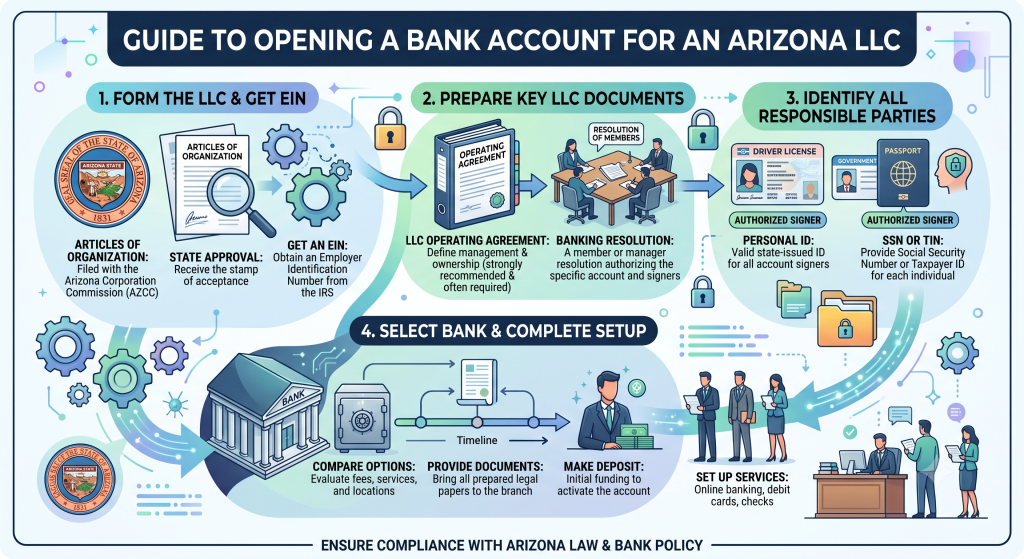
Most Arizona banks will ask for the LLC’s file-stamped Articles of Organization from the Arizona Corporation Commission, the LLC’s EIN (federal tax ID number) from the IRS, the LLC’s operating agreement, and identification for the members or managers who will sign on the account. Open the account in the LLC’s exact legal name, use the LLC’s EIN rather than your Social Security number, and make sure the signature card and monthly statements show the company’s name. From the very first deposit forward, run all company income into that account and pay all company expenses from it.
What are the best practices for my Arizona LLC’s bank account?
- Open one operating account in the LLC’s exact legal name using its EIN.
- Deposit all company revenue into that account and pay all company expenses from it.
- Never pay personal expenses directly from the company account — instead, take a documented distribution or salary and spend from your personal account.
- Never run another person’s or another business’s money through the account.
- Keep a written operating agreement and clean books that match the bank statements.
- Take money out the right way, as documented distributions, guaranteed payments, or salary, rather than dipping in informally.
- If you truly need a second account, give it a clear business purpose and title it in the LLC’s name.
Talk With an Arizona LLC Attorney
Arizona LLC attorneys Richard Keyt and his son, attorney and former CPA Richard C. Keyt, have formed 10,000+ Arizona LLCs. If you have questions about setting up your LLC’s bank account, protecting your liability shield, or fixing commingled funds, we can help you do it right.
See the contents of our Bronze, Silver & Gold LLC packages.
To hire us to form an LLC or PLLC submit our online formation questionnaire at keytlaw.com/llcq or call Rick at 480-664-7478 (email rk@keytlaw.com) or his son former CPA Ricky at 480-664-7472 (email rck@keytlaw.com).
Book a free office, phone or Zoom video meeting with one of our LLC attorneys using our online calendar.
We want to form your Arizona LLC or PLLC
- To get free answers to your LLC questions call Arizona LLC attorneys Richard Keyt (480-664-7478 & rk@keytlaw.com) or his son Richard C. Keyt (480-664-7472 & rck@keytlaw.com).
- 60+ articles about Forming & Operating Arizona LLCs
- Book a free office, phone or Zoom video meeting to get answers to your LLC questions
- See the contents & prices of our 3 LLC formation packages
- Submit our LLC formation questionnaire to hire us to form your AZ LLC today
Questions? Book a free meeting or call or email one of our Arizona estate planning attorneys. We don't charge to talk to people.
Call, email or text Richard Keyt, father
Direct phone: 480-664-7478
Email: rk@keytlaw.com
Call, email or text Richard C. Keyt, son
Direct phone: 480-664-7472
Email: rck@keytlaw.com