
Federal Income Tax Consequences of Terminating an LLC
Written by Richard Keyt & Richard C. Keyt | Arizona LLC Attorneys
Richard Keyt (practicing law in Arizona since 1979) and his son, former CPA Richard C. Keyt are Arizona LLC attorneys who have formed more than 10,000 Arizona LLCs.. They have 432 5-star reviews across Google, Facebook, and Birdeye. Call 480-664-7478 (Rick) or 480-664-7472 (Ricky) to speak with an LLC attorney, or book a free office, phone, or Zoom video consultation.
FAQ Summary
When an Arizona LLC terminates, the federal income tax consequences depend on how the LLC is classified for tax purposes — as a disregarded entity, a partnership, a C corporation, or an S corporation. For most LLCs, which are taxed as partnerships by default, the governing rules are found in Subchapter K of the Internal Revenue Code. Those rules determine whether members recognize gain or loss when they receive liquidating distributions, how basis is calculated for distributed property, and when ordinary income rather than capital gain applies under the “hot assets” rule of IRC Section 751. LLCs taxed as C corporations face a double tax on liquidation. LLCs taxed as S corporations avoid the double tax but still trigger gain recognition on appreciated assets. All terminating LLCs must file a final federal tax return and satisfy any remaining tax obligations before closing. This FAQ explains the key federal income tax rules that apply when you dissolve and wind up an Arizona LLC.
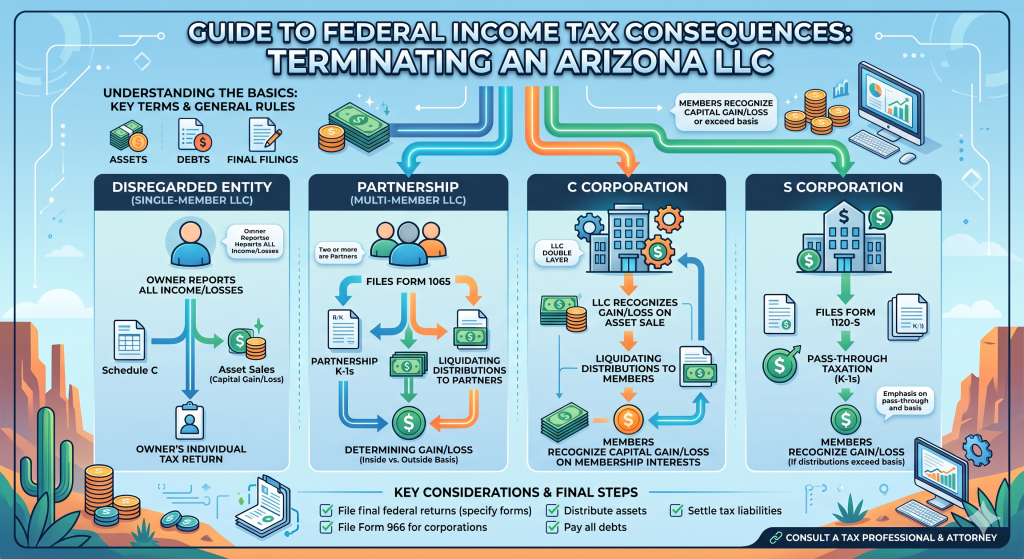
Federal Income Tax Consequences of Terminating an Arizona LLC
When you dissolve an Arizona LLC, federal income tax law — not Arizona law — determines how the IRS treats the liquidation of the company. The tax consequences depend on how your LLC is classified for federal tax purposes, what assets the LLC owns, and how those assets are distributed to the members. This article answers the most common questions Arizona LLC owners ask about the federal income tax consequences of terminating their LLC.
Arizona LLC attorney Richard Keyt has formed more than 10,000 Arizona LLCs and regularly advises LLC members on the legal and tax aspects of dissolving and winding up their companies. The information below is general in nature. You should consult a qualified tax advisor or CPA before dissolving your LLC so you understand the specific tax consequences that apply to your situation.
Frequently Asked Questions
How is an LLC taxed for federal income tax purposes?
The federal income tax treatment of your LLC's termination depends entirely on how the IRS classifies your LLC. The IRS does not recognize the LLC as a separate tax entity the way it does a corporation. Instead, the IRS treats an LLC as one of three things: a disregarded entity, a partnership, or a corporation — depending on how many members the LLC has and what tax elections, if any, the LLC has made.
A single-member LLC is treated as a disregarded entity by default, meaning the IRS ignores the LLC and taxes the sole member directly on all income and losses. A multi-member LLC is treated as a partnership by default. Any LLC — single-member or multi-member — can elect to be treated as a corporation by filing IRS Form 8832. A corporation can then elect S corporation status by filing IRS Form 2553.
The tax rules that apply when you terminate your LLC differ significantly depending on which of these tax classifications applies to your LLC.
What are the federal tax consequences when a single-member LLC (disregarded entity) terminates?
When a single-member LLC taxed as a disregarded entity terminates, the IRS treats the event as if the sole member is simply winding up a sole proprietorship or, if the member is itself a business entity, an entity that holds assets directly. There is no separate LLC-level tax return for a disregarded entity.
The tax consequences to the sole member depend on the nature of the assets owned by the LLC at the time of termination:
- Cash. If the LLC distributes cash to the sole member, there is generally no separate tax event from the distribution itself — the member has been reporting the LLC's income and deductions on his or her own tax return all along. The member's adjusted basis in the LLC is adjusted accordingly.
- Appreciated property. When the LLC distributes appreciated property (property worth more than its tax basis) to the sole member, the IRS treats this as if the sole member directly sold or exchanged the property. Whether this triggers immediate gain recognition depends on the asset type and the applicable tax rules.
- Depreciated or loss property. If the LLC holds property worth less than its adjusted tax basis, the member may recognize a loss when the LLC terminates, subject to applicable limitations.
Because the sole member has been directly reporting all LLC income and deductions all along, the termination of a disregarded entity LLC is typically a simpler tax event than the termination of a partnership or corporation.
What are the federal tax consequences when a multi-member LLC taxed as a partnership terminates?
This is the most common and often the most complex situation. When a multi-member LLC taxed as a partnership liquidates and terminates, the rules of Subchapter K of the Internal Revenue Code govern the tax treatment. The key rules are:
The LLC recognizes no gain or loss on liquidating distributions. Under IRC Section 731(b), the LLC itself does not recognize gain or loss when it distributes property to its members in liquidation. The tax consequences flow to the members individually.
Members may or may not recognize gain or loss. Under IRC Section 731(a), a member generally does not recognize gain when receiving a liquidating distribution unless the member receives cash (including the relief of the member's share of LLC debt under IRC Section 752) in excess of the member's adjusted basis in his or her LLC interest. A member recognizes a loss in a liquidating distribution only if: (1) no property other than cash, unrealized receivables, or inventory is received, and (2) the cash and the fair market value of unrealized receivables and inventory received is less than the member's adjusted basis in the LLC interest.
The character of any recognized gain is generally capital gain. Gain recognized by a member on a liquidating distribution is generally treated as gain from the sale or exchange of a partnership interest, which is capital gain. However, IRC Section 751 ("hot assets") can recharacterize some of that gain as ordinary income if the LLC owns unrealized receivables or substantially appreciated inventory.
Members take a substituted basis in distributed property. Under IRC Section 732(b), a member who receives property in a liquidating distribution takes a basis in that property equal to the member's adjusted basis in the LLC interest, reduced by any cash received in the same distribution. This rule prevents gain or loss from being recognized in most liquidating distributions.
The holding period carries over. Under IRC Section 735(b), the member's holding period for property received in a liquidating distribution generally includes the LLC's holding period for that property.
What is the "hot assets" rule and how does it affect the termination of a partnership-taxed LLC?
IRC Section 751 contains the so-called "hot assets" rule, which is one of the most important — and sometimes surprising — provisions that applies when an LLC taxed as a partnership terminates. Congress enacted this rule to prevent members from converting ordinary income into lower-taxed capital gain by routing income through the liquidation of a partnership.
Hot assets are: (1) unrealized receivables, and (2) inventory items. Unrealized receivables include accounts receivable of a cash-basis LLC that have not yet been included in income, as well as potential recapture income under IRC Sections 1245 and 1250 (depreciation recapture). Inventory items include any property that would produce ordinary income if sold by the LLC at its fair market value.
When a liquidating distribution involves hot assets, the IRS may recharacterize a portion of any gain that would otherwise be capital gain as ordinary income. This can significantly increase the tax cost of dissolving an LLC that holds appreciated inventory, accounts receivable, or depreciable property subject to recapture.
Members of an LLC that owns hot assets should consult a tax advisor before winding up the company to understand how IRC Section 751 applies to their specific situation.
What happens if the LLC distributes property that has been depreciated?
Depreciation recapture is one of the most common tax traps that arises when an LLC that owns real estate or equipment terminates. When depreciable property is distributed from a partnership-taxed LLC to its members, the potential for recapture income carries over to the member under IRC Section 735(a). This means that if the member later sells the property, the member will recognize ordinary income (not capital gain) to the extent of the depreciation that was deducted by the LLC.
For real property, IRC Section 1250 may require recapture of depreciation taken in excess of straight-line depreciation as ordinary income. For personal property such as equipment, IRC Section 1245 requires recapture of all depreciation taken as ordinary income upon a subsequent sale.
Importantly, this recapture potential does not disappear when the property is distributed from the LLC — it just shifts to the member who receives the property. Members who receive depreciable property in a liquidating distribution need to track the amount of recapture potential they inherit.
What are the federal tax consequences when an LLC taxed as a C corporation terminates?
If your LLC elected to be taxed as a C corporation by filing IRS Form 8832, the termination of the LLC is treated as a corporate liquidation under IRC Sections 331 through 346. The tax consequences of a C corporation liquidation are particularly harsh because they create a "double tax" — the corporation is taxed once, and the shareholders (members) are taxed again.
At the corporate level, under IRC Section 336, the C corporation recognizes gain or loss on each asset it distributes to its members in complete liquidation, just as if the corporation sold each asset at its fair market value on the date of distribution. This gain is taxed at the applicable corporate income tax rate.
At the member level, under IRC Section 331, the members are treated as having sold their LLC interests for the fair market value of the property they receive. The difference between what the member receives and the member's adjusted basis in the LLC interest is taxed as capital gain or loss.
Because of this double tax, members of an LLC taxed as a C corporation should carefully plan the termination with a qualified tax professional. In some cases, there may be strategies available to reduce the overall tax burden, such as selling assets before liquidation in a manner that takes advantage of specific tax provisions.
What are the federal tax consequences when an LLC taxed as an S corporation terminates?
If your LLC elected to be taxed as an S corporation, the liquidation rules of IRC Sections 331 and 336 also apply, but with a critical difference: S corporations are generally pass-through entities, so the corporation's gain on the deemed sale of its assets is passed through to and taxed at the member level, rather than at the corporate level. This avoids the double tax that applies to C corporation liquidations.
At the entity level, the S corporation recognizes gain or loss on each distributed asset as if it had sold the asset at fair market value, under IRC Section 336. This gain passes through to the members on Schedule K-1 and is taxed on their individual returns.
At the member level, the members treat the liquidating distribution as proceeds from the sale of their LLC interest under IRC Section 331, which generally produces capital gain or loss. The member's basis in the LLC interest is first increased by the member's share of the pass-through gain, which reduces the capital gain at the member level and prevents double taxation of the same income.
Even without the double tax, the termination of an S corporation LLC can produce significant taxable gain if the LLC owns appreciated assets, particularly real estate or equipment with substantial built-in gain.
Does the LLC have to file a final federal tax return when it terminates?
Yes. The filing requirement depends on how the LLC is classified for federal tax purposes:
| LLC Tax Classification | Final Federal Return Required |
|---|---|
| Single-member disregarded entity | No separate LLC return. The sole member reports all activity on his or her own return (Schedule C, Schedule E, or the entity's own return). Mark the final year. |
| Multi-member LLC taxed as partnership | Form 1065 (U.S. Return of Partnership Income). Check the "Final return" box. Issue final Schedule K-1s to all members. |
| LLC taxed as C corporation | Form 1120 (U.S. Corporation Income Tax Return). Check the "Final return" box. |
| LLC taxed as S corporation | Form 1120-S (U.S. Income Tax Return for an S Corporation). Check the "Final return" box. Issue final Schedule K-1s to all members. |
The final return covers the period from the beginning of the tax year through the date the LLC's affairs are concluded. All final payroll tax deposits must also be made, and the LLC should close its employer identification number (EIN) account with the IRS by sending a letter to the IRS once all final returns have been filed.
What happens to the LLC's EIN when it terminates?
The EIN itself is not cancelled — EINs are permanent and are never reused. However, when the LLC ceases operations, you should notify the IRS that the EIN is no longer active. You do this by sending a letter to the IRS that includes: (1) the LLC's full legal name, (2) the EIN, (3) the business address, and (4) a statement that the LLC has closed and the EIN should be deactivated. The IRS recommends doing this only after all final returns have been filed and all outstanding tax obligations have been satisfied.
What is the member's adjusted basis in the LLC interest, and why does it matter?
A member's adjusted basis in an LLC interest — sometimes called the "outside basis" — is one of the most important numbers in LLC tax law. It represents the member's investment in the LLC for tax purposes. The adjusted basis starts with the amount the member contributed to the LLC (money plus the tax basis of contributed property), is increased by the member's share of LLC income and gains, and is decreased by distributions received and the member's share of LLC losses and deductions.
The adjusted basis matters enormously at termination because it determines: (1) whether the member recognizes gain when receiving a liquidating distribution, (2) the amount of any recognized gain or loss, and (3) the member's starting basis in any property received in the liquidating distribution.
Members who have not been tracking their adjusted basis carefully throughout the life of the LLC should reconstruct it before the LLC terminates to ensure they report the termination correctly on their federal tax return. A CPA or tax advisor can help with this calculation.
What is the difference between the LLC's "inside basis" and a member's "outside basis," and why does the difference matter at termination?
Inside basis refers to the LLC's adjusted tax basis in its own assets — the sum of what the LLC paid for its property, adjusted for depreciation and other items. Outside basis refers to each member's adjusted tax basis in his or her LLC interest, as described in the previous question.
In an ideal world, the total of all members' outside bases would equal the LLC's total inside basis. In practice, these numbers often diverge because of events such as: a member purchasing an LLC interest from another member for more or less than the departing member's share of inside basis, a contribution of appreciated or depreciated property, or the LLC making distributions that reduce outside basis without a corresponding reduction in inside basis.
When inside basis and outside basis are misaligned at termination, the tax results can be unexpected. For example, if the LLC distributes property with a high inside basis but a member's outside basis is low, the member may take a very low basis in the distributed property under the substituted basis rule of IRC Section 732(b), resulting in a large taxable gain when the member later sells the property.
An IRC Section 754 election can help align inside and outside basis in some situations, but discussing whether to make that election is beyond the scope of this article and should be addressed with a qualified tax professional.
Are there any federal income tax consequences if the LLC simply stops doing business without formally dissolving?
Yes. Under the Internal Revenue Code, a partnership-taxed LLC terminates for federal tax purposes when it ceases all business operations and no longer has any assets other than cash needed to pay liabilities. The IRS does not require a formal state-law dissolution for this rule to apply. If the LLC distributes all its assets to its members and stops operating, the tax consequences described in this article apply even if the LLC's owners never filed Articles of Termination with the Arizona Corporation Commission.
That said, failing to formally dissolve the LLC under Arizona law can create significant ongoing liabilities, including annual report obligations and statutory agent fees. KEYTLaw strongly recommends properly winding up and terminating the LLC under Arizona law in addition to meeting all federal and state tax obligations.
What state income tax obligations arise when an Arizona LLC terminates?
Arizona imposes its own income tax on individuals and corporations. Arizona generally conforms to federal tax treatment for pass-through entities, meaning that gains and losses recognized at the federal level by LLC members will generally also be reportable on Arizona income tax returns. Members who are Arizona residents report all LLC income and gain on their Arizona individual income tax returns. Non-resident members may be required to file Arizona non-resident returns for income sourced to Arizona.
In addition to income tax, the LLC may have outstanding Arizona transaction privilege tax (TPT) obligations, withholding obligations, and other state tax liabilities that must be satisfied before the LLC terminates. The Arizona Department of Revenue should be notified of the LLC's closure.
This article focuses on federal income tax. A qualified Arizona tax professional can advise you on all applicable Arizona state tax obligations.
What planning steps should members consider before terminating an Arizona LLC?
Dissolving an LLC without tax planning can result in unnecessary and avoidable tax costs. Before beginning the termination process, members should consider the following steps:
- Identify and value all LLC assets. Get current fair market value appraisals for any significant non-cash assets, including real estate, equipment, intellectual property, and business goodwill.
- Calculate each member's adjusted basis. Reconstruct outside basis if it has not been carefully tracked. This is the foundation for all termination tax calculations.
- Identify hot assets. Determine whether the LLC owns unrealized receivables, inventory, or depreciable property subject to recapture under IRC Sections 1245 or 1250.
- Evaluate the allocation of assets among members. Different members may have different tax positions. A thoughtful allocation of assets can minimize the overall tax burden among all members.
- Consider installment sale treatment. If the LLC sells assets (rather than distributing them) before terminating, installment sale treatment under IRC Section 453 may allow members to spread gain recognition over multiple tax years.
- Plan the timing of the termination. If the LLC expects to recognize gain, terminating in a year when a member has capital loss carryovers or other offsetting deductions may reduce the tax cost.
- Consult a CPA or tax attorney. The federal tax rules governing LLC terminations are complex. The cost of professional tax advice is almost always far less than the tax cost of an unplanned termination.
Arizona LLC attorneys Richard Keyt and his son, attorney and former CPA Richard C. Keyt, have formed 10,000+ Arizona LLCs. Questions about dissolving your Arizona LLC? Call KEYTLaw at 480-664-7478 or email rk@keytlaw.com.
To hire us to prepare the documents to terminate your Arizona LLC or PLLC for $467 submit our online termination questionnaire.
Legal Disclaimer: This article provides general information about federal income tax law as it applies to the termination of Arizona LLCs. It is not legal or tax advice and does not create an attorney-client relationship. Tax law is complex and fact-specific. You should consult a qualified attorney and tax professional before dissolving your LLC.
We want to form your Arizona LLC or PLLC
- To get free answers to your LLC questions call Arizona LLC attorneys Richard Keyt (480-664-7478 & rk@keytlaw.com) or his son Richard C. Keyt (480-664-7472 & rck@keytlaw.com).
- 60+ articles about Forming & Operating Arizona LLCs
- Book a free office, phone or Zoom video meeting to get answers to your LLC questions
- See the contents & prices of our 3 LLC formation packages
- Submit our LLC formation questionnaire to hire us to form your AZ LLC today
Questions? Book a free meeting or call or email one of our Arizona estate planning attorneys. We don't charge to talk to people.
Call, email or text Richard Keyt, father
Direct phone: 480-664-7478
Email: rk@keytlaw.com
Call, email or text Richard C. Keyt, son
Direct phone: 480-664-7472
Email: rck@keytlaw.com