
FAQ: Why an Arizona LLC Should
Own Your Rental Property
By Arizona LLC attorneys Richard Keyt (480-664-7478 & rk@keytlaw.com) and his son Richard C. Keyt (480-664-7472 & rck@keytlaw.com). We have formed over 10,000 LLCs and have 432 five-star reviews on Google, Facebook & Birdeye. Book a free office, phone or Zoom consultation.
FAQ Summary
Owning Arizona rental property in your own name exposes your home, bank accounts, and savings to tenant lawsuits, but transferring the property to an Arizona LLC builds a legal wall between that liability and your personal assets. This FAQ guide from Arizona LLC attorney Richard Keyt—who has formed 10,000+ Arizona LLCs—explains why an LLC is the right vehicle for rental real estate, the six key benefits (personal asset protection, charging order protection, separating multiple properties, professional credibility, estate planning, and tax flexibility), and the exact four steps to move a property into an LLC: forming the LLC, opening its bank account, recording a deed, and updating your insurance and lease.
It also covers the risks landlords miss—the due-on-sale clause, piercing the corporate veil, insurance and title-policy gaps, and losing the homestead exemption—plus how to properly notify your tenant, reassign the lease, handle security deposits under Arizona law, and file an eviction once the LLC is the landlord.
Read our 40+ LLC Frequently Asked Questions Articles.
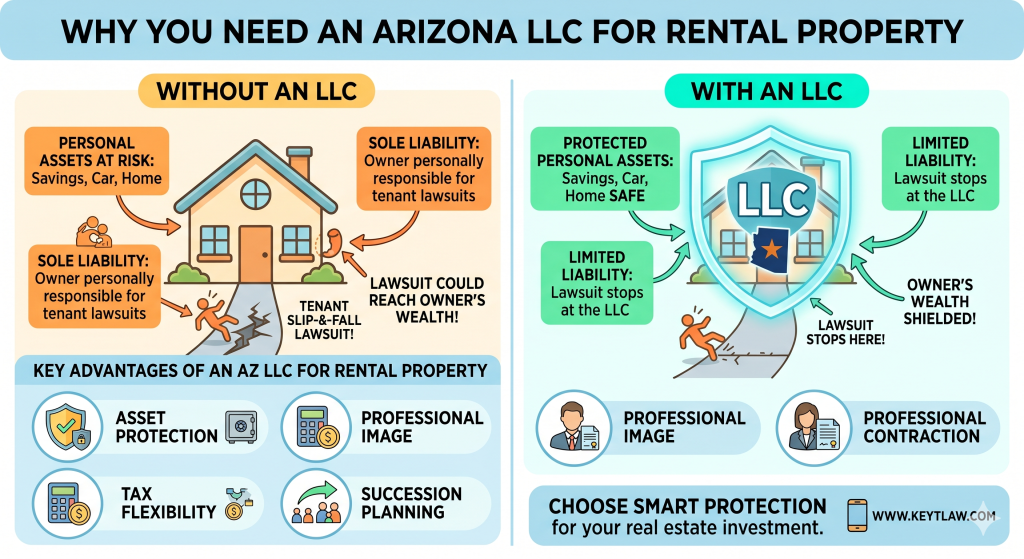
How an Arizona LLC Protects Your Assets
If you own rental real estate in Arizona—whether it is a single-family home, a duplex, a vacation rental, or a small apartment building—you have a target on your back. Tenants, their guests, and delivery workers can all sue you personally if something goes wrong on the property. A judgment against you can wipe out not just the rental property, but your home, your bank accounts, your car, and your retirement savings.
There is a straightforward, low-cost way to protect yourself: transfer the rental property into an Arizona limited liability company (LLC). This article explains why an LLC is the right vehicle for rental real estate, the benefits it provides, how to get property into an LLC, the potential downsides you need to know about, and how the LLC changes your relationship with your tenant.
I have formed more than 10,000 Arizona LLCs. I have seen what happens when landlords protect themselves—and what happens when they do not. This article is based on that experience.
Why Rental Property Is Risky to Own in Your Own Name
When you own rental property individually, you own it as what lawyers call a “sole proprietor” or as a co-owner with your spouse. Every liability connected to that property is also connected to you personally. If a tenant trips on a broken step and sues you for $500,000—and wins—the judgment creditor can go after everything you personally own.
Arizona does offer some protections. The homestead exemption shields a portion of your primary residence’s equity. IRAs and 401(k)s have strong federal protections. But general bank accounts, investment accounts, and other real estate you own personally are largely exposed.
The risk is not hypothetical. Common sources of tenant lawsuits against landlords include:
- Slip-and-fall injuries on the property
- Dog bites if a tenant’s dog injures a visitor
- Mold, lead paint, or habitability complaints
- Carbon monoxide or smoke detector failures
- Swimming pool accidents
- Injuries to workers who maintain the property
- Fair housing violations (intentional or not)
Any of these can generate a lawsuit that exceeds your insurance policy limits. An LLC creates a legal barrier between that liability and your personal assets.
The Benefits of Owning Rental Property in an Arizona LLC
1. Personal Asset Protection
The primary reason to use an LLC is liability protection. When your rental property is owned by an LLC, the LLC—not you personally—is the property owner and the landlord. If someone is injured on the property and sues, they sue the LLC. A judgment against the LLC can only be collected from LLC assets. Your personal home, bank accounts, cars, and other property are shielded.
This protection is not absolute—see the “negatives” section below—but it is substantial when the LLC is properly formed and maintained.
2. Charging Order Protection
Arizona law provides a protection that runs in the other direction as well. If you personally get sued—say, from a car accident that exceeds your auto insurance—and a creditor gets a judgment against you personally, that creditor generally cannot seize your LLC membership interest or the property the LLC owns. The creditor’s remedy is limited to a “charging order,” which is essentially a lien on any distributions the LLC makes to you. If the LLC does not distribute money to you, the creditor may get nothing. This makes an LLC doubly protective.
3. Separation of Properties
If you own multiple rental properties, consider placing each one in a separate LLC. This compartmentalizes risk. A lawsuit arising from Property A cannot reach Property B if they are in different LLCs. Each property is its own silo of liability.
Note: Owning multiple properties in a single LLC offers no separation. A judgment from one property can reach the other properties in the same LLC.
4. Professional Credibility
Tenants, contractors, and other parties see you as a professional business operation rather than an individual landlord. Leases, bank accounts, and correspondence all carry the LLC name. This can reduce the likelihood of disputes and signal that you take the landlord-tenant relationship seriously.
5. Estate Planning Integration
An LLC membership interest is personal property, not real property. This matters enormously for estate planning. You can transfer your LLC membership interest to a revocable living trust without triggering a deed recordation tax or disturbing the property itself. Your trust then controls what happens to the LLC when you die—without probate. This is far simpler than trying to deed real property directly into a trust or navigating beneficiary deed rules.
If you have a revocable living trust, your trust should own your LLC membership interests. This keeps everything out of probate and passes your rental properties seamlessly to your heirs.
6. Tax Flexibility
A single-member Arizona LLC is a “disregarded entity” for federal income tax purposes by default. That means you report rental income and expenses on Schedule E of your personal tax return exactly as you do now. Nothing changes for income tax. You can also elect to be taxed as an S corporation or C corporation if that ever makes sense for your situation—something you cannot do as an individual.
A multi-member LLC (where you and your spouse or a partner co-own the LLC) is taxed as a partnership by default, using Form 1065, with each member reporting their share of income on Schedule K-1.
How to Get Rental Property Into an Arizona LLC
Step 1: Form the Arizona LLC
Before you can transfer property, you need a properly formed LLC. In Arizona, you form an LLC by filing Articles of Organization with the Arizona Corporation Commission. The articles must include:
- The LLC name (must include “LLC” or “L.L.C.”)
- The statutory agent name and address (a person or company in Arizona who accepts legal papers on behalf of the LLC)
- Whether the LLC is member-managed or manager-managed
- The names and addresses of each member or manager
Once the Articles are approved, you should also adopt an Operating Agreement. Arizona law does not require one, but you absolutely should have one. The Operating Agreement governs how the LLC is managed, what happens if a member dies or wants to leave, how profits are distributed, and dozens of other critical issues. Without one, Arizona’s default LLC statutes control your LLC—and those defaults are rarely what you would choose.
Step 2: Open an LLC Bank Account
Before—or at the same time as—transferring property, open a separate bank account in the LLC’s name. All rental income should flow into this account. All property expenses—mortgage payments, insurance, repairs, property taxes—should be paid from this account. Do not commingle personal funds with LLC funds. Commingling is the fastest way to destroy the liability protection the LLC provides.
Step 3: Transfer Title by Deed
To move real property into an LLC, you must execute and record a deed that transfers the property from your name (or you and your spouse) to the LLC. In Arizona, this is typically a Warranty Deed.
The deed must be:
- In writing and signed by all current owners
- Notarized
- Recorded in the county recorder’s office in the county where the property is located
- Accompanied by the Arizona Affidavit of Property Value (or a claim of exemption from it)
The county recorder’s fee to record a deed is $30. Arizona does not impose a state real estate transfer tax, which makes transfers relatively inexpensive.
Hire KEYTLaw to prepare a Special Warranty Deed for $295 by submitting our online questionnaire.
Step 4: Update Related Documents
After recording the deed, update the following:
- Property insurance: Contact your insurance company immediately. Your existing landlord policy may be in your name. You need a policy that lists the LLC as the insured. Some carriers simply endorse the existing policy; others require a new policy. Do not skip this step—a claim on a policy that names you personally when the LLC owns the property could be denied.
- Lease agreements: Your existing lease was between you (as landlord) and the tenant. After the transfer, the LLC is the landlord. You may need to notify the tenant of the change in ownership and landlord identity. Consider having new leases run from the LLC.
- Mortgage and lender notification: See the due-on-sale discussion below.
- Utilities and service accounts: Some landlords transfer utility accounts to the LLC; others keep them in their own names for convenience. Either approach is acceptable, but the LLC should pay from its own account.
Negatives and Risks You Must Understand
1. The Due-on-Sale Clause
If your rental property has a mortgage on it, that mortgage almost certainly contains a “due-on-sale” clause. This clause gives the lender the right to demand full repayment of the loan if you transfer the property without the lender’s consent.
Federal law (the Garn-St. Germain Act) limits lenders’ ability to enforce due-on-sale clauses in certain situations, but a transfer to an LLC is generally not one of those protected situations. Technically, the lender could call your loan due.
In practice, most lenders do not actively monitor title changes and do not enforce due-on-sale clauses on performing loans. But the risk exists.
To learn when lenders cannot call the loan when you transfer land to an LLC, read my article called FAQ: Can a Lender Call Your Loan if You Transfer Land to an LLC?
2. The LLC Must Be Properly Maintained
An LLC’s liability protection can be pierced—wiped away—if a court finds the LLC is not a real, separate entity but merely an alter ego of the owner. Courts look for:
- Commingling personal and LLC funds
- Failure to maintain a separate bank account
- Using LLC funds to pay personal expenses
- Failure to identify the LLC properly in contracts and leases
- Ignoring the Operating Agreement
If a plaintiff successfully “pierces the corporate veil,” they can reach your personal assets. Maintaining the formalities is not difficult, but it requires discipline.
3. Insurance Must Be Correct
As noted above, your property insurance must be updated to reflect the LLC as owner. If you suffer a loss—fire, flood, liability claim—and your policy is in your personal name while the LLC owns the property, your insurer may deny the claim. This is an easily avoidable catastrophe.
4. Title Insurance
When you first purchased the property, you likely obtained title insurance. When you transfer to the LLC, that prior title policy does not automatically follow the property to the LLC. You may want to obtain a new title insurance policy in the LLC’s name. Discuss this with a title company.
5. Homestead Exemption Loss
If you live on the property—for example, you occupy one unit of a duplex while renting the other—you may currently claim the Arizona homestead exemption on the property. Transferring the property to an LLC means the LLC owns it, not you, and the LLC cannot claim a homestead exemption. This is a real trade-off to evaluate with your attorney.
Arizona’s homestead exemption is a consumer protection law that automatically shields up to $425,200 of equity in a primary residence from being seized or forced into sale by general judgment creditors. Codified under A.R.S. § 33-1101, this legal safeguard ensures that a medical crisis, credit card lawsuit, or personal injury judgment cannot easily cost you your home.
Dealing With Your Tenant After the Transfer
Notify the Tenant in Writing
After you transfer the property to the LLC, your tenant should be notified in writing that the property now has a new owner: the LLC. Under Arizona law (A.R.S. § 33-1315), a landlord who transfers ownership of a dwelling unit must provide written notice to the tenant of the new owner’s name and address. Failure to do so does not void the tenancy, but it creates confusion and potential liability.
The notice should:
- State that the property has been transferred to the LLC
- Provide the LLC’s name
- State where rent payments should now be sent (the LLC’s bank account or a new address if applicable)
- Be sent certified mail and kept with your records
Update the Lease
The existing lease was signed between you (individually) as landlord and the tenant. After the transfer, the LLC is the landlord. You have several options:
- Assignment of lease: Execute a written assignment of the lease from you to the LLC, with the tenant’s acknowledgment. This keeps the existing lease terms intact while substituting the LLC as the landlord party.
- New lease: When the existing lease expires, execute a new lease that names the LLC as the landlord. This is cleaner for leases with upcoming renewals.
Either way, future leases should be signed in the LLC’s name. The signature block should look like this:
KEYT RENTALS, LLC, an Arizona limited liability company
By: ________________________
Richard Keyt, Manager
Never sign a lease personally when the LLC is the landlord. If you sign in your personal name, you may be creating personal liability that defeats the purpose of the LLC.
Collect Rent in the LLC’s Name
Rent checks and electronic payments should be payable to and deposited in the LLC’s bank account. Accepting rent into your personal account is commingling and weakens the LLC’s liability protection. Set up ACH or check payment in the LLC’s name and communicate the new payment instructions to the tenant with the ownership transfer notice.
Handle Security Deposits Properly
Arizona law (A.R.S. § 33-1321) governs security deposits. If the tenant already has a deposit on file with you personally, you should transfer that deposit—along with written notice—to the LLC. Maintain the deposit in a separate account and keep accurate records. The security deposit requirements do not change simply because an LLC now owns the property, but the LLC is now the party responsible for returning the deposit or accounting for any deductions at the end of the tenancy.
Repairs and Maintenance
The LLC is now the landlord responsible for maintaining the property in a habitable condition under Arizona’s landlord-tenant laws. Contracts for repairs, landscaping, pest control, and other services should be in the LLC’s name. When a contractor invoices for work at the rental, the invoice should name the LLC and be paid from the LLC’s account. Retain these records—they are both deductions for tax purposes and documentation of your performance of landlord obligations.
Evictions
If you ever need to evict a non-paying or lease-violating tenant, the eviction action (called a “Forcible Entry and Detainer” action in Arizona) must be filed by the LLC, not by you personally. In Arizona, a business entity like an LLC cannot represent itself in court—it must be represented by a licensed Arizona attorney. Plan accordingly. An individual landlord can appear pro se (without an attorney) in eviction court; an LLC cannot.
Summary: Is an Arizona LLC Right for Your Rental Property?
For most Arizona rental property owners, the answer is yes. The liability protection is real and significant. The tax treatment for a single-member LLC is unchanged from owning the property in your own name. The costs are modest. The ongoing maintenance requirements are reasonable.
The analysis may differ if:
- You have a mortgage with a hair-trigger lender who monitors title changes and enforces due-on-sale clauses aggressively.
- You occupy the property and rely on the homestead exemption for asset protection.
- The property is in a trust and you have estate planning considerations that require careful coordination.
Every situation is different. The right answer for you depends on your specific property, your lender, your insurance, your estate plan, and your overall asset protection picture. An experienced Arizona LLC attorney can analyze your situation and help you structure ownership correctly.
Arizona LLC attorneys Richard Keyt and his son, former CPA and attorney Richard C. Keyt, have formed 10,000+ Arizona LLCs. They give every client lifetime free legal support and file most LLCs the same day.
See the fees and contents of our 3 LLC Formation Packages.
To hire us to form an LLC submit our online questionnaire at azllc.com/llcq, or call Richard Keyt at 480-664-7478 or email rk@keytlaw.com.
We want to form your Arizona LLC or PLLC
- To get free answers to your LLC questions call Arizona LLC attorneys Richard Keyt (480-664-7478 & rk@keytlaw.com) or his son Richard C. Keyt (480-664-7472 & rck@keytlaw.com).
- 60+ articles about Forming & Operating Arizona LLCs
- Book a free office, phone or Zoom video meeting to get answers to your LLC questions
- See the contents & prices of our 3 LLC formation packages
- Submit our LLC formation questionnaire to hire us to form your AZ LLC today
To protect your most valuable assets—your loved ones— read our article that describes the 36 documents and services you will get if you hire us to prepare your comprehensive estate plan with a revocable living trust or watch our video about the documents and services.
Questions? Book a free meeting or call or email one of our Arizona estate planning attorneys. We don't charge to talk to people.
Call, email or text Richard Keyt, father
Direct phone: 480-664-7478
Email: rk@keytlaw.com
Call, email or text Richard C. Keyt, son
Direct phone: 480-664-7472
Email: rck@keytlaw.com