
FAQ: Member Loans to an Arizona LLC:
Tax & Legal Rules
By Arizona LLC attorneys Richard Keyt (480-664-7478 & rk@keytlaw.com) and his son Richard C. Keyt (480-664-7472 & rck@keytlaw.com). We have formed over 10,000 LLCs and have 432 five-star reviews on Google, Facebook & Birdeye. Book a free office, phone or Zoom consultation.
FAQ Summary
When a member of an Arizona LLC wants to loan money to the LLC, Arizona law permits the transaction — but only if it is handled correctly. This article, written by Arizona LLC attorney Richard Keyt of KEYTLaw, explains every legal, tax, and practical issue a member must address before making a loan to the member’s LLC, including whether the other members must approve the loan, how to document the loan with a promissory note, whether the loan should be secured by a UCC lien or deed of trust, how the loan is recorded on the LLC’s books, what interest rate the IRS requires, whether the IRS can recharacterize the loan as a capital contribution, what happens when the LLC defaults, and what priority the lending member has if the LLC dissolves. Whether you are a single member or one of several members in an Arizona LLC, this article gives you the complete roadmap for making a legally sound member loan.
Read our 40+ LLC Frequently Asked Questions Articles.
Arizona LLC Law — Member Financing
Member Loans to an Arizona LLC: Everything You Need to Know
When an Arizona LLC needs cash, the members sometimes want to provide it themselves rather than go to a bank. Lending money to your own LLC is perfectly legal under Arizona law, but it comes with a series of legal, tax, and practical issues that must be handled correctly. Get any of them wrong and the IRS may reclassify the loan, other members may claim a breach of fiduciary duty, or the lending member may find they are last in line when things go wrong.
This article covers every significant issue a member faces when considering a loan to the member's Arizona LLC. If you have questions after reading it, call Arizona LLC attorney Richard Keyt at 480‑664‑7478.
Part 1: The Basics of Member Loans
Can a member of an Arizona LLC loan money to the LLC?
Yes. Arizona law does not prohibit a member from lending money to the LLC. The Arizona Revised Statutes governing LLCs (“ARS”) specifically contemplate transactions between members and the LLC. A member loan is a legitimate arm's-length business transaction — so long as it is properly documented, bears a commercially reasonable interest rate, and complies with the LLC's operating agreement.
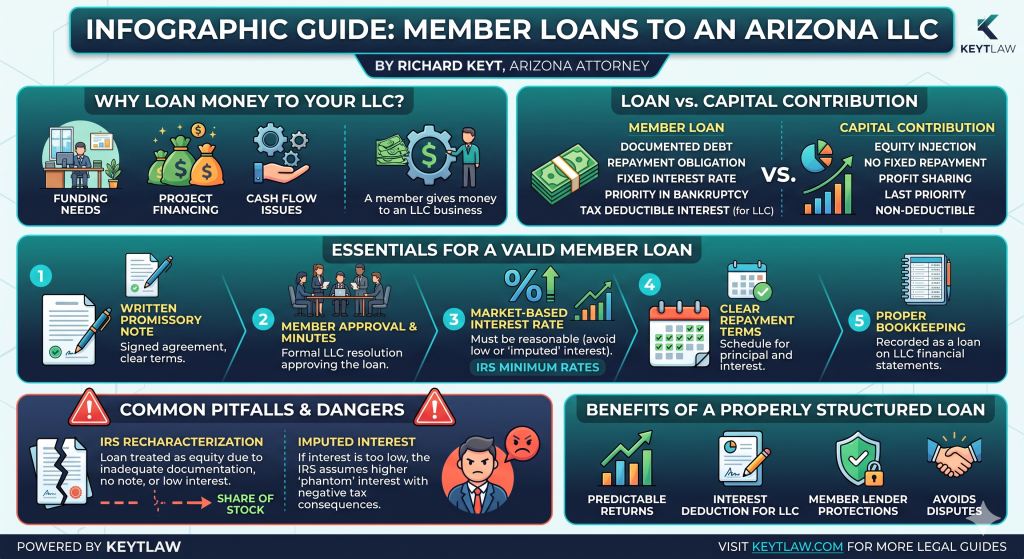
The critical distinction is between a loan and a capital contribution. A loan creates a debt owed by the LLC to the member. A capital contribution increases the member's equity in the LLC. The legal and tax consequences of the two are entirely different, which is why documentation matters enormously.
Why would a member loan money to the LLC instead of making a capital contribution?
Several reasons make a loan more attractive than a contribution in many situations:
- Priority on repayment. A creditor gets paid before equity owners. If the LLC struggles financially, the lending member stands ahead of the other members in the repayment queue.
- Interest income. The lending member earns interest, which is a return on the money regardless of the LLC's profitability.
- No dilution. A loan does not change anyone's ownership percentage. A capital contribution from one member may require adjusting all members' percentages, which can be contentious.
- Flexibility. Loans can be repaid when the LLC has cash flow without the complexity of a formal distribution or redemption.
- Deductibility. The LLC can deduct interest payments as a business expense, reducing taxable income passed through to the members.
Part 2: Approval Requirements
Do the members have to approve a member loan?
Whether a member vote is required depends entirely on the LLC's operating agreement. Arizona's LLC statute (ARS Chapter 29, Article 3) gives operating agreements broad authority to set the rules for member approval of major transactions.
In a manager-managed LLC, the manager typically has the authority to borrow money on the LLC's behalf without a member vote unless the operating agreement says otherwise. In a member-managed LLC, the managing member or the members acting by majority have similar default authority.
However, many operating agreements specifically require member approval for:
- Any loan exceeding a specified dollar threshold;
- Any transaction between the LLC and a member (a “related-party transaction”);
- Granting a security interest in LLC assets; or
- Any borrowing that is not in the ordinary course of business.
Read the operating agreement carefully before proceeding. If a vote is required and skipped, the other members may have grounds to challenge the loan or the lending member's authority to act on behalf of the LLC.
If member approval is required, how should it be documented?
Hold a formal meeting or take a written consent in lieu of a meeting. The consent or meeting minutes should state: (1) the amount of the loan; (2) the interest rate; (3) the repayment schedule; (4) any collateral; and (5) the fact that the interested member disclosed the conflict of interest. Store the signed consent or minutes with the LLC's official records.
Part 3: Promissory Note and Loan Documentation
Should a member loan to an Arizona LLC be evidenced by a promissory note?
Yes — always. The promissory note is the foundational document that proves the transaction is a loan and not a capital contribution. Without a note, the IRS and other members can argue that the money was a contribution to equity, not debt. The note should be signed by the manager or an authorized member on behalf of the LLC (not by the lending member).
A proper promissory note for a member loan to an LLC should include:
- Principal amount — the exact amount being loaned;
- Interest rate — must be at least the current IRS Applicable Federal Rate (see Part 4);
- Repayment schedule — fixed monthly payments, a balloon payment date, or a demand feature;
- Default and cure provisions — what constitutes default and how long the LLC has to cure it;
- Remedies on default — acceleration of the full balance, the right to sue, and foreclosure on collateral if any;
- Governing law — Arizona;
- Attorney's fees provision — whether the prevailing party in any dispute is entitled to fees; and
- Signatures — the LLC by its authorized signer, and acknowledgment by the lending member.
Should the loan be secured?
Whether to take security depends on the dollar amount of the loan and the lending member's appetite for risk. A lending member who wants meaningful protection should require the LLC to grant a security interest in its assets.
For personal property (equipment, inventory, receivables, bank accounts, LLC membership interests in subsidiaries), the security interest is created under Arizona's Uniform Commercial Code, Article 9 (ARS Title 47, Chapter 9). The lending member must:
- Execute a security agreement signed by the LLC;
- File a UCC-1 Financing Statement with the Arizona Secretary of State to perfect the security interest; and
- Describe the collateral with specificity.
For real property owned by the LLC, the security instrument is a deed of trust (Arizona uses deeds of trust rather than mortgages). The deed of trust must be signed by the LLC, notarized, and recorded in the county recorder's office where the property is located.
A secured member-lender has priority over unsecured creditors with respect to the collateral. An unsecured member-lender is in the same position as any other unsecured creditor if the LLC becomes insolvent — and may recover nothing.
Part 4: Interest Rate and Tax Issues
What interest rate must a member charge when loaning money to the LLC?
Arizona law imposes no minimum interest rate requirement between members and their LLCs. However, federal tax law does. IRC Section 1274 and Section 7872 require that loans between related parties (including a member and the LLC) charge at least the Applicable Federal Rate (AFR).
The IRS publishes three AFRs monthly: short-term (loans of three years or less), mid-term (three to nine years), and long-term (over nine years). If the promissory note bears a rate below the applicable AFR:
- The IRS will impute (deem) interest at the AFR;
- The lending member will be taxed on interest income that was never actually received; and
- The LLC will be treated as having paid deductible interest even though it did not.
Search “IRS Applicable Federal Rate” or visit IRS.gov to find the current AFR before setting the interest rate. Charging a rate modestly above the AFR is prudent — it demonstrates arm's-length dealing and gives a buffer against rate fluctuations.
What are the tax consequences to the member who loans money to the LLC?
The lending member must report interest income as ordinary income in the year it is received (or accrued, depending on the member's accounting method). Principal repayments are not income.
For a multi-member LLC taxed as a partnership (the default for federal tax purposes), IRC Section 707(a) treats payments from the LLC to a member acting as a non-member — such as interest on a loan — as payments to an outside party. This means the interest deduction flows through to all members in proportion to their profit-sharing ratios, not exclusively to the non-lending members.
A single-member LLC is a disregarded entity for federal tax purposes unless it has elected to be taxed as a corporation. For a disregarded single-member LLC, the loan is simply a transaction between the member and the member's own entity — meaning it has no federal income tax consequences at all. The loan is invisible to the IRS unless the LLC is taxed as an S or C corporation.
Can the IRS recharacterize a member loan as a capital contribution?
Yes, and this is one of the most important risks to address. The IRS applies a multi-factor test to determine whether a purported loan is genuine debt or disguised equity. Factors the IRS examines include:
- Whether there is a written promissory note;
- Whether the note has a fixed maturity date;
- Whether a commercially reasonable interest rate was charged;
- Whether the LLC actually made regular payments of principal and interest;
- Whether the LLC was solvent when the loan was made and capable of repayment;
- Whether the loan was recorded as a liability (not equity) on the LLC's books;
- Whether the lending member had the right to enforce the debt as a creditor; and
- Whether the loan was proportionate to the member's ownership percentage (loans matching ownership percentages look like contributions).
If the IRS recharacterizes the loan as a capital contribution, the LLC cannot deduct the interest, and the characterization can affect the lending member's ownership percentage, capital account, and distributions. Recharacterization is best avoided by following all the documentation steps described in this article.
Does a member loan affect the lending member's tax basis in the LLC?
For a multi-member LLC taxed as a partnership, the question is complicated by the partnership tax rules of IRC Sections 752 and 1.752-1 through 1.752-4. A member's outside basis is generally increased by that member's share of LLC liabilities. Whether a member loan increases the lending member's basis depends on whether the loan is classified as a “recourse” or “nonrecourse” liability and how it is allocated among the members under the regulations.
This analysis can significantly affect the member's ability to deduct LLC losses. Consult a CPA or tax attorney experienced in partnership taxation before making a large loan to the LLC.
Part 5: Accounting Treatment
How is a member loan recorded on the LLC's books?
The loan must be recorded as a liability on the LLC's balance sheet — specifically in an account called “Loan Payable to Member” or “Notes Payable — Related Party.” It must not be recorded in the member's capital account or treated as a capital contribution.
As interest accrues, the LLC records:
- Debit: Interest Expense (income statement);
- Credit: Accrued Interest Payable to Member (balance sheet liability).
When the LLC makes a principal or interest payment to the lending member:
- Principal: Debit Loan Payable to Member; Credit Cash;
- Interest: Debit Accrued Interest Payable; Credit Cash.
The LLC's tax return (typically Form 1065 for a partnership-taxed LLC) must disclose related-party transactions. Interest paid to a member is reported on the member's Schedule K-1 as “guaranteed payment” or as separate interest income depending on how it is classified under IRC Section 707(a).
Proper bookkeeping creates a paper trail that substantiates the debt character of the transaction if the IRS ever inquires.
Part 6: Fiduciary Duties and Conflict of Interest
Does Arizona law impose fiduciary duty concerns when a member loans money to the LLC?
Yes. ARS Section 29-3409 imposes fiduciary duties on members (in a member-managed LLC) and managers (in a manager-managed LLC). Those duties include the duty of loyalty, which requires that the member or manager act in the best interests of the LLC and not engage in self-dealing on terms that are unfair to the LLC.
A loan by a member to the LLC is a classic conflict-of-interest transaction because the lending member benefits from the interest rate and security terms negotiated. To protect against a breach-of-duty claim:
- Disclose the conflict. The lending member should fully disclose the terms of the proposed loan to all other members in writing before the loan is made.
- Obtain approval from disinterested members. The non-lending members should vote to approve the loan after receiving full disclosure. Document that vote.
- Charge a fair market rate. The interest rate and other terms should be comparable to what an unrelated commercial lender would charge the LLC for a similar loan. If the rate is above market, it looks like the lending member is extracting value from the LLC at the expense of the other members.
- Do not self-deal on collateral. If the LLC grants a security interest in its primary operating asset to the lending member, the other members may argue that this prejudices their ability to obtain outside financing or to protect their equity in insolvency. Make sure the collateral arrangement is reasonable.
ARS Section 29-3409 allows operating agreements to modify or eliminate fiduciary duties to some extent. Review the operating agreement to understand what duties apply and whether any have been limited by agreement.
Part 7: Default and Remedies
What happens if the LLC defaults on the member loan?
Default typically occurs when the LLC misses a payment, fails to maintain required insurance on pledged collateral, files for bankruptcy, or breaches a covenant in the loan documents. The promissory note should define all events of default with precision.
Upon default, the lending member's remedies depend on whether the loan is secured:
Remedies for a secured lending member
If the lending member holds a properly perfected UCC security interest in personal property, the member may:
- Send a written notice of default and demand for cure;
- Accelerate the entire outstanding balance;
- Repossess personal property collateral through self-help (without breach of the peace) under ARS Section 47-9609; and
- Sell the collateral in a commercially reasonable manner and apply the proceeds to the debt.
If the collateral is real property secured by a deed of trust, the lending member (as beneficiary) may instruct the trustee to conduct a trustee's sale under Arizona's non-judicial foreclosure statute (ARS Sections 33-807 through 33-821). This process takes a minimum of 91 days from the recording of the notice of sale.
Remedies for an unsecured lending member
An unsecured member-lender must:
- Send a demand letter;
- File a lawsuit in Arizona Superior Court on the promissory note;
- Obtain a judgment; and
- Attempt to collect by garnishing the LLC's bank accounts, levying on its personal property, or recording a judgment lien on real property.
If the LLC is insolvent, the unsecured member-lender competes with all other unsecured creditors for whatever assets remain after secured creditors are paid. The member may recover little or nothing.
Can the LLC file for bankruptcy, and what happens to the member loan?
Yes. An LLC can file for bankruptcy under Chapter 7 (liquidation) or Chapter 11 (reorganization). In bankruptcy, the lending member's claim is treated as that of any other creditor. If the bankruptcy trustee or court determines that the loan was actually an equity contribution, the claim will be subordinated to all other creditors and the member may receive nothing. This is yet another reason why loan documentation must be airtight.
Part 8: Dissolution and Winding Up
What happens to a member loan if the LLC dissolves?
Arizona's LLC statute, ARS Section 29-3708, establishes the order in which an LLC's assets are distributed when it winds up:
- First: Creditors, including members who are creditors of the LLC (i.e., lending members), in the order of priority established by applicable law;
- Second: Members in respect of their capital accounts and other equity interests.
This means the lending member is entitled to repayment of the loan and accrued interest before any member receives a liquidating distribution of equity. However, the lending member stands behind all third-party secured creditors (banks, equipment lenders, landlords with security deposits, etc.) in the priority queue.
If the LLC's assets are insufficient to repay all debt, the lending member shares pro rata with other unsecured creditors in the remaining assets. Nothing flows to members as equity holders until all debts are paid.
Part 9: Converting a Loan to Equity
Can a member loan convert to equity in the LLC?
Yes, but only by agreement of all members and with careful documentation. A debt-to-equity conversion means the LLC “repays” the loan not with cash but by issuing the lending member an additional membership interest (or increasing the member's existing interest) equal in value to the outstanding loan balance.
To execute a debt-to-equity conversion properly:
- All members must consent in writing;
- The operating agreement must be amended to reflect the new ownership percentages;
- The capital accounts must be adjusted to reflect the conversion; and
- The promissory note must be cancelled or marked “Paid in Full.”
From a tax standpoint, the IRS may scrutinize a debt-to-equity conversion closely, especially if it occurs when the LLC is in financial distress. Consult a tax attorney before executing the conversion to understand the potential gain recognition and basis consequences to all parties.
Part 10: Operating Agreement Provisions
Should the LLC's operating agreement address member loans?
Absolutely. A well-drafted operating agreement eliminates ambiguity and prevents disputes before they arise. At a minimum, the operating agreement should address the following with respect to member loans:
- Approval thresholds. Define what loan amounts require member approval and how many votes are needed (majority, supermajority, or unanimous).
- Interest rate floor. Require that member loans bear interest at no less than the IRS Applicable Federal Rate to avoid imputed interest problems.
- Repayment priority. Specify whether member loans are repaid before, after, or pari passu with distributions to members.
- Security restrictions. State whether a lending member may take a security interest in LLC assets and, if so, what approval is needed.
- Conflict of interest procedures. Require disclosure and approval by disinterested members for any related-party transaction.
- Conversion mechanics. Describe the process and required consents for converting a member loan to equity.
- Default remedies. Limit or expand the remedies available to the lending member, including whether the lending member may vote to dissolve the LLC in the event of an uncured default.
If your existing operating agreement does not address these issues, it should be amended. KEYTLaw drafts custom operating agreements and amendments for Arizona LLCs. Call 480‑664‑7478 to discuss your LLC's needs.
Complete Checklist: Issues to Address When a Member Loans Money to an Arizona LLC
The following checklist summarizes every issue a member and the LLC should address before and after making a member loan:
- Review the operating agreement. Confirm whether member approval is required and whether there are any restrictions on related-party loans.
- Hold a member vote or take a written consent if required by the operating agreement. Document the approval and retain the signed records.
- Determine the loan amount and purpose and confirm the LLC actually needs the money as debt rather than equity.
- Check the current IRS Applicable Federal Rate. Set the interest rate at or above the AFR for the appropriate term.
- Draft and execute a written promissory note signed by the LLC's authorized signer, with a fixed repayment schedule, default provisions, and a clear statement that the instrument is a loan obligation.
- Decide whether to secure the loan. If securing against personal property, execute a UCC security agreement and file a UCC-1 Financing Statement with the Arizona Secretary of State. If securing against real property, execute and record a deed of trust.
- Record the loan on the LLC's books as a liability (Loan Payable to Member), not as a capital contribution or equity.
- Disclose the conflict of interest to all non-lending members in writing and obtain their written approval.
- Make payments as scheduled. A loan that is never repaid will be treated by the IRS as a contribution. Keep records of every payment of principal and interest.
- Report interest income on the lending member's individual tax return and ensure the LLC properly reports interest expense on its tax return.
- Consult a CPA or tax attorney about the impact of the loan on the lending member's outside basis and the allocation of LLC liabilities under IRC Section 752.
- Review the loan annually. Confirm payments are current, update records, and reassess whether the security interest (if any) remains properly perfected.
- Update the operating agreement if it does not currently address member loans, conversion rights, or related-party approval procedures.
- Plan for dissolution. Understand that on winding up, the member loan is a debt paid before any equity distributions but after third-party secured creditors.
Questions About a Member Loan to Your Arizona LLC?
Arizona LLC attorney Richard Keyt has formed more than 10,000 Arizona LLCs and has been helping members navigate LLC legal and business issues since 1979. Call or email today for a consultation.
Phone: 480‑664‑7478
Email: rk@keytlaw.com
Contact Richard Keyt
We want to form your Arizona LLC or PLLC
- To get free answers to your LLC questions call Arizona LLC attorneys Richard Keyt (480-664-7478 & rk@keytlaw.com) or his son Richard C. Keyt (480-664-7472 & rck@keytlaw.com).
- 60+ articles about Forming & Operating Arizona LLCs
- Book a free office, phone or Zoom video meeting to get answers to your LLC questions
- See the contents & prices of our 3 LLC formation packages
- Submit our LLC formation questionnaire to hire us to form your AZ LLC today
See the Contents of Our Estate Plan
To protect your most valuable assets—your loved ones— read our article that describes the 36 documents and services you will get if you hire us to prepare your comprehensive estate plan with a revocable living trust or watch our video about the documents and services.
Questions? Book a free meeting or call or email one of our Arizona estate planning attorneys. We don't charge to talk to people.
Call, email or text Richard Keyt, father
Direct phone: 480-664-7478
Email: rk@keytlaw.com
Call, email or text Richard C. Keyt, son
Direct phone: 480-664-7472
Email: rck@keytlaw.com