
FAQ: LLC Owners: How to
Legally Hire & Pay Your Child
By Arizona LLC attorneys Richard Keyt (480-664-7478 & rk@keytlaw.com) and his son Richard C. Keyt (480-664-7472 & rck@keytlaw.com). We have formed over 10,000 LLCs and have 432 five-star reviews on Google, Facebook & Birdeye. Book a free office, phone or Zoom consultation.
FAQ Summary
Arizona LLC owners can legally hire their minor or adult child — and unlock powerful tax advantages — but only when the work is real, the pay is reasonable, and the payroll documentation is done correctly. This article answers the most common questions LLC members have about hiring a child: what tasks qualify, how much to pay, the FICA tax exemption for children under 18 (and when it does not apply), how to fund a Roth IRA with the child’s wages, what records to keep, and when the strategy is the wrong move. Arizona LLC attorneys Richard Keyt and his son, former CPA Richard C. Keyt, have formed 10,000+ Arizona LLCs and explain the rules, the benefits, and the compliance requirements in plain English.
Can My Arizona LLC Hire My Minor or Adult Child?
Written by Richard Keyt, Arizona LLC Attorney & Founder of KEYTLaw •
Arizona Licensed Since 1979 • 10,000+ LLCs Formed
Hiring your child through your Arizona LLC is one of the most tax-efficient strategies available to a business owner — but only when it is done right. Done wrong, it triggers IRS audits, back taxes, and penalties. This article gives you the straight answers: what the rules are, what the benefits are, what the risks are, when to do it, and when to walk away.
Short Answer
Yes, your Arizona LLC can legally hire your minor or adult child — but the work must be real, the pay must be reasonable, and the payroll documentation must be done correctly. Get those three things right and you can legally shift income to a lower tax bracket, deduct the wages as a business expense, save on FICA taxes (if your child is under 18 and your LLC is not taxed as a corporation), and even fund your child's Roth IRA — all at the same time.
The Basics
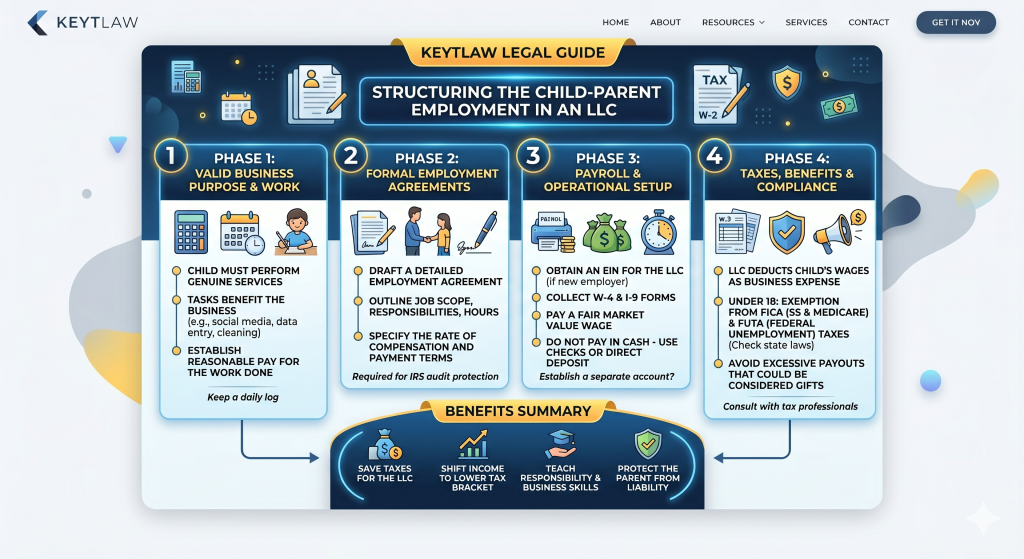
Yes — with conditions. Your Arizona LLC can hire your minor child as long as:
- The work is real and actually performed by the child.
- The tasks are age-appropriate and within the child's actual ability.
- The pay is reasonable — what you would pay an unrelated person for the same work.
- The arrangement is properly documented with a job description, time sheets, and payroll records.
A paper-only arrangement in which the child performs no real services — or a wildly inflated wage for tasks a child could not actually do — will be disallowed by the IRS and may subject you to back taxes, penalties, and interest.
Absolutely, and this is very common in family-run businesses. Once your child turns 18 there are no special rules — they may be an employee, an independent contractor, or even a manager or officer of the LLC. The same fair-market-compensation and genuine-work rules apply. Note that the FICA tax exemption available for children under 18 does not apply once the child reaches 18; full payroll taxes apply like any other worker.
The work must match the child's genuine ability and age. Examples that typically survive IRS scrutiny:
- Filing, organizing, or shredding documents
- Cleaning and maintaining the office
- Stuffing envelopes, assembling mailers, preparing packages for shipping
- Social media content creation, photography, video editing (teenagers are often genuinely skilled)
- Data entry, spreadsheet work, basic bookkeeping assistance
- Delivering materials or running errands
- Creating artwork used in marketing
- Answering phones, greeting clients, reception work (older teens)
- Light janitorial or maintenance work
The Tax Benefits — Why This Strategy Works
When structured correctly, the strategy delivers several simultaneous benefits:
- Business deduction. The LLC deducts wages as an ordinary business expense, reducing its taxable income dollar-for-dollar.
- Tax shifting. The wages move from your higher marginal rate to your child's much lower rate — often zero, because the standard deduction ($14,600 in 2024 for a single filer) shelters that much earned income from federal income tax entirely.
- FICA savings. For children under 18 employed by a sole-proprietor LLC or qualifying partnership, Social Security and Medicare taxes (totaling 15.3%) do not apply to the child's wages (see details below).
- Roth IRA eligibility. Earned income from your LLC makes your child eligible to contribute to a Roth IRA — up to $7,000 in 2024, or the amount of their earnings if less. Decades of tax-free compounding can result from starting early.
The LLC deducts $12,000. Your child owes zero federal income tax (covered by the standard deduction). You save FICA taxes on the wages.
Your child then contributes $7,000 of those earnings into a Roth IRA. That's a substantial real-dollar benefit for a genuine and well-documented work arrangement.
Under IRC § 3121(b)(3), wages paid by a parent to a child under age 18 are exempt from FICA (Social Security and Medicare taxes) when the business is:
- A sole proprietorship, or
- A partnership in which each partner is a parent of the child.
A single-member LLC taxed as a sole proprietorship typically qualifies. However, this exemption does NOT apply if your LLC is taxed as an S corporation or C corporation. In that case, FICA applies to the child's wages exactly as it would for any unrelated employee.
Yes — and this is one of the most powerful long-term advantages of the strategy. A child with earned income may contribute the lesser of their earned income or the annual Roth IRA limit ($7,000 in 2024) to a Roth IRA. Contributions are made with after-tax dollars, grow tax-free, and qualified withdrawals in retirement are also tax-free.
A Roth IRA opened for a 14-year-old has potentially 50+ years of tax-free compounding ahead of it. The parent opens and manages the account as custodian until the child reaches adulthood. Because your child's income may already be zeroed out by the standard deduction, the Roth IRA contribution costs them nothing in current taxes.
How Much Should I Pay My Child?
The IRS standard is reasonable compensation — the amount you would pay a non-family member to perform the same services. Here are general guidelines:
| Type of Work | Typical Hourly Range (2024) |
|---|---|
| Filing, organizing, cleaning, light office work | $14.35–$16/hr (near Arizona minimum wage) |
| Data entry, phone answering, reception | $15–$18/hr |
| Social media management, content writing | $18–$30/hr |
| Photography, graphic design | $20–$40/hr (depending on quality) |
| Video production and editing | $25–$50/hr |
| Bookkeeping assistance (trained) | $18–$25/hr |
Pay the rate that reflects the child's actual skill level. A teenager who genuinely manages your business's social media presence and produces quality content can legitimately earn more than one who only files papers. Document the basis for the rate you choose.
Pros and Cons at a Glance
| Pros ✔ | Cons / Risks ✘ |
|---|---|
| Income shifts to child's lower tax bracket | IRS scrutiny — sham arrangements are disallowed |
| LLC deducts wages as business expense | Payroll compliance: EIN, 941s, W-2s, deposits |
| FICA savings for children under 18 (qualifying LLCs) | No FICA savings if LLC is taxed as S-corp or C-corp |
| Child can fund a Roth IRA with earned wages | Child's income may reduce college financial aid (FAFSA) |
| Teaches work ethic and financial literacy | Family tension if expectations aren't clearly set |
| Can support family business succession planning | Workers' comp coverage may be required in Arizona |
| Child's standard deduction shelters first $14,600 of earnings | Added bookkeeping and tax filing costs |
When You Should NOT Do This
This strategy is powerful when done correctly — but it is the wrong move in these situations:
- The child will not actually work. If you cannot document real tasks performed by the child, do not do this. The entire deduction will be disallowed and you face IRS penalties on top of the back taxes.
- The pay exceeds fair market value. Inflated wages over what the work is actually worth will be partially disallowed and treated as a gift — eliminating the tax benefit you were seeking.
- Tax avoidance is the only reason. The arrangement must have genuine business purpose. Courts and the IRS look for substance over form.
- College is approaching and financial aid matters. A child's earned income is assessed at a higher rate (up to 50%) for FAFSA purposes than parental assets. Paying your 17-year-old significant wages in the years just before college could cost you far more in lost financial aid than you save in taxes.
- Your LLC is taxed as an S-corp or C-corp and you were counting on FICA savings. Run the numbers with a CPA before proceeding. The cost of compliance may not justify the benefit.
- You cannot or will not maintain proper payroll records. Informal cash payments without W-2s, 941 filings, and payroll records create significant tax and legal exposure. The IRS can — and does — assess penalties against employers who pay wages off the books.
Compliance & Documentation
Yes. Once your LLC employs any person — family or not — you must:
- Obtain an Employer Identification Number (EIN) if you do not already have one.
- Withhold federal income tax from wages (and Arizona income tax where applicable).
- Make periodic tax deposits as required by the IRS deposit schedule.
- File IRS Form 941 (quarterly payroll tax return).
- File IRS Form 940 (annual federal unemployment return — FUTA; note that the under-18 child labor exemption does not exempt from FUTA in all cases).
- Issue a W-2 to the child by January 31 of the following year.
Many small business owners use payroll services such as Gusto, ADP, or QuickBooks Payroll to handle the mechanics efficiently and at low cost.
Maintain the same documentation you would for any employee:
- A written job description specifying duties and hourly rate or salary
- Time sheets or work logs recording hours worked and tasks performed
- Payroll records showing gross pay, withholdings, and net pay each pay period
- Copies of all IRS and Arizona tax filings (941, 940, W-2)
- Evidence of work product where possible (photos, social media posts, spreadsheets, etc.)
If the child is engaged as an independent contractor rather than an employee, issue a Form 1099-NEC for total payments over $600 per year. Keep all records for at least seven years.
Yes. Arizona's child labor statutes (A.R.S. § 23-230 et seq.) restrict the hours, times, and types of work minors may perform. Children under 14 face the most significant restrictions; children 16 and 17 have considerably more flexibility. Many of Arizona's rules provide a parent-owned business exemption — but even with that exemption, keeping hours reasonable and avoiding hazardous conditions is always the right approach. Confirm the specific requirements with your attorney before putting a young child to work in the business.
Getting Professional Help
Yes — and ideally both. The benefits of this strategy depend on:
- How your LLC is classified for federal tax purposes (sole prop, partnership, S-corp, C-corp)
- Your personal marginal income tax rate
- The child's age and anticipated income from other sources
- Whether the child is approaching college age and financial aid eligibility
- Whether you can realistically maintain compliant payroll records
A CPA can run the numbers and tell you whether the benefits justify the compliance costs in your specific situation. An attorney can ensure the employment arrangement is structured and documented correctly to withstand IRS scrutiny and comply with Arizona employment law.
Questions About Your Arizona LLC?
Richard Keyt has formed 10,000+ Arizona LLCs. Call or contact us today for a free consultation
on LLC formation, structure, and strategy.
About the Author — Richard Keyt
Richard Keyt is an Arizona LLC attorney and the founder of KEYTLaw, LLC, based in Scottsdale, Arizona. Licensed in Arizona since 1979, Richard has formed over 10,000 Arizona LLCs and is one of the state's most experienced LLC attorneys. He practices alongside his son and law partner Richard C. Keyt (Ricky), who is both an Arizona attorney and a licensed CPA — providing clients with integrated legal and tax guidance under one roof. Richard is also a former USAF F-4 Phantom pilot.
We want to form your Arizona LLC or PLLC
- To get free answers to your LLC questions call Arizona LLC attorneys Richard Keyt (480-664-7478 & rk@keytlaw.com) or his son Richard C. Keyt (480-664-7472 & rck@keytlaw.com).
- 60+ articles about Forming & Operating Arizona LLCs
- Book a free office, phone or Zoom video meeting to get answers to your LLC questions
- See the contents & prices of our 3 LLC formation packages
- Submit our LLC formation questionnaire to hire us to form your AZ LLC today
See the Contents of Our Estate Plan
To protect your most valuable assets—your loved ones— read our article that describes the 36 documents and services you will get if you hire us to prepare your comprehensive estate plan with a revocable living trust or watch our video about the documents and services.
Questions? Book a free meeting or call or email one of our Arizona estate planning attorneys. We don't charge to talk to people.
Call, email or text Richard Keyt, father
Direct phone: 480-664-7478
Email: rk@keytlaw.com
Call, email or text Richard C. Keyt, son
Direct phone: 480-664-7472
Email: rck@keytlaw.com