
FAQ: Arizona LLC Meetings: Rules, Minutes & Requirements
By Arizona LLC attorneys Richard Keyt (480-664-7478 & rk@keytlaw.com) and his son Richard C. Keyt (480-664-7472 & rck@keytlaw.com). We have formed over 10,000 LLCs and have 432 five-star reviews on Google, Facebook & Birdeye. Book a free office, phone or Zoom consultation.
FAQ Summary
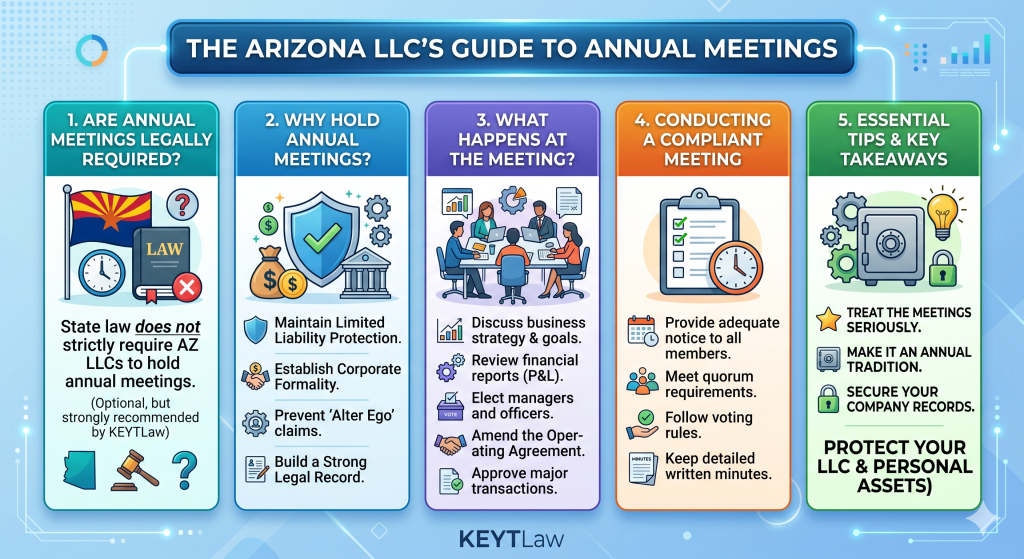
Arizona law does not require an LLC to hold annual meetings, special meetings, or any meetings at all — unlike Arizona corporations, which must hold annual shareholder meetings. This flexibility is a key advantage of the LLC form, but skipping meetings entirely can backfire: an LLC with no records, no minutes, and no documented decisions gives courts ammunition to pierce the veil and hold members personally liable for company debts.
This FAQ guide answers the most common questions Arizona LLC owners ask about meetings, including whether your Operating Agreement can require meetings even when state law doesn’t (some generic templates do — and violating your own agreement is a veil-piercing risk), how often to meet, what to put in your meeting minutes, and how single-member LLCs can use written consents (“Action by Consent”) instead of formal meetings.
Read our 40+ LLC Frequently Asked Questions Articles.
Does an Arizona LLC Have to Hold Annual Meetings?
Most Arizona LLC owners assume they have to hold annual meetings — like corporations do — or risk losing their liability protection. The truth is more nuanced and, frankly, more interesting. Arizona law doesn't require LLC meetings at all. But that doesn't mean you should skip them. Here are the answers to the questions I hear most often on this topic.
-
Does Arizona law require an LLC to hold annual meetings?
No. Arizona's LLC statutes do not require the members or managers of an Arizona LLC to hold annual meetings, special meetings, or any meetings at all. This is one of the key structural advantages of the LLC form over a corporation — you are not locked into rigid corporate governance formalities.
Corporations are a different story. Arizona corporate law imposes annual shareholder meeting requirements. But the LLC Act gives members and managers enormous flexibility to structure their governance however they see fit — including choosing not to meet at all.
-
What is veil piercing and why does it matter to LLC meetings?
Veil piercing is the legal process by which a court sets aside the liability protection of your LLC and holds the members personally liable for the company's debts or court judgments. It is the nightmare scenario that every LLC owner is trying to avoid.
When a plaintiff asks a court to pierce the veil, the court does not just look at one factor. It considers the totality of how the LLC was operated. One important factor is whether the LLC operated like a legitimate business or more like a hobby, a personal account, or an afterthought.
Legitimate businesses hold meetings. They document decisions. They maintain records. LLCs that never hold meetings, never create any documentation, and cannot show any paper trail of corporate governance give courts exactly the ammunition a plaintiff's attorney needs to argue that the LLC was not a real business entity — and that the liability protection should be disregarded.
-
Can my Operating Agreement require meetings even if Arizona law doesn't?
Yes — and this is a trap that catches a lot of LLC owners. Some Operating Agreements, particularly generic templates, contain language requiring that the members or managers hold annual meetings. If your Operating Agreement includes that requirement, it is part of your binding contract with your co-members. You must comply with it.
The lesson here: know what your Operating Agreement says. Pull it out and search for the word "meeting." If annual meetings are required, put them on the calendar and document that they happened.
KEYTLaw's Operating Agreement does not require members or managers to hold any meetings.
-
What happens if my Operating Agreement requires meetings and we don't hold them?
This is more dangerous than simply never having a meeting requirement at all. When your LLC's own Operating Agreement requires annual meetings and you ignore that requirement, you are violating your own governing document. Courts have specifically cited failure to follow an LLC's Operating Agreement as a factor in favor of piercing the veil.
Think about it from a judge's perspective: if you don't take your own company's rules seriously enough to follow them, why should the court respect the company's liability shield?
An LLC that has no meeting requirement and never meets is in a better position than an LLC whose Operating Agreement demands meetings and whose members never hold them. The latter signals negligence and disregard for the company's integrity.
-
How often should an Arizona LLC hold meetings?
At minimum, once a year. An annual meeting gives the members and managers a structured opportunity to review the prior year, assess the company's financial health, ratify actions taken during the year, and plan for what's ahead.
Beyond the annual meeting, your LLC should call a special meeting whenever a significant decision arises — entering a major contract, taking on debt, admitting a new member, transferring membership interests, buying or selling significant assets, or amending the Operating Agreement. Any time the company faces a decision with major consequences, that decision should be discussed, voted on, and documented.
-
What is a special meeting of LLC members?
A special meeting is a meeting called at any time outside of the regular annual meeting cycle to address a specific matter requiring member or manager input and a vote. Common examples include:
Approving a large expenditure or major contract · Admitting or removing a member · Authorizing the company to borrow money · Refinancing existing company debt · Authorizing the purchase or sale of significant assets · Amending the Operating Agreement · Authorizing litigation or settlement of a lawsuit
Any time your LLC faces a decision with significant financial, legal, or operational consequences, call a special meeting. Document it. The five minutes it takes to write up a brief set of minutes is worth far more than the trouble it can save you later.
-
Does an LLC meeting have to be formal?
No. An LLC meeting can be a phone call, a Zoom video conference, or a sit-down at a kitchen table. The format is completely up to you. You do not need a boardroom, a gavel, or a parliamentary procedure rulebook.
What matters is not formality — it is documentation. You can have the most formal meeting in history, but if you don't create a written record of what was decided, the meeting might as well have never happened from a legal standpoint. Conversely, even an informal conversation counts as a meeting if you document what was discussed and decided.
-
What are meeting minutes and why do I need them?
Meeting minutes are the written record of what happened at a meeting — who attended, what was discussed, what was voted on, how each member voted, and what was approved or rejected. They are your proof that the meeting actually took place and that the LLC's decisions were made through a legitimate governance process.
Without minutes, you have no evidence the meeting happened. And without evidence, a court has no reason to give your LLC the benefit of the doubt when its liability protection is being challenged.
-
What information should LLC meeting minutes include?
Proper Arizona LLC meeting minutes should include all of the following:
1. Date, time, and location (or method — phone, Zoom, in-person)
2. Who attended — list every member or manager present
3. Matters discussed or proposed — summarize what was brought before the group
4. Vote on each matter — record who voted in favor, who voted against, and who abstained
5. Results — note whether each matter was approved or rejected
6. Conditions or notes — any significant discussion, conditions attached to the approval, or next steps
Keep your minutes in your LLC's records book or a dedicated folder — physical or digital — along with your Operating Agreement, Articles of Organization, and other important company documents.
-
Can my LLC approve actions without actually holding a meeting?
Yes. Most well-drafted Operating Agreements — including the ones my firm prepares — allow members and managers to approve actions through a written document without gathering for a formal meeting. This is called an Action by Consent or a Written Consent in Lieu of Meeting. All required parties sign the document, and it has the same legal effect as a unanimous vote at a meeting.
For single-member LLCs, written consents are the most practical approach since there is no one else to meet with. For small multi-member LLCs where everyone is in regular communication, a written consent is often faster and more convenient than scheduling a meeting.
The principle is the same either way: you need a written record. Whether you hold a meeting and prepare minutes, or you skip the meeting and use a written consent, the documentation is what gives the action legal legitimacy.
-
My LLC has only one member. Do I still need to hold meetings or document decisions?
Technically no meeting is required for a single-member LLC since there is no one else to meet with. But you should absolutely document significant company decisions in writing throughout the year.
At a minimum, prepare an annual written consent each year — a simple document acknowledging the company's activities, confirming any standing decisions, and noting what occurred during the year. Use written consents to document major actions as they happen: signing a significant contract, opening a new bank account, acquiring property, taking on debt.
The purpose of this paper trail is to demonstrate — if your LLC is ever challenged in court — that you were running a legitimate business with real governance, not treating the company as a personal bank account or ignoring the fact that it exists as a separate legal entity.
-
My LLC has multiple unrelated members. Why are meetings especially important for us?
Multi-member LLCs face the greatest practical risk from failing to hold meetings and keep members informed. Consider two scenarios.
No meeting: The majority member — who is also the manager — decides to sign a large contract with a vendor. He signs it without telling the other members, who find out after the fact. They disagree with the decision. They feel blindsided. Resentment builds. Before long you have a company divorce, with members suing each other and legal fees consuming whatever profit the business was generating.
Meeting held: Same LLC, same proposed contract. But this time the manager calls a meeting. All members review the contract, ask questions, raise concerns, and vote. The majority member's vote carries the decision. The other members may not be thrilled with the outcome — but they were part of the process. They were heard.
People who feel heard are far less likely to become adversaries. Regular meetings create accountability, improve communication, and dramatically reduce the risk of member disputes. This is one of the most practical and cost-effective protections any multi-member LLC can provide itself.
Questions About Your Arizona LLC?
If you're not sure whether your Operating Agreement requires meetings, whether your LLC is at risk for veil piercing, or how to set up proper governance for your company, I'm happy to help. Schedule a free office, phone, or Zoom meeting — no obligation.
Book a Free Meeting → Or call Richard Keyt directly: 480-664-7478We want to form your Arizona LLC or PLLC
- To get free answers to your LLC questions call Arizona LLC attorneys Richard Keyt (480-664-7478 & rk@keytlaw.com) or his son Richard C. Keyt (480-664-7472 & rck@keytlaw.com).
- 60+ articles about Forming & Operating Arizona LLCs
- Book a free office, phone or Zoom video meeting to get answers to your LLC questions
- See the contents & prices of our 3 LLC formation packages
- Submit our LLC formation questionnaire to hire us to form your AZ LLC today
See the Contents of Our Estate Plan
To protect your most valuable assets—your loved ones— read our article that describes the 36 documents and services you will get if you hire us to prepare your comprehensive estate plan with a revocable living trust or watch our video about the documents and services.
Questions? Book a free meeting or call or email one of our Arizona estate planning attorneys. We don't charge to talk to people.
Call, email or text Richard Keyt, father
Direct phone: 480-664-7478
Email: rk@keytlaw.com
Call, email or text Richard C. Keyt, son
Direct phone: 480-664-7472
Email: rck@keytlaw.com