
FAQ: LLC Taxation Explained:
4 Ways the IRS Taxes LLCs
By Arizona LLC attorneys Richard Keyt (480-664-7478 & rk@keytlaw.com) and his son Richard C. Keyt (480-664-7472 & rck@keytlaw.com). We have formed over 10,000 LLCs and have 432 five-star reviews on Google, Facebook & Birdeye. Book a free office, phone or Zoom consultation.
FAQ Summary
The IRS taxes an LLC in one of four ways: as a disregarded entity, a partnership, an S corporation, or a C corporation. Two are automatic IRS defaults that require no election — a single-member LLC is a disregarded entity (income reported on Schedule C of Form 1040), and a multi-member LLC is a partnership (files Form 1065 and issues Schedule K-1s). The other two must be affirmatively elected: S corporation status is elected on IRS Form 2553 (due by March 15 for calendar-year LLCs) and can save actively managed, profitable businesses thousands in self-employment tax, while C corporation status is elected on IRS Form 8832 and suits venture-backed startups and QSBS candidates despite double taxation.
This FAQ guide by Arizona LLC attorney Richard Keyt explains when each classification makes sense, exactly what to file with the IRS, and how Arizona state tax conformity applies.
Read our 40+ LLC Frequently Asked Questions Articles.
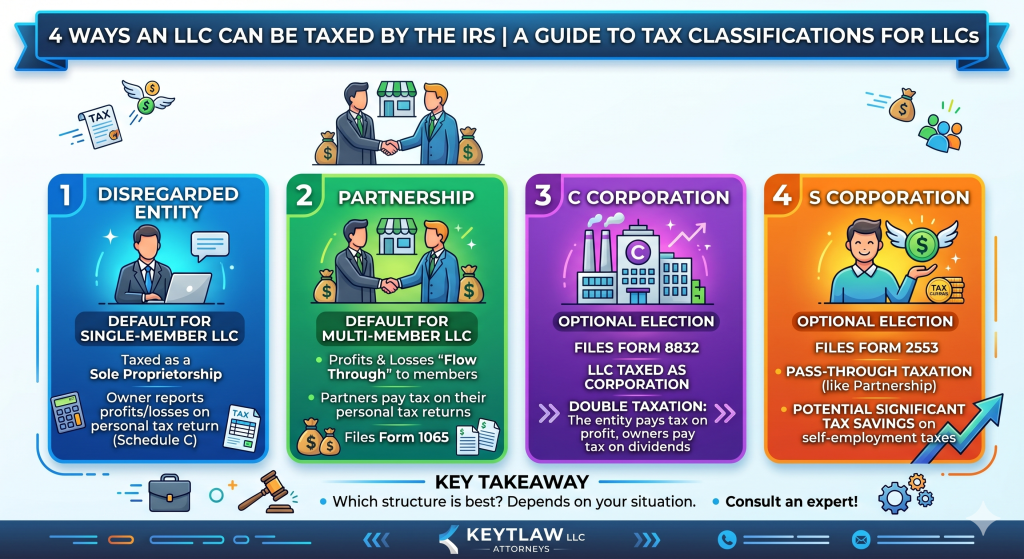
The 4 Ways the IRS Can Tax Your LLC
Forming an LLC is only half the decision. How you choose to be taxed can save you thousands — or cost you dearly. Here is what every LLC owner needs to know.
One of the most powerful — and most misunderstood — features of a limited liability company is its tax flexibility. Unlike a corporation, which is locked into a specific tax structure by default, an LLC can choose from four different federal income tax regimes. That flexibility is an enormous advantage, but only if you understand your options and make a deliberate, informed choice.
This article explains each of the four ways an LLC can be taxed, when each makes sense, and — critically — exactly what you must file with the IRS to make each election.
Key Takeaways
- An LLC has four possible federal income tax classifications: disregarded entity, partnership, S corporation, or C corporation.
- Two of those four — disregarded entity and partnership — are the IRS default. No filing is required to be taxed those ways.
- Two — S corporation and C corporation — require an affirmative election filed with the IRS on specific forms and by specific deadlines.
- The right choice depends on your income level, the number of members, how you plan to take money out of the business, and your long-term goals.
- Getting the tax election wrong can be very expensive. Talk to a CPA or tax attorney before making this decision.
The Four Tax Options at a Glance
Federal tax law gives LLCs remarkable flexibility. The Internal Revenue Code does not treat an LLC as a separate category — instead, it forces the LLC to be classified as one of the entity types the Code already recognizes: a sole proprietorship (called a "disregarded entity"), a partnership, an S corporation, or a C corporation. Here is a quick summary before we dive into each one.
Disregarded Entity
Available to single-member LLCs. The LLC is ignored for tax purposes. All income and loss flows to the owner's personal return. No separate LLC tax return is filed.
Partnership
Available to multi-member LLCs. Income and loss flow through to each member's personal return. The LLC files an informational return (Form 1065) but pays no tax itself.
S Corporation
Available to eligible LLCs. The LLC files a corporate return (Form 1120-S) but pays no tax. Profits flow through to members, who can split income between salary and distributions to reduce self-employment tax.
C Corporation
Available to any LLC. The LLC files a corporate return (Form 1120) and pays corporate income tax. Shareholders pay tax again on dividends received — the classic "double taxation."
Option 1: Disregarded Entity (Single-Member LLC Default)
If you form a single-member LLC and do nothing else, the IRS will treat it as a disregarded entity. This is the default classification for any LLC with exactly one member (owner).
"Disregarded" means the IRS ignores the LLC as a separate taxable entity. From a federal tax standpoint, it is as if the LLC does not exist. All of the LLC's income, deductions, gains, losses, and credits are reported directly on the owner's personal federal income tax return.
If the single member is an individual, the LLC's business income and expenses are typically reported on Schedule C of Form 1040, just as they would be for a sole proprietor. Net profit from Schedule C is subject to both ordinary income tax and self-employment tax (currently 15.3% on the first $176,100 of net self-employment income in 2025, and 2.9% on amounts above that threshold).
If the single member is itself a corporation or another LLC, the income flows into that entity's tax return instead.
When a Disregarded Entity Makes Sense
A disregarded entity is a good fit when:
- The business is in its startup phase with modest or unpredictable income.
- The owner wants maximum simplicity — no separate business tax return to file.
- Net profit is low enough that the self-employment tax burden is not a significant concern.
- The owner wants to use business losses to offset other personal income (losses flow directly to the 1040).
- The LLC is a rental property holding entity, where self-employment tax is generally not an issue.
No filing required. A single-member LLC is automatically treated as a disregarded entity unless it files Form 8832 to elect otherwise. Simply file your personal tax return (Form 1040) and attach Schedule C reporting the LLC's income and expenses. The IRS infers the disregarded entity classification from the way you file.
Option 2: Partnership Taxation (Multi-Member LLC Default)
If an LLC has two or more members and makes no election, the IRS automatically treats it as a partnership for federal income tax purposes. Like the disregarded entity, partnership taxation is a pass-through system — the LLC itself pays no federal income tax.
Instead, the LLC files an annual informational return, Form 1065 (U.S. Return of Partnership Income). Along with Form 1065, the LLC issues a Schedule K-1 to each member, reporting that member's allocable share of the LLC's income, deductions, gains, losses, and credits. Each member then reports those K-1 figures on his or her personal tax return.
Members who are active in the business are treated as self-employed and pay self-employment tax on their distributive share of business income. Members who are passive investors generally are not subject to self-employment tax on their share of profits, but they may be subject to the 3.8% Net Investment Income Tax (NIIT) instead.
One important and often overlooked point: partnership taxation allows tremendous flexibility in allocating income and loss among members in ways that do not necessarily correspond to each member's ownership percentage, as long as the allocations have "substantial economic effect" under the Treasury regulations.
When Partnership Taxation Makes Sense
- The LLC has two or more members and income is relatively modest.
- The members want pass-through loss treatment — losses can offset other personal income.
- The members need flexible allocation of profits and losses that differs from ownership percentages.
- Simplicity of operation is a priority (no payroll required, unlike an S or C corporation).
- The business is real estate or investment-focused, where passive income rules may limit self-employment tax exposure.
No filing required. A multi-member LLC is automatically classified as a partnership unless it elects otherwise. File Form 1065 annually and issue Schedule K-1 to each member. The IRS recognizes partnership taxation from the Form 1065 filing alone — no separate election form is needed.
Option 3: S Corporation Taxation
S corporation taxation is the most popular tax election for profitable, actively managed small businesses. It is a pass-through tax structure — like a partnership — but with a key structural difference that can produce substantial self-employment tax savings.
How It Works
When an LLC is taxed as an S corporation, the LLC files Form 1120-S (U.S. Income Tax Return for an S Corporation) each year. The LLC itself pays no federal income tax. Income and loss flow through to each member's personal return via a Schedule K-1, similar to partnership taxation.
The key difference — and the primary reason business owners choose S corporation status — is the ability to split business income into two components:
- Reasonable salary. An owner who works in the business must pay himself or herself a "reasonable" W-2 salary. That salary is subject to payroll taxes (Social Security and Medicare) just like any employee's wages.
- Distributions. Profits above the reasonable salary can be distributed to the owner as dividends. Those distributions are not subject to self-employment tax or payroll taxes.
For a business generating $150,000 or more in net profit, this split can easily save $10,000 to $20,000 or more per year in self-employment taxes, depending on the salary set and the net profit level. That is the reason S corporation elections are so popular.
Important: The IRS requires that the salary paid to an owner-employee be "reasonable" for the services performed. Setting an artificially low salary to maximize distributions is a well-known audit red flag. Work with a CPA to determine what constitutes a defensible reasonable salary for your role in the business.
S Corporation Eligibility Requirements
Not every LLC qualifies for S corporation status. To elect S corporation taxation, the LLC must meet all of the following IRS requirements:
- No more than 100 shareholders (members).
- All shareholders must be U.S. citizens or permanent residents. Non-resident aliens cannot be members of an S corporation.
- The LLC may have only one class of membership interest (differences in voting rights are permitted, but not differences in economic rights).
- Certain types of entities — corporations, partnerships, and most trusts — cannot be members.
- The LLC cannot be an insurance company, a financial institution that uses the bank bad debt reserve method, or a domestic international sales corporation (DISC).
When S Corporation Taxation Makes Sense
- The LLC is actively operated by its members and produces consistent net profit.
- Net profit is high enough — generally $50,000 or more above a reasonable salary — that self-employment tax savings justify the additional administrative costs (payroll, quarterly filings, Form 1120-S).
- The member(s) meet the eligibility requirements above.
- The business does not need the flexible profit/loss allocation available under partnership taxation.
To elect S corporation taxation, the LLC must file IRS Form 2553, "Election by a Small Business Corporation." All members (shareholders) must sign the form.
Deadline: The election must be filed no later than two months and 15 days after the beginning of the tax year in which the election is to take effect, or at any time during the preceding tax year. For a calendar-year LLC, this means the Form 2553 must be filed by March 15 for the election to be effective for that year. If you miss the deadline, the IRS has a late-election relief procedure, but it requires a reasonable cause explanation and the consent of all members.
Note: An LLC technically elects to be treated as a corporation first and then immediately elects S corporation status. In practice, Form 2553 handles both steps simultaneously — you do not need to file Form 8832 separately when using Form 2553 to elect S corporation status.
Option 4: C Corporation Taxation
The fourth option is for the LLC to be taxed as a C corporation. Under C corporation taxation, the LLC is treated as a completely separate taxpaying entity. It files its own federal corporate income tax return — Form 1120 (U.S. Corporation Income Tax Return) — and pays tax on its net income at the federal corporate rate, which is currently a flat 21%.
When the LLC distributes after-tax profits to its members as dividends, those dividends are taxed again on each member's personal return — typically at qualified dividend rates (0%, 15%, or 20% depending on the member's income). This is the famous "double taxation" of C corporations. The LLC pays tax on the income once, and the member pays tax on the dividend a second time.
Why Would Any LLC Choose C Corporation Taxation?
The double-taxation disadvantage sounds terrible — and for most small, closely held businesses, it is. But C corporation taxation is not without strategic advantages in certain situations:
- Venture capital and institutional investment. Many venture capital funds are structured as pass-through entities (partnerships) whose investors are tax-exempt organizations or foreign persons. These investors generally cannot receive pass-through income from an S corporation without adverse tax consequences. A C corporation is often required to attract institutional venture funding.
- Retained earnings at a low corporate rate. If the business intends to reinvest most of its profits rather than distribute them to owners, the 21% corporate rate may be lower than the owner's marginal individual rate, creating a tax deferral benefit.
- Qualified Small Business Stock (QSBS) exclusion. Under IRC § 1202, shareholders who hold "qualified small business stock" in a C corporation for more than five years may exclude up to 100% of their gain on sale from federal income tax — a potentially enormous benefit for startup founders. LLCs taxed as partnerships or S corporations do not qualify for the QSBS exclusion.
- Employee fringe benefits. Certain fringe benefits — such as employer-paid health insurance and group term life insurance — are deductible by a C corporation but not fully deductible by an S corporation for more-than-2% shareholders.
- Anticipated public offering or acquisition. The corporate structure may simplify the legal and tax mechanics of a future IPO or sale to a public acquirer.
When C Corporation Taxation Makes Sense
- The LLC is seeking or expects to seek venture capital or institutional investment.
- The founders intend to qualify for the QSBS exclusion under IRC § 1202.
- The business will retain and reinvest the vast majority of its earnings rather than distributing them.
- The LLC plans to go public or be acquired by a publicly traded company.
For the typical small business — a service-based business, a local retail operation, a professional practice — C corporation taxation is rarely the right choice because of double taxation. But for high-growth startups with investor ambitions, it can be exactly right.
To elect C corporation taxation, the LLC files IRS Form 8832, "Entity Classification Election." This form is also known as the "check-the-box" election form because it was designed to allow entities to simply check a box to select their tax classification.
Effective date: The Form 8832 election can be made effective as of the date it is filed, up to 75 days before the date it is filed, or up to 12 months after the date it is filed. This gives the LLC some flexibility to make the election retroactive or prospective.
60-month waiting period: Once an LLC elects to change its tax classification, it generally must wait 60 months (five years) before it can change its classification again, unless the IRS consents to an earlier change.
Side-by-Side Comparison
The table below summarizes the key differences among the four tax classifications.
| Feature | Disregarded Entity | Partnership | S Corporation | C Corporation |
|---|---|---|---|---|
| Members required | 1 only | 2 or more | 1–100 | Any number |
| Default or election? | Default | Default | Election required | Election required |
| IRS form to elect | None | None | Form 2553 | Form 8832 |
| Annual LLC return | None (Schedule C) | Form 1065 | Form 1120-S | Form 1120 |
| Pass-through taxation | Yes | Yes | Yes | No |
| Self-employment tax on profits | Yes (active income) | Yes (active members) | Only on salary | Only on salary |
| Non-U.S. citizen members allowed | Yes | Yes | No | Yes |
| Best for… | Simple sole proprietors; rentals | Multi-member businesses with modest profit | Profitable businesses with active owner-employees | Venture-backed startups; QSBS candidates |
A Word About Arizona State Taxes
This article focuses on federal income tax. Arizona generally conforms to the federal tax classification of an LLC for Arizona income tax purposes. If your LLC is taxed as a disregarded entity or partnership at the federal level, it will be treated similarly for Arizona income tax. If your LLC elects S or C corporation status federally, Arizona will follow that classification.
Arizona does impose a Transaction Privilege Tax (TPT) — often called a sales tax — on certain business activities. The LLC's federal tax classification does not affect its TPT obligations. Arizona also has its own corporate income tax rate for C corporations (currently 4.9%) that applies in addition to the federal corporate rate.
State tax implications are an important part of any tax planning discussion. Be sure to address both federal and Arizona state taxes with your CPA or tax attorney.
Frequently Asked Questions
No. Forming an LLC does not change your tax situation unless you take additional steps. The IRS applies its default classification rules based on the number of members. A single-member LLC is automatically a disregarded entity. A multi-member LLC is automatically a partnership. To be taxed differently, you must file an election with the IRS.
For a calendar-year LLC, the Form 2553 must be filed by March 15 of the tax year for which the election is to be effective. For example, to have S corporation status for the 2025 tax year, the form must be filed by March 15, 2025. You can also file the form at any time during the prior tax year. The IRS offers late-election relief if you missed the deadline, but relief is not guaranteed and requires documentation of a reasonable cause.
No. S corporations may only have shareholders who are U.S. citizens or lawful permanent residents. A non-resident alien cannot be a member of an LLC that elects S corporation taxation. If your LLC includes a foreign national member, your options are the partnership default, or C corporation taxation.
There is no bright-line rule, but most CPAs suggest that S corporation status begins to generate meaningful self-employment tax savings when net profit exceeds approximately $50,000 above what would constitute a reasonable salary for the owner's role. Below that threshold, the cost of payroll administration, quarterly payroll tax filings, and the annual Form 1120-S preparation often outweighs the tax savings. Your CPA can run a break-even analysis for your specific situation.
Yes, but there are restrictions. Once an LLC changes its tax classification by filing Form 8832, it generally must wait 60 months (five years) before it can elect to change its classification again, unless the IRS consents to an earlier change. Changes in classification can also trigger significant tax consequences, so always get tax advice before switching.
No. A single-member LLC is taxed as a disregarded entity by default, but it can elect to be taxed as a corporation (C or S) by filing the appropriate IRS form. Many single-member LLCs with significant net profit elect S corporation status to reduce self-employment taxes.
You do not legally need an attorney to file Form 2553 or Form 8832. However, the decision of which tax classification to choose — and the timing of that election — has significant and long-term financial consequences. It is strongly advisable to work with a CPA or tax attorney before making any tax election for your LLC. Getting it wrong is expensive; getting it right pays dividends for years.
The Bottom Line
The LLC is a uniquely flexible business structure, and its tax flexibility is one of its greatest advantages. The four tax options — disregarded entity, partnership, S corporation, and C corporation — each serve a different type of business owner at a different stage of business growth.
Most small business owners benefit most from the S corporation election once their business reaches consistent profitability above a reasonable salary. The savings in self-employment taxes can fund a vacation, a retirement contribution, or a marketing campaign. But the right answer depends entirely on your specific facts: your income level, your number of members, the nature of your business, and your plans for the future.
Do not leave this decision to chance or default. Make a deliberate, informed choice — and make it with professional guidance.
Ready to Form Your Arizona LLC?
Richard Keyt and his son Ricky Keyt have formed more than 10,000 Arizona LLCs. They can help you choose the right entity structure and tax classification for your business.
Contact KEYTLaw - 480-664-7478We want to form your Arizona LLC or PLLC
- To get free answers to your LLC questions call Arizona LLC attorneys Richard Keyt (480-664-7478 & rk@keytlaw.com) or his son Richard C. Keyt (480-664-7472 & rck@keytlaw.com).
- 60+ articles about Forming & Operating Arizona LLCs
- Book a free office, phone or Zoom video meeting to get answers to your LLC questions
- See the contents & prices of our 3 LLC formation packages
- Submit our LLC formation questionnaire to hire us to form your AZ LLC today
See the Contents of Our Estate Plan
To protect your most valuable assets—your loved ones— read our article that describes the 36 documents and services you will get if you hire us to prepare your comprehensive estate plan with a revocable living trust or watch our video about the documents and services.
Questions? Book a free meeting or call or email one of our Arizona estate planning attorneys. We don't charge to talk to people.
Call, email or text Richard Keyt, father
Direct phone: 480-664-7478
Email: rk@keytlaw.com
Call, email or text Richard C. Keyt, son
Direct phone: 480-664-7472
Email: rck@keytlaw.com