
Arizona LLC Divorce: What Happens When Members Can't Get Along and There's No Buy-Sell Agreement
By Arizona LLC attorneys Richard Keyt (480-664-7478 & rk@keytlaw.com) and his son Richard C. Keyt (480-664-7472 & rck@keytlaw.com). We have formed over 10,000 LLCs and have 432 five-star reviews on Google, Facebook & Birdeye. Book a free office, phone or Zoom consultation.
FAQ Summary
When multi-member LLC owners can no longer work together, Arizona law offers a ladder of exit options — and the higher you climb, the more it costs. The first and best rung is always a negotiated solution: one member buys out the other, the members sell the whole business, or they voluntarily wind up and divide the proceeds. When the parties agree to separate but can’t agree on price, a binding neutral appraisal, mediation, or arbitration can bridge the gap without a courtroom.
Arizona law lets any member dissociate (withdraw) at will, but withdrawing does not guarantee a buyout — a dissociated member becomes a mere “transferee” with an economic interest but no vote and no control. You generally cannot force out a co-member involuntarily except by court order or in three narrow statutory situations. The last resort is judicial dissolution: a lawsuit asking a judge to terminate the LLC (or, more often, order a fair-value buyout), which is slow, public, expensive, and destructive to business value. The overriding lesson runs through every question below: every multi-member LLC should adopt a well-drafted buy-sell agreement before a dispute arises, because it fixes the exit rules while everyone still gets along and gives both sides certainty about how the story ends.
The 15 questions that follow cover buy-sell agreements, dissociation, valuation, fiduciary duties, and judicial dissolution under Arizona’s LLC statute.
Read our 40+ LLC Frequently Asked Questions Articles.
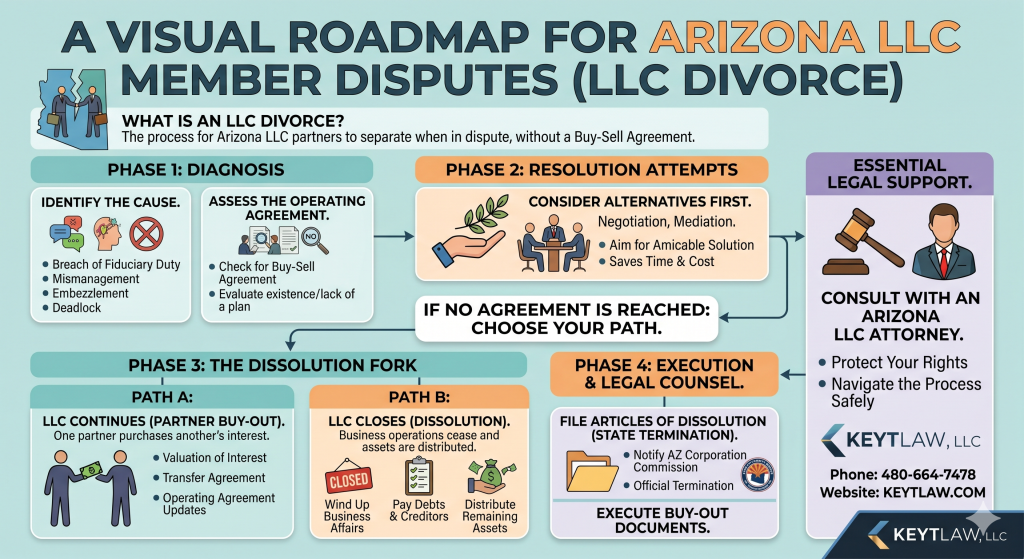
LLC Divorce: How to Separate Feuding Members of an Arizona LLC
When two or more people form an Arizona LLC together, they rarely imagine a day when they won’t be able to stand each other. But it happens. Business partners clash over money, strategy, effort, and personalities. When the relationship breaks down and there is no buy-sell agreement spelling out the exit rules, members are often shocked to discover how hard it is to force a separation under Arizona law. This FAQ explains your options — from the practical to the nuclear.
Book a free office, phone, or Zoom consultation at https://www.keytlaw.com/calendar.
Q1: What is an “LLC divorce”?
An “LLC divorce” is an informal term for the legal process of separating feuding members of a limited liability company. Just like a marital divorce, it can be amicable and cheap — or bitter, prolonged, and ruinously expensive. It can involve one member buying out the other, a sale of the entire business to a third party, a voluntary wind-up and dissolution of the LLC, or in the worst case, a court-ordered judicial dissolution. The specific path depends entirely on what the members can agree to, what their operating agreement says, and what Arizona law permits.
Q2: What is a buy-sell agreement, and why does it matter so much?
A buy-sell agreement (sometimes called a buyout agreement) is a contract among the LLC members that establishes the rules for what happens when a member wants to leave, dies, becomes permanently disabled, files for bankruptcy, gets divorced, or can no longer work with the other members. It specifies triggering events, the valuation method for determining what the departing member’s interest is worth, the payment terms for the buyout, and which members have the right to buy. Without a buy-sell agreement, there are no pre-agreed rules. Every single issue — from how to value the business to how long the buyer has to pay — must be negotiated from scratch, often by people who already despise each other.
Q3: What is always the first and best option when members can’t get along?
Negotiate. Every time. A negotiated voluntary buyout or a negotiated sale of the entire LLC or its assets is always faster, cheaper, more private, and less destructive to business value than any court process. One member buys the other out at a mutually agreed price. Or both members agree to sell the business to a third party and split the proceeds. Or the members agree to wind up the business, liquidate the assets, pay the debts, and divide what’s left. Any of these outcomes reached by agreement — even a painful one — is almost certainly better than what litigation will produce.
Q4: Does Arizona law give a member the right to simply walk away from the LLC?
Yes — a member always has the power to dissociate (withdraw) from an Arizona LLC at any time simply by giving written notice to the other members. (A.R.S. § 29-3602.) However, having the power to leave is not the same as having the right to be paid. Dissociation does not automatically entitle the departing member to a cash payment for their interest. Unless the operating agreement or a separate agreement requires the remaining members to buy out the departing member, they have no legal obligation to do so just because someone wants out.
Q5: What happens to a member who dissociates but doesn’t get bought out?
Under A.R.S. § 29-3603, once a member dissociates they lose the right to participate in management and lose the right to vote or act as a member. They become a mere “transferee” — someone who retains an economic interest (the right to receive their share of distributions and allocations) but has no management rights, no voting rights, and very limited rights to inspect the LLC’s books. So a dissociated member is stuck in a frustrating limbo: they no longer control anything, but they remain financially tied to the LLC until their interest is purchased or the LLC is wound up.
Q6: What if the members want to separate but simply can’t agree on price?
If the parties agree on who is buying and who is selling but cannot agree on price, there are three good options short of court:
- Neutral appraisal — hire a certified business valuator, agree in advance to accept the appraisal as binding, and split the cost.
- Mediation — a neutral mediator facilitates negotiation and helps both parties reach a voluntary settlement. The mediator has no power to impose a result, but skilled mediators resolve the majority of business disputes they touch.
- Arbitration — the parties submit to a neutral arbitrator who hears both sides and issues a binding decision. Arbitration is faster and cheaper than litigation and is private.
All three are far superior to court.
Q7: What is a “shotgun” or “Texas shootout” clause, and can members use one without having written it in advance?
A shotgun clause is a buyout mechanism where one member names a price per percentage point of membership interest, and the other member must either buy at that price or sell at that price. It brilliantly solves the valuation problem because the member naming the price is incentivized to name a fair one — they don’t know which side of the transaction they’ll end up on. The catch: this mechanism must be agreed to by both members before it can be used. It works perfectly when it’s built into the operating agreement. It can also be agreed to after a dispute arises, but only if both parties consent. You cannot force a shotgun buyout on an unwilling co-member who didn’t agree to it.
Q8: Can one member force out another member involuntarily without going to court?
Generally no. Under A.R.S. § 29-3602(5), a member may only be expelled without a court order by unanimous vote of the other members, and only in three narrow circumstances: (a) it has become unlawful to carry on the LLC’s business with that member participating; (b) the member has transferred all of their transferable interest; or (c) the member is a legal entity (like a corporation or another LLC) that has been dissolved. You cannot vote out a co-member simply because you dislike them, disagree with their business decisions, or believe they are not pulling their weight. Expulsion requires a court order except in those three specific situations.
Q9: What is judicial dissolution, and when can a member ask for it?
Judicial dissolution is a lawsuit filed in Arizona superior court asking a judge to order the LLC wound up and terminated. Under A.R.S. § 29-3702(A)(4), a member may petition for judicial dissolution if the members or managers are so deadlocked in the management of the business that the LLC’s activities and affairs can no longer be conducted to the advantage of the members, and there is a risk of irreparable injury to the LLC because the deadlock cannot be broken. A member may also seek dissolution if those in control of the LLC have acted illegally, oppressively, or fraudulently toward a member.
Q10: Is judicial dissolution a good strategy?
Almost never. Judicial dissolution is the nuclear option — use it only after everything else has failed. Litigation is expensive, can take years, destroys business value, exposes every aspect of the LLC’s business to public scrutiny, and poisons any chance of an amicable resolution. Courts also have broad discretion: a judge who finds that a less drastic remedy is available may refuse to dissolve the LLC even if deadlock is proven. Arizona courts have been clear that dissolution is a last resort, not a first response to a business dispute. File a dissolution lawsuit only after good-faith attempts at negotiation and mediation have genuinely failed.
Q11: Can a court order a buyout instead of dissolving the LLC?
Yes — and this happens frequently. Under A.R.S. § 29-3702(D), in a proceeding for judicial dissolution the court may order any remedy it finds equitable, including ordering the LLC or the other members to purchase the petitioning member’s interest at fair value. A court-ordered buyout lets the business survive with the remaining member while giving the exiting member fair compensation. Courts prefer this outcome when the LLC has ongoing value and the underlying dispute is really about money and exit terms rather than fundamental fraud or illegality.
Q12: How is a member’s interest valued when there is no agreed formula?
Without a buy-sell formula, value is determined by negotiation or by a qualified business appraiser. Business valuation is part art and part science: appraisers look at the LLC’s assets, cash flow, revenue, profitability, comparable sales of similar businesses, and industry-specific multipliers. Critically, Arizona courts in buyout proceedings typically use fair value rather than strict fair market value — and fair value in the LLC context generally does not apply a minority discount (a reduction in value because the interest is less than a controlling interest). This means a minority member may receive more in a court-ordered buyout than they would receive selling their interest on the open market.
Q13: What fiduciary duties do members owe each other during a dispute?
LLC members in Arizona owe each other duties of loyalty and care, and these duties do not disappear simply because the members are fighting. A.R.S. § 29-3409 requires members to account to the LLC for any benefit they receive from the conduct of the LLC’s business, to refrain from competing with the LLC, and to act in good faith. A member who diverts business opportunities to a new competing entity, drains LLC bank accounts, destroys records, or deliberately drives away customers while a dispute is pending is not only breaching their fiduciary duty — they are handing the other member powerful ammunition for both damages claims and a favorable court-ordered buyout.
Q14: What does the operating agreement say? Isn’t that the first thing to check?
Absolutely. Even if there is no separate buy-sell agreement, many LLC operating agreements contain provisions about member withdrawal, restrictions on transferring membership interests, what happens upon a member’s death or bankruptcy, and dispute resolution procedures. The operating agreement is the first document to pull out and read carefully when a dispute arises. If it addresses the situation, those provisions govern. If it is silent, Arizona’s LLC statute fills the gaps with default rules — and those default rules may or may not be favorable to either member’s position.
Q15: What is the single most important lesson from LLC divorces that go badly wrong?
Every multi-member LLC should have a well-drafted buy-sell agreement — ideally built directly into the operating agreement — before any dispute arises, and ideally before the LLC opens its doors. A good buy-sell agreement specifies what events trigger a buyout (death, disability, divorce, bankruptcy, voluntary withdrawal, deadlock), how the business is valued, how long the buyer has to pay, what happens to outstanding loans from members to the LLC, and what happens to personal guarantees on business debt. Drafting a buy-sell agreement when everyone is getting along and the future is bright costs a fraction of what it costs to litigate an exit when the relationship has collapsed. And unlike litigation, a good buy-sell agreement actually gives both sides certainty about how the story ends.
How to Hire Us to Prepare a Custom Buy-Sell Agreement for Multi-Member LLCs
Submit our Buy Sell Agreement Questionnaire.
- Why Multi-Member LLCs Should Have a Buy Sell Agreement
- See events that can trigger a buy out. The purpose of a Buy Sell Agreement or Buyout Agreement is to name events the occurrence of which gives the company and other members an option to buy or require them to buy the membership interest of a member that causes or suffers one of the events (called a “triggering event”). See Common Events that Can Trigger a Buy Out.
Protect Your Arizona LLC Before a Dispute Starts
Arizona LLC attorney Richard Keyt has formed 10,000+ Arizona LLCs since 1979. He can add a buy-sell agreement to your operating agreement now — or help you navigate an LLC divorce that has already begun.
Book a Free Office, Phone or Zoom Video Meeting Call 480-664-7478 • azllc.com
We want to form your Arizona LLC or PLLC
- To get free answers to your LLC questions call Arizona LLC attorneys Richard Keyt (480-664-7478 & rk@keytlaw.com) or his son Richard C. Keyt (480-664-7472 & rck@keytlaw.com).
- 60+ articles about Forming & Operating Arizona LLCs
- Book a free office, phone or Zoom video meeting to get answers to your LLC questions
- See the contents & prices of our 3 LLC formation packages
- Submit our LLC formation questionnaire to hire us to form your AZ LLC today
See the Contents of Our Estate Plan
To protect your most valuable assets—your loved ones— read our article that describes the 36 documents and services you will get if you hire us to prepare your comprehensive estate plan with a revocable living trust or watch our video about the documents and services.
Questions? Book a free meeting or call or email one of our Arizona estate planning attorneys. We don't charge to talk to people.
Call, email or text Richard Keyt, father
Direct phone: 480-664-7478
Email: rk@keytlaw.com
Call, email or text Richard C. Keyt, son
Direct phone: 480-664-7472
Email: rck@keytlaw.com