
FAQ: How Members of an LLC
Pay Themselves
By Arizona LLC attorneys Richard Keyt (480-664-7478 & rk@keytlaw.com) and his son Richard C. Keyt (480-664-7472 & rck@keytlaw.com). We have formed over 10,000 LLCs and have 432 five-star reviews on Google, Facebook & Birdeye. Book a free office, phone or Zoom consultation.
FAQ Summary
Read our 40+ LLC Frequently Asked Questions Articles.
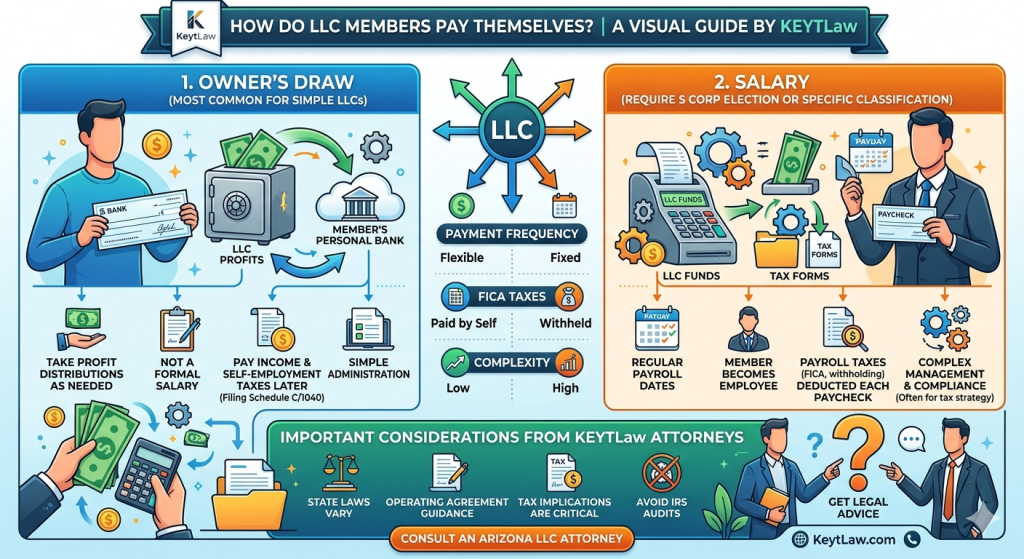
Arizona LLC members pay themselves in one of two ways, depending on how the LLC is taxed. By default, a single-member Arizona LLC is a “disregarded entity,” so the owner pays themselves through distributions — simply transferring money from the LLC’s bank account to a personal account — with no payroll or W-2. Distributions are not tax-deductible, and the owner owes 15.3% self-employment tax on all net profit plus federal and Arizona income tax.
Once annual net profit consistently exceeds $40,000–$50,000, electing S-Corporation status (via IRS Form 2553 and Form 8832) often saves thousands per year by splitting income into a reasonable W-2 salary and FICA-free distributions.
This FAQ article explains distributions, self-employment tax, reasonable compensation, the S-Corp election process, and Arizona-specific tax rules — with side-by-side tax comparisons.
How Arizona LLC Members Pay Themselves
Distributions, self-employment tax, S-Corp elections, and how to legally reduce what you owe — explained by an Arizona LLC attorney
By Richard Keyt | Arizona LLC Attorney Since 1979 | 10,000+ Arizona LLCs Formed
One of the most common questions Arizona LLC owners ask is: How do I pay myself from my LLC? It seems like a simple question, but the answer has significant tax consequences — and getting it wrong can cost you thousands of dollars every year.
This article explains exactly how single-member Arizona LLC owners pay themselves, why distributions can be expensive from a tax standpoint, and when it makes sense to elect S-Corporation status to reduce your self-employment tax burden.
What Is a Single-Member Arizona LLC?
When you form a single-member LLC in Arizona, you are the sole owner — the only "member." Arizona LLCs are governed by the Arizona Limited Liability Company Act, A.R.S. § 29-3101 et seq. Your LLC is a separate legal entity that shields your personal assets from business liabilities.
For federal income tax purposes, however, the IRS treats a single-member LLC as a disregarded entity — meaning the LLC itself pays no federal income tax. All profit and loss flows directly to your personal tax return on Schedule C, exactly as if you were a sole proprietor.
Your LLC has its own Employer Identification Number (EIN), which you use to open a business bank account and keep your business finances separate from your personal finances.
Critical: Keep your LLC bank account separate from your personal accounts. Commingling funds — depositing business income into your personal account or paying personal bills from your business account — can destroy your LLC's liability protection and expose your personal assets to business creditors.
How Single-Member LLC Owners Pay Themselves: Distributions
When you move money from your LLC business bank account to your personal bank account, that transfer is called a distribution. There is no formal payroll process, no W-2, and no pay stub. You simply transfer the money.
Here is the important tax rule: distributions are not tax-deductible by the LLC. The IRS does not allow a single-member LLC to deduct money paid to its sole owner as a business expense. This is because the owner and the LLC are the same taxpayer for federal income tax purposes.
This means if your LLC has $100,000 in net profit, the IRS taxes you on $100,000 — regardless of whether you transferred all of it to your personal account, none of it, or anything in between. The act of taking a distribution does not reduce your taxable income.
The Self-Employment Tax Problem
Here is where the tax pain becomes real. As a single-member LLC owner, you pay self-employment tax of 15.3% on your net business profit. Self-employment tax covers:
- Social Security tax: 12.4% (on net earnings up to the annual wage base, which is $168,600 in 2024)
- Medicare tax: 2.9% (no income cap; an additional 0.9% applies above $200,000 for single filers)
On $100,000 in net LLC profit, self-employment tax alone is $15,300. You can deduct half of self-employment tax on your personal return as an above-the-line deduction, but you still owe the full amount.
After that, you still owe federal income tax and Arizona state income tax on the remaining income. Here is what the total tax picture looks like on $100,000 net profit as a single-member LLC:
| Tax | Rate / Calculation | Amount |
|---|---|---|
| Self-employment tax | 15.3% × $100,000 | $15,300 |
| Federal income tax (24% bracket, single) | Approximate effective tax | ~$18,000 |
| Arizona state income tax (2.5% flat) | 2.5% × net taxable income | ~$2,300 |
| Estimated total tax | ~$35,600 |
Note: These numbers are estimates for illustration purposes only. Your actual tax liability depends on your filing status, deductions, credits, and other income. Consult your CPA for your specific situation.
The S-Corporation Solution: Reducing Self-Employment Tax
Once your Arizona LLC's annual net profit consistently exceeds $40,000 to $50,000, many CPAs recommend electing to have your LLC taxed as an S Corporation for federal income tax purposes.
An S-Corp election does not change your Arizona LLC under state law. Your LLC remains an Arizona LLC — it still has the same operating agreement, the same members, and the same liability protection. The only thing that changes is how the IRS taxes it.
How to Make the S-Corp Election
To elect S-Corp taxation, you file two IRS forms:
- Form 2553 — Election by a Small Business Corporation
- Form 8832 — Entity Classification Election
The election must generally be filed within 75 days of the start of the tax year in which you want it to take effect, or by March 15th of that year. Arizona automatically recognizes the federal S-Corp election — there is no separate Arizona state form required.
Important: S-Corp returns are due March 15th, not April 15th. File Form 7004 if you need an extension.
How S-Corp Taxation Works: Salary + Distribution
When your LLC is taxed as an S-Corp, you wear two hats: you are both an owner and an employee of your own company. As an employee, you must pay yourself a reasonable W-2 salary for services you perform. That salary is a deductible business expense for the LLC.
After paying yourself a reasonable salary, the remaining net profit flows through to your personal return as S-Corp distribution income — which is not subject to self-employment tax or FICA payroll taxes. That is where the savings come from.
Reasonable Compensation: What Does It Mean?
The IRS requires that S-Corp owner-employees pay themselves a salary that is "reasonable" for the services they perform. The IRS scrutinizes S-Corps that pay unreasonably low salaries specifically to avoid payroll taxes.
There is no one-size-fits-all number. Reasonable compensation depends on:
- The nature of the work you perform
- Your industry and geographic market
- What you would pay someone else to do the same work
- Your LLC's net profit available for compensation
A practical guideline many tax professionals use: pay yourself at least 30% to 40% of net profit as a W-2 salary, and take the remainder as an S-Corp distribution. Work with your CPA annually to set an appropriate reasonable compensation amount.
Side-by-Side Tax Comparison: LLC vs. S-Corp
Here is a concrete comparison using $100,000 in net profit, with a $40,000 reasonable salary under the S-Corp structure. Your figures will vary based on your deductions and filing status.
| Tax Item | Single-Member LLC | LLC Taxed as S-Corp |
|---|---|---|
| Net profit | $100,000 | $100,000 |
| Reasonable W-2 salary | None | $40,000 |
| S-Corp distribution (not subject to FICA) | N/A | $60,000 |
| Self-employment / FICA tax | $15,300 (15.3% × $100K) | $6,120 (employer + employee FICA on $40K salary) |
| Federal income tax (approx.) | ~$18,000 | ~$15,000 |
| Arizona income tax (2.5%) | ~$2,300 | ~$2,300 |
| Estimated total tax | ~$35,600 | ~$23,420 |
| Estimated annual savings | ~$12,180 |
Important: S-Corp status comes with additional costs: payroll service fees ($500–$2,000/year), a separate corporate tax return (Form 1120-S), and additional accounting complexity. The net tax savings need to comfortably exceed those costs. At $40,000–$50,000 in net profit, it often does.
Arizona-Specific Considerations
- Arizona flat income tax rate: Arizona's individual income tax rate is a flat 2.5% — one of the lowest in the country. This makes the state tax component relatively predictable.
- No Arizona franchise tax: Arizona does not impose a franchise tax or annual LLC income tax. Arizona LLCs pay a $50 annual report fee to the Arizona Corporation Commission.
- S-Corp recognition: Arizona automatically follows the federal S-Corp election. No separate Arizona form is required.
- Annual report deadline: Arizona LLC annual reports are due on the anniversary of the LLC's formation date.
Key Takeaways
- Single-member Arizona LLC owners pay themselves through distributions — not salary — unless they have elected S-Corp status.
- Distributions are not deductible. You pay self-employment tax of 15.3% on all net LLC profit.
- An S-Corp election allows you to split income between a reasonable W-2 salary (subject to FICA) and a distribution (not subject to FICA), generating significant tax savings.
- The S-Corp election generally makes financial sense once net profit exceeds $40,000–$50,000 per year.
- Reasonable compensation must be set carefully — work with a CPA to determine the right amount each year.
- Always keep your LLC bank account separate from personal finances.
Frequently Asked Questions
How does a single-member Arizona LLC owner pay themselves?
By taking a distribution — transferring money from the LLC business bank account to your personal bank account. No formal payroll or W-2 is required. However, you pay self-employment tax of 15.3% on all net LLC profit, plus federal and Arizona income tax.
What is self-employment tax and how does it affect Arizona LLC owners?
Self-employment tax is 15.3% of net profit, covering Social Security (12.4%) and Medicare (2.9%). Every single-member Arizona LLC owner who has not elected S-Corp status pays this on 100% of net business income. On $100,000 net profit, that is $15,300 before any income tax.
When should an Arizona LLC elect to be taxed as an S Corporation?
Most Arizona CPAs recommend considering an S-Corp election when your LLC's annual net profit consistently exceeds $40,000 to $50,000. At that income level, the self-employment tax savings typically outweigh the additional cost of running payroll and filing a corporate tax return.
What forms do I file to elect S-Corp status for my Arizona LLC?
File IRS Form 2553 (Election by a Small Business Corporation) and IRS Form 8832 (Entity Classification Election). Arizona automatically recognizes the federal S-Corp election — no separate Arizona state form is required. The election must generally be filed within 75 days of the start of the applicable tax year.
What is reasonable compensation for an Arizona LLC taxed as an S-Corp?
Reasonable compensation is the W-2 salary you must pay yourself as an S-Corp employee for services you perform. A common guideline is to pay at least 30%–40% of net profit as salary and take the remainder as an S-Corp distribution. Work with a CPA to determine your specific amount each year.
Does Arizona have a franchise tax or annual LLC income tax?
No. Arizona does not impose a franchise tax or annual LLC tax based on income. Arizona LLCs pay a $50 annual report fee. Arizona's flat individual income tax rate is 2.5% — one of the lowest in the country.
Can I still take distributions from my LLC after electing S-Corp status?
Yes. After electing S-Corp status, you pay yourself a reasonable W-2 salary and can also take additional distributions. The distributions are not subject to FICA payroll taxes. You pay FICA only on the W-2 salary portion — which is the primary tax benefit of the S-Corp election.
Questions About Your Arizona LLC?
Richard Keyt has formed over 10,000 Arizona LLCs and practiced Arizona law since 1979. Call or visit us online to learn how to structure your Arizona LLC correctly from day one.
Form an Arizona LLC Call (480) 664-7478 More Arizona LLC ArticlesWe want to form your Arizona LLC or PLLC
- To get free answers to your LLC questions call Arizona LLC attorneys Richard Keyt (480-664-7478 & rk@keytlaw.com) or his son Richard C. Keyt (480-664-7472 & rck@keytlaw.com).
- 60+ articles about Forming & Operating Arizona LLCs
- Book a free office, phone or Zoom video meeting to get answers to your LLC questions
- See the contents & prices of our 3 LLC formation packages
- Submit our LLC formation questionnaire to hire us to form your AZ LLC today
See the Contents of Our Estate Plan
To protect your most valuable assets—your loved ones— read our article that describes the 36 documents and services you will get if you hire us to prepare your comprehensive estate plan with a revocable living trust or watch our video about the documents and services.
Questions? Book a free meeting or call or email one of our Arizona estate planning attorneys. We don't charge to talk to people.
Call, email or text Richard Keyt, father
Direct phone: 480-664-7478
Email: rk@keytlaw.com
Call, email or text Richard C. Keyt, son
Direct phone: 480-664-7472
Email: rck@keytlaw.com