
Arizona LLC S Corp Election Guide & FAQ
By Arizona LLC attorneys Richard Keyt (480-664-7478 & rk@keytlaw.com) and his son Richard C. Keyt (480-664-7472 & rck@keytlaw.com). We have formed over 10,000 LLCs and have 432 five-star reviews on Google, Facebook & Birdeye. Book a free office, phone or Zoom consultation.
FAQ Summary
An LLC can elect to be taxed as an S corporation, but the election has strict IRS deadlines, specific eligibility rules, and real compliance costs that owners must weigh against the potential payroll tax savings. This FAQ explains how the election works, what IRS forms to file, who qualifies, and the key pros and cons — so you can decide whether S corporation taxation makes financial sense for your LLC.
Read our 40+ LLC Frequently Asked Questions Articles.
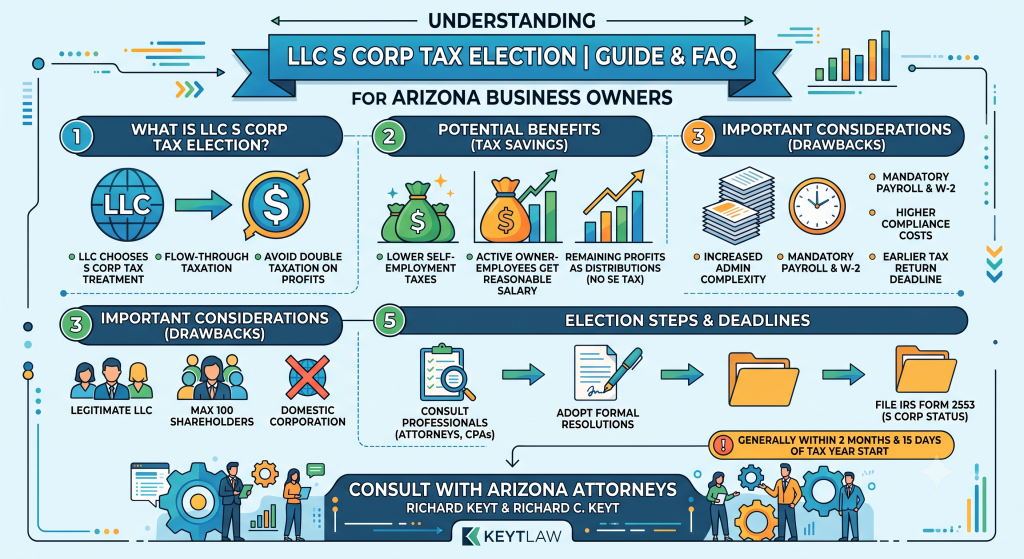
LLC S Corporation Election:
Pros & Cons
LLC S Corporation Election: A Complete FAQ
One of the most powerful — and misunderstood — tax strategies available to LLC owners is the election to be taxed as an S corporation. Done correctly and at the right profit level, it can save an LLC member thousands of dollars in payroll taxes every year. Done wrong — or at the wrong time — it adds compliance costs and audit risk that outweigh the savings.
The following FAQ answers the most important questions Arizona LLC owners ask about the S corporation election: what it is, how to make it, who qualifies, and what the real-world pros and cons are.
What the S Corporation Election Is — and Isn't
What does it mean for an LLC to be taxed as an S corporation?
An LLC is a state-law entity, not a federal tax entity. By default, the IRS taxes a single-member LLC as a sole proprietorship (disregarded entity) and a multi-member LLC as a partnership. When an LLC elects S corporation status, the IRS agrees to tax the LLC as if it were an S corporation for federal income tax purposes.
The LLC still exists as an LLC under Arizona law — it does not become a corporation — but it is taxed under Subchapter S of the Internal Revenue Code. The members still own membership interests, still operate under an operating agreement, and still enjoy LLC liability protection. The S election changes only how the entity is taxed.
Does the S corporation election affect the LLC's liability protection?
No. The S corporation election is a federal income tax classification only. The LLC's legal structure — including the liability protection that shields members from personal responsibility for the LLC's debts and obligations — remains governed entirely by Arizona LLC law. Members retain the same statutory liability protection they had before the election.
How to Make the S Corporation Election
What IRS forms does an LLC file to elect S corporation taxation?
An LLC that has not previously elected to be classified as a corporation must file two IRS forms:
- IRS Form 8832 — Entity Classification Election. This form tells the IRS the LLC wants to be treated as a corporation for federal tax purposes. Without this step, the IRS cannot treat the LLC as an S corporation because S corp status is only available to entities classified as corporations.
- IRS Form 2553 — Election by a Small Business Corporation. This form elects S corporation status under Subchapter S of the Internal Revenue Code.
Many tax practitioners file both forms simultaneously, attaching Form 8832 to Form 2553 or filing them together in the same envelope. If the LLC previously filed Form 8832 and was already being taxed as a C corporation, it only needs to file Form 2553.
What is the deadline for making the S corporation election?
To have S corporation status apply for the current tax year, the election must be filed no later than two months and 15 days after the beginning of the tax year in which the election is to be effective. For a calendar-year LLC, that deadline is March 15.
For a newly formed LLC, the two-month-and-15-day period begins on the date the LLC is formed, the date it first has assets, acquires business, or has members — whichever comes first. Missing this window means S corporation status does not take effect until the following tax year.
Late Election Relief. The IRS may grant relief for late S corporation elections under Revenue Procedure 2013-30 if the LLC can demonstrate that the failure to timely file was due to reasonable cause. This relief is not automatic — it requires a written statement explaining the facts and requesting relief. A tax attorney or CPA can evaluate whether your situation qualifies.
Who must consent to the S corporation election?
Every member of the LLC who held a membership interest on the date the election is filed must sign Form 2553, consenting to the election. If any member refuses to sign, the election cannot be made. This is a practical concern in multi-member LLCs where members may have different tax situations and different opinions about the strategy.
Eligibility Requirements
What are the eligibility requirements for S corporation status?
To qualify for and maintain S corporation taxation, the LLC must satisfy all of the following requirements at all times:
- No more than 100 members. All members of a family (as defined under the tax code) may be counted as one member for this purpose.
- Only one class of membership interest. All members must have identical rights to distributions and liquidation proceeds. Different voting rights are permitted, but economic rights must be uniform. A multi-class structure (such as preferred and common membership interests) disqualifies the LLC.
- Only eligible members. Members must be U.S. citizens, lawful permanent residents (green card holders), certain trusts (grantor trusts, qualified subchapter S trusts, or electing small business trusts), or estates.
- No nonresident alien members. A nonresident alien who acquires even a single membership unit automatically terminates the S election.
- No entity members. Corporations, partnerships, and most LLCs cannot be members of an LLC taxed as an S corporation. If an ineligible entity acquires a membership interest, the S election is automatically and immediately terminated.
Can an LLC with only one member elect S corporation status?
Yes. A single-member LLC may elect S corporation status. The sole member would be the only shareholder and would be required to receive a reasonable W-2 salary for services performed in the business. The remaining net profits would be distributed free of self-employment tax — the same tax-saving benefit available to multi-member LLCs.
Can an LLC taxed as an S corp have members who are themselves LLCs or corporations?
No. S corporation rules prohibit corporate shareholders, partnership shareholders, and most LLC shareholders. All members must be eligible individuals, qualifying trusts, or estates. If an ineligible owner acquires a membership interest — even inadvertently, such as through a transfer by an existing member — the S election is automatically terminated retroactively to the date the ineligible person or entity became a member. This can create a significant and unexpected tax problem.
How S Corporation Taxation Works
How does S corporation pass-through taxation work?
An S corporation does not pay federal income tax at the entity level (with very limited exceptions for built-in gains and passive investment income). Instead, all income, deductions, credits, and losses pass through to the members in proportion to their ownership percentages. Each member reports their allocated share on their individual federal income tax return — on Schedule E of Form 1040.
The LLC files an annual federal S corporation return on IRS Form 1120-S and issues a Schedule K-1 to each member showing their share of income, deductions, and credits for the year. Members pay income tax on their K-1 income whether or not the LLC actually distributed the money to them.
What is the primary tax advantage of S corporation status for an LLC?
The main advantage is a potential reduction in self-employment (SE) and payroll taxes. Here is how the math works:
- Default LLC (no S election): All net profit passing through to an active member is subject to self-employment tax — 15.3% on the first $176,100 of net earnings (2025 figure; this wage base adjusts annually) and 2.9% on amounts above that. On a $150,000 profit, that is roughly $21,195 in SE tax, paid entirely by the member.
- LLC taxed as S corporation: The active member-employee receives a reasonable W-2 salary — say $80,000. That salary is subject to FICA payroll taxes (7.65% employee share + 7.65% employer share = 15.3%). The remaining $70,000 in profit is distributed to the member and is not subject to payroll or self-employment tax. The payroll tax savings on that $70,000 is approximately $10,710 — subject to offset by the additional compliance costs described below.
What does "reasonable salary" mean for S corporation member-employees?
The IRS requires every S corporation member who actively works in the business to receive a reasonable W-2 salary before any profit distributions are made. "Reasonable compensation" is defined as the amount a similar business operating at arm's length would pay for the same services. Factors the IRS considers include:
- The nature, extent, and scope of services performed
- Comparable wages for similar positions in the same industry and geographic area
- The LLC's overall profitability
- The member's qualifications, experience, and time devoted to the business
- What the member was paid in prior years
Audit Warning. Setting the salary too low to maximize tax-free distributions is one of the most common S corporation audit triggers. The IRS has successfully recharacterized artificially low salaries as wages in litigation, resulting in back payroll taxes, interest, and penalties. Your salary should be defensible based on market data for your role and industry. An experienced former CPA, such as Richard C. Keyt, can help you determine an appropriate salary range.
What tax return does an LLC taxed as an S corporation file?
The LLC files IRS Form 1120-S (U.S. Income Tax Return for an S Corporation) annually. Key deadlines:
- March 15 — Original filing deadline for calendar-year S corporations
- September 15 — Extended deadline if a timely extension (Form 7004) is filed
Note that the S corporation return is due one month earlier than individual income tax returns. This matters because each member needs their Schedule K-1 from the LLC before completing their own Form 1040. Members can request a personal filing extension separately.
Does Arizona impose any special taxes or fees on LLCs that elect S corporation status?
Arizona recognizes and conforms to the federal S corporation election. Arizona S corporations file Arizona Form 120S annually. Arizona does not impose a franchise tax on LLCs or S corporations — a significant advantage compared to states like California, which charges a minimum $800 annual franchise tax regardless of profit. Members pay Arizona income tax on their share of S corporation income at Arizona's flat individual income tax rate. Member-employees also pay Arizona income tax on their W-2 wages.
Compliance and Administrative Requirements
What are the bookkeeping and payroll requirements for an LLC taxed as an S corp?
This is where many LLC owners are surprised. Once the S election is in place and active members begin receiving salaries, the LLC must:
- Run formal payroll for all member-employees through a payroll system
- Withhold federal income tax, Social Security, and Medicare (FICA) taxes from each payroll check
- Match the employee FICA withholding with an equal employer FICA contribution
- Make timely federal and Arizona payroll tax deposits (often semi-weekly or monthly)
- File quarterly IRS Form 941 (Employer's Quarterly Federal Tax Return)
- File quarterly Arizona Form A1-QRT
- Issue W-2s to all employee-members by January 31 each year
- File Form W-3 with the Social Security Administration
These obligations are best handled by a payroll service (such as Gusto, ADP, or Paychex) plus an experienced CPA. This is a significant administrative step up from a default single-member or multi-member LLC, where no payroll is required.
Pros and Cons of S Corporation Taxation for an LLC
The following table summarizes the key advantages and disadvantages of electing S corporation status for an LLC.
| ✅ Advantages | ❌ Disadvantages |
|---|---|
| Profits above the reasonable salary are distributed free of self-employment and FICA payroll taxes | Mandatory W-2 payroll for active member-employees adds administrative burden and cost |
| Can produce significant payroll tax savings for profitable LLCs (often $5,000–$20,000+ per year) | IRS scrutinizes unreasonably low salaries — audit risk if salary is not defensible |
| Pass-through taxation — no federal income tax at the entity level (with limited exceptions) | Earlier tax return deadline — Form 1120-S due March 15 (one month before individual returns) |
| Losses pass through to members and may offset other income on their personal returns (subject to basis and at-risk rules) | Stricter membership eligibility — no foreign nationals, no corporations, no partnerships as members |
| Arizona has no franchise tax on S corporations, unlike some other states | One class of membership interest required — limits ownership flexibility and capital structure options |
| LLC liability protection is fully preserved — the S election is a tax classification only | Special allocations of income and loss are generally not permitted — income allocates strictly by ownership percentage |
| Can still deduct 100% of health insurance premiums for 2%-or-more shareholders (with proper payroll treatment) | More complex and expensive annual tax compliance — Form 1120-S plus Schedule K-1s typically cost more than a simple partnership or Schedule C return |
| Elected S status can be revoked if the business circumstances change | After revoking S status, the LLC generally cannot re-elect for five years without IRS consent |
| Inadvertent termination risk — if an ineligible member acquires an interest, the election terminates automatically and retroactively |
Is the S Corporation Election Right for Your LLC?
At what income level does it make sense for an LLC to elect S corporation status?
There is no universal threshold, but the analysis is straightforward: the potential payroll tax savings must exceed the additional cost of compliance. Those additional costs typically include:
- Payroll service fees: $500–$2,000 per year
- Additional CPA fees for Form 1120-S and K-1s: $1,000–$3,000 per year above what a simple return would cost
- Any state-level S corporation filing fees
A commonly cited rule of thumb is that the S election produces meaningful net savings when the LLC's net profit exceeds roughly $40,000–$60,000 per year and the member actively participates in the business. Below that level, compliance costs may consume most or all of the payroll tax savings. Your CPA should model the specific numbers for your situation before you file.
Can the LLC revoke the S corporation election if it no longer makes sense?
Yes. An S corporation election can be voluntarily revoked. The revocation requires the written consent of members holding more than 50% of the total membership interests on the date the revocation is made. The revocation is filed with the same IRS Service Center that processed the original Form 2553.
- If filed on or before the 15th day of the third month of the tax year, the revocation is generally effective on the first day of that tax year.
- If filed later, it is generally effective on the first day of the following tax year.
Five-Year Waiting Period. After voluntarily revoking an S corporation election, the LLC generally cannot re-elect S corporation status for five years without IRS consent. Before revoking, make sure the decision is well-considered and the circumstances that made the S election disadvantageous are not likely to reverse.
Should I make the S corporation election myself, or hire a professional?
Given the strict timing rules, the ongoing compliance obligations, and the audit risk associated with setting an unreasonable salary, most LLC owners benefit significantly from working with a CPA before filing the election. An improperly completed or untimely Form 2553 can be rejected by the IRS, leaving you without S corp status for the year and potentially exposing you to more self-employment tax than if you had never attempted the election.
Arizona LLC attorneys Richard Keyt and his son, attorney and former CPA Richard C. Keyt, have formed 10,000+ Arizona LLCs.
See the fees and contents of our 3 LLC Formation Packages. To hire us to form an LLC submit our online questionnaire at azllc.com/llcq, or call 480-664-7478 or email rk@keytlaw.com.
We want to form your Arizona LLC or PLLC
- To get free answers to your LLC questions call Arizona LLC attorneys Richard Keyt (480-664-7478 & rk@keytlaw.com) or his son Richard C. Keyt (480-664-7472 & rck@keytlaw.com).
- 60+ articles about Forming & Operating Arizona LLCs
- Book a free office, phone or Zoom video meeting to get answers to your LLC questions
- See the contents & prices of our 3 LLC formation packages
- Submit our LLC formation questionnaire to hire us to form your AZ LLC today
See the Contents of Our Estate Plan
To protect your most valuable assets—your loved ones— read our article that describes the 36 documents and services you will get if you hire us to prepare your comprehensive estate plan with a revocable living trust or watch our video about the documents and services.
Questions? Book a free meeting or call or email one of our Arizona estate planning attorneys. We don't charge to talk to people.
Call, email or text Richard Keyt, father
Direct phone: 480-664-7478
Email: rk@keytlaw.com
Call, email or text Richard C. Keyt, son
Direct phone: 480-664-7472
Email: rck@keytlaw.com