
Arizona Statutory Agent FAQ:
Requirements & Rules
By Arizona LLC attorneys Richard Keyt (480-664-7478 & rk@keytlaw.com) and his son Richard C. Keyt (480-664-7472 & rck@keytlaw.com). We have formed over 10,000 LLCs and have 432 five-star reviews on Google, Facebook & Birdeye. Book a free office, phone or Zoom consultation.
FAQ Summary
A statutory agent in Arizona is an individual or business entity legally designated by an LLC to receive lawsuits, subpoenas, and official correspondence from the Arizona Corporation Commission (ACC).
Every Arizona LLC must have a statutory agent from the day it is formed until the day it is dissolved. The statutory agent is the person or entity designated by your LLC to receive lawsuits, legal notices, and official correspondence from the Arizona Corporation Commission on your LLC’s behalf. If your LLC fails to maintain a statutory agent, the ACC can administratively dissolve it and strip away the personal liability protection you formed the LLC to get. This article answers the most important questions Arizona LLC owners ask about statutory agents, including who can serve, what the agent’s legal duties are, what address is required, how to change agents, and why many LLC owners choose to use a professional statutory agent service rather than listing themselves on the public record.
Read our 40+ LLC Frequently Asked Questions Articles.
Arizona LLC Statutory Agent: Complete FAQ (2026)
By Richard Keyt, JD, LL.M. (Tax) — Arizona LLC Attorney • KEYTLaw, LLC • 480-664-7478
Every Arizona LLC must have a statutory agent. If yours does not, or if your statutory agent information is out of date, the Arizona Corporation Commission can administratively dissolve your LLC and strip away the liability protection you formed it to get. This FAQ answers every common question Arizona LLC owners ask about statutory agents, straight from Arizona law.
Governing Law: Arizona Revised Statutes § 29-3115 (Statutory Agent), § 29-3116 (Statement of Change), § 29-3117 (Resignation of Statutory Agent), and § 29-3708 (Administrative Dissolution).
The Basics
What is a statutory agent of an Arizona LLC?
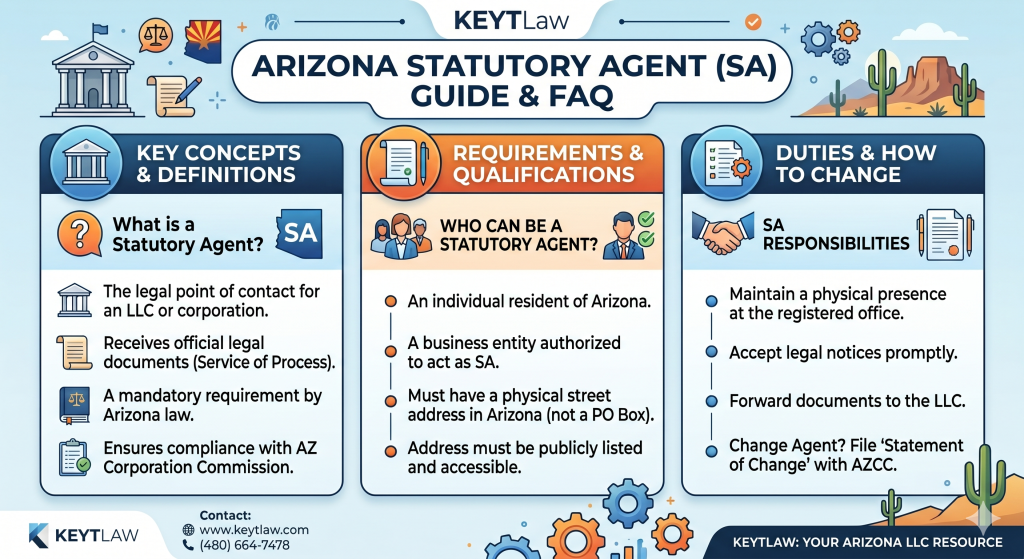
A statutory agent is the person or entity that an Arizona LLC officially designates to receive service of process (lawsuits), legal notices, and official state correspondence on the LLC's behalf. The name comes from the fact that a statute — Arizona law — requires every LLC to have one.
When a plaintiff files a lawsuit against your LLC, the process server does not have to hunt down the members or managers. The process server delivers the summons and complaint to your statutory agent. Your statutory agent then forwards those documents to the LLC. This gives the court system a reliable, public point of contact for reaching any Arizona LLC.
In other states, the same role is often called a registered agent or resident agent. Those are informal synonyms. In Arizona, “statutory agent” is the official legal term.
Statutory Agent vs. Registered Agent
In Arizona, a Statutory Agent serves the exact same function as what other states call a Registered Agent or Resident Agent. Each term means the same thing, but Arizona law uses the phrase “statutory agent.”
Is a statutory agent required for an Arizona LLC?
Yes, without exception. Arizona Revised Statutes § 29-3115(A) states:
Every domestic Arizona LLC and every foreign (out-of-state) LLC registered to do business in Arizona must designate and continuously maintain a statutory agent. There is no exception for small LLCs, single-member LLCs, or dormant LLCs.
Why does Arizona require every LLC to have a statutory agent?
Arizona requires a statutory agent so that the public, courts, and the Arizona Corporation Commission always have a known, accessible contact point for any LLC doing business in the state. Without a statutory agent requirement, a business owner could form an LLC, conduct business, and become effectively unreachable when someone needs to file a lawsuit or serve official notice. The statutory agent requirement protects the public by guaranteeing that every LLC has a publicly listed person or entity that can accept legal documents on the LLC's behalf.
The Arizona Corporation Commission also uses the statutory agent's address to send official notices to LLCs, including notices about annual reports, administrative actions, and potential dissolution proceedings.
Who Can Be the Statutory Agent
Who can serve as the statutory agent of an Arizona LLC?
Under A.R.S. § 29-3115(B), the statutory agent must be one of the following:
- An adult individual who resides in Arizona and has a physical Arizona street address.
- A domestic corporation formed under Arizona law.
- A foreign corporation authorized to transact business in Arizona.
- A domestic limited liability company formed under Arizona law.
- A foreign limited liability company authorized to transact business in Arizona.
In every case, the statutory agent must maintain a physical place of business or residence in Arizona. A statutory agent cannot have only a P.O. Box address.
Can a member or manager of the LLC be its own statutory agent?
Yes. A member or manager of an Arizona LLC may serve as the LLC's statutory agent, as long as that person is an adult who resides in Arizona and has a valid Arizona street address to list on the public records. This is a common choice for small LLCs with Arizona-based owners.
However, there are significant privacy and practical reasons why many LLC owners choose not to serve as their own statutory agent. See the section below on using a professional statutory agent service.
Can an Arizona LLC name itself as its own statutory agent?
No. An Arizona LLC cannot serve as its own statutory agent. The statutory agent must be a separate person or a separate business entity. This is a firm requirement under Arizona law.
Can an employee of the LLC be the statutory agent?
Yes, an employee of the LLC who is an adult Arizona resident with a physical Arizona address can serve as the LLC's statutory agent. There is no prohibition in Arizona law against naming an employee. However, keep in mind that if that employee leaves the company, you must promptly file a change of statutory agent with the Arizona Corporation Commission to appoint a replacement.
Can an attorney serve as the statutory agent?
Yes. An Arizona-licensed attorney who resides or has a business office in Arizona can serve as the statutory agent of an Arizona LLC. Many LLC owners use their attorney or their attorney's law firm as the statutory agent. KEYTLaw, LLC provides statutory agent services to Arizona LLCs for $99 per year. See the section below for details.
Address Requirements
What address must the statutory agent have?
The statutory agent must have a physical Arizona street address. A.R.S. § 29-3115(B) requires the statutory agent to have a place of business or residence in Arizona. The Arizona Corporation Commission and the courts interpret this requirement to mean a physical street address where someone is actually present and available to accept hand-delivered legal documents during normal business hours.
The following types of addresses are not acceptable for an Arizona LLC's statutory agent:
- Post office boxes (P.O. Boxes)
- Private mailbox services
- Commercial mail receiving agencies (CMRAs)
- UPS Store mailboxes or similar services
Can a member use their home address as the statutory agent's address?
Yes, a member of an Arizona LLC who resides in Arizona may use their home address as the statutory agent's address. However, there are important reasons to think carefully before doing so. The statutory agent's name and address are part of the public record maintained by the Arizona Corporation Commission. Anyone can look up your LLC and find the statutory agent's address. If you use your home address, that address becomes publicly visible and searchable.
In addition, using your home address means process servers may arrive at your home at any hour to serve legal documents, potentially in front of family members, neighbors, or visitors.
Duties of the Statutory Agent
What are the legal duties of an Arizona LLC's statutory agent?
A.R.S. § 29-3115(C) limits the duties of a statutory agent who has complied with Arizona law to exactly three things:
- Forward process, notices, and demands. The statutory agent must forward to the LLC any legal process, notice, or demand that is served on or received by the agent. The agent forwards these documents to the address most recently provided to the agent by the LLC.
- Provide resignation notice. If the statutory agent resigns, the agent must provide the required notice to the LLC at the LLC's most recently provided address.
- Keep information current. The statutory agent must keep the agent's own information current in the LLC's Articles of Organization or, for a foreign LLC, in the foreign registration statement.
Arizona law is precise on this point: these are the only duties imposed on a statutory agent by the Arizona LLC Act. The statutory agent has no duty to advise the LLC on legal matters, no duty to respond to lawsuits on the LLC's behalf, and no duty to manage the LLC's affairs in any way. The role is limited to receiving and forwarding official documents.
Is the statutory agent responsible for responding to a lawsuit served on the LLC?
No. The statutory agent's only responsibility is to receive the legal documents and forward them to the LLC. The statutory agent has no duty or authority to respond to the lawsuit on the LLC's behalf. Once the LLC receives the documents, it is the LLC's responsibility — and that of its attorneys — to respond appropriately and within the required time limits.
This is why it is critical that your statutory agent always has your current mailing address. If the statutory agent forwards a summons and complaint to an outdated address, the LLC may never receive it, miss the response deadline, and face a default judgment.
Appointment and Acceptance
How is a statutory agent appointed when forming an Arizona LLC?
When you file Articles of Organization with the Arizona Corporation Commission to form your LLC, you must include the name and Arizona street address of the LLC's statutory agent. The Articles of Organization become the public record of your LLC's statutory agent.
However, simply naming someone in the Articles of Organization is not sufficient to make the appointment effective. Under A.R.S. § 29-3115(A), unless the statutory agent signed the Articles of Organization itself, the appointment is not effective until the agent or the LLC delivers a record to the Arizona Corporation Commission signed by the agent accepting the appointment.
Must the statutory agent sign a consent to serve?
Yes. Arizona law requires the statutory agent to sign a statement accepting the appointment before the appointment becomes legally effective. The Arizona Corporation Commission provides a Statutory Agent Acceptance form (Form M002) for this purpose, but use of that exact form is not required. Any signed written acceptance of the appointment satisfies the statute.
When forming an LLC through the ACC's eCorp online system, the statutory agent can accept the appointment directly through the eCorp dashboard without a separate paper form.
Changing the Statutory Agent
Can an Arizona LLC change its statutory agent?
Yes. An Arizona LLC may change its statutory agent at any time by filing a Statement of Change (Form L020 for LLCs) with the Arizona Corporation Commission. The filing fee is $5 for standard processing. Expedited processing is available for an additional fee.
The new statutory agent must sign a Statutory Agent Acceptance form, which is filed together with the Statement of Change. The change takes effect when the ACC processes the filing.
How quickly should an LLC change its statutory agent when the current agent is no longer available?
Immediately. An LLC that allows its statutory agent appointment to lapse puts itself at risk of administrative dissolution. Under A.R.S. § 29-3708, the failure to maintain a statutory agent in Arizona for 60 consecutive days is a ground for the ACC to begin administrative dissolution proceedings against the LLC. Dissolution means the LLC loses its legal right to do business and loses the liability protection that its members depend on.
If your statutory agent resigns, moves out of state, dies, or otherwise becomes unavailable, file a Statement of Change with a new statutory agent as quickly as possible.
Can the statutory agent resign?
Yes. Under A.R.S. § 29-3117, a statutory agent may resign by delivering a written statement of resignation to the Arizona Corporation Commission. The resignation must include a copy of the notice sent to the LLC at its most recently provided address. The resignation becomes effective on the 31st day after the ACC receives the statement, or when the LLC appoints a new statutory agent, whichever comes first.
During the gap period after a statutory agent resigns and before a new agent is appointed, the LLC is at risk. The ACC may serve the LLC by sending documents to the LLC's last known principal address, but the LLC should not rely on this as a substitute for having a properly designated statutory agent at all times.
Consequences of Non-Compliance
What happens if an Arizona LLC does not have a statutory agent?
An Arizona LLC that fails to maintain a statutory agent faces serious consequences under Arizona law:
- Administrative dissolution. A.R.S. § 29-3708 authorizes the ACC to administratively dissolve an LLC that fails to maintain a statutory agent in Arizona for 60 consecutive days. Once dissolved, the LLC loses its authority to conduct business in Arizona.
- Loss of liability protection. An administratively dissolved LLC no longer provides its members with the personal liability protection that is the primary reason most people form an LLC in the first place. Members of a dissolved LLC may become personally liable for the LLC's debts and obligations.
- Default judgments. If a plaintiff cannot locate a statutory agent to serve a lawsuit, the court may permit alternative service of process. The LLC could receive a default judgment without ever learning about the lawsuit.
- Title company problems. An LLC with an inactive statutory agent or that has been administratively dissolved will create problems when it tries to buy, sell, or refinance real estate. Title companies run searches and will flag any inactive or dissolved entity.
Important: Never ignore a notice from the Arizona Corporation Commission about your statutory agent. These notices are serious compliance warnings. If you receive one, act immediately to resolve the issue.
Can an administratively dissolved LLC be reinstated?
Yes. An LLC that has been administratively dissolved for failure to maintain a statutory agent can typically be reinstated by filing an Application for Reinstatement with the ACC, paying a $100 reinstatement fee (plus any other outstanding fees and penalties), appointing a new statutory agent, and resolving any other issues that led to dissolution. Once reinstated, the LLC's existence is treated as having continued without interruption as long as rights were not acquired by third parties in reliance on the dissolution.
Reinstatement is available, but it is far better to keep your statutory agent current and avoid dissolution in the first place.
Using a Professional Statutory Agent Service
Why should I use a professional statutory agent service instead of listing myself?
There are several good reasons to use a professional statutory agent service rather than serving as your own statutory agent or naming a family member or employee:
- Privacy. The statutory agent's name and address are part of the public record at the ACC. Anyone can look it up online. If you list your home address, it is permanently accessible to anyone who searches for your LLC. Using a professional service keeps your personal address off the public record.
- Avoiding surprise service of process. Process servers are permitted to show up at the statutory agent's address at any time during business hours to hand-deliver legal documents. If your home is the statutory agent address, a process server may arrive at your front door in front of family members, neighbors, or customers. A professional service absorbs these visits at their office.
- Reliability. A professional statutory agent service is available at its address during all regular business hours and has systems in place to promptly forward documents. If you list yourself or an employee, you must ensure constant availability at the listed address.
- Out-of-state owners. If you live outside Arizona, you are legally required to have an Arizona-based statutory agent anyway. A professional service is the straightforward solution.
- Business address service. Many statutory agent services, including KEYTLaw, also offer a business address service so that the address your company uses on its public filings is the service's office address rather than your home or personal business address.
Does KEYTLaw offer statutory agent services?
Yes. KEYTLaw, LLC provides statutory agent services for Arizona LLCs, corporations, and other entities. Our fees are:
- Statutory Agent Service: $99 per year
- Known Address (Business Address) Service: $100 per year
When you use KEYTLaw as your statutory agent, any legal process, official notices, or other documents served on or sent to KEYTLaw on behalf of your LLC will be promptly forwarded to you. Our office is located at 7373 E. Doubletree Ranch Road, Suite 135, Scottsdale, Arizona 85258.
To hire KEYTLaw to serve as your statutory agent, complete our Statutory Agent Questionnaire.
Foreign LLCs Doing Business in Arizona
Does a foreign LLC doing business in Arizona also need a statutory agent?
Yes. A.R.S. § 29-3115(A) requires every registered foreign limited liability company to designate and maintain a statutory agent in Arizona. If your LLC was formed in another state but is registered to do business in Arizona, you must have an Arizona statutory agent just as a domestic Arizona LLC does. All of the same rules regarding who can serve, address requirements, and duties apply.
If your out-of-state LLC is doing business in Arizona but has not yet registered with the ACC, you should consult with an Arizona LLC attorney about your registration obligations. Operating without proper registration can result in fines and the inability to sue in Arizona courts to enforce contracts.
Practical Tips for Arizona LLC Owners
What should every Arizona LLC owner know about keeping their statutory agent information current?
Here are the most important practical steps for maintaining statutory agent compliance:
- Always keep the ACC informed of your current statutory agent. If you change agents, file a Statement of Change promptly. The $5 filing fee is a small price to maintain your LLC's good standing.
- Keep your statutory agent informed of your current mailing address. Your agent can only forward documents to the address you have provided. If you move and do not update your agent, critical legal documents could be lost.
- Never ignore correspondence from your statutory agent. If your agent forwards documents to you, treat them as urgent. Missing a lawsuit deadline by even one day can result in a default judgment against your LLC.
- Verify your statutory agent information annually. Check the ACC's eCorp system once a year to confirm that your statutory agent's name and address are current and accurate.
- Plan ahead when using a person as the statutory agent. If you use an individual — even yourself — as the statutory agent, plan for what happens if that person moves out of Arizona, becomes unavailable, or passes away. A professional service eliminates this continuity risk.
Need to Form an Arizona LLC or Change Your Statutory Agent?
Richard Keyt and his son Richard C. Keyt have formed over 10,000 Arizona LLCs. We offer full LLC formation packages and statutory agent services.
Call: 480-664-7478 • azllc.com
We want to form your Arizona LLC or PLLC
- To get free answers to your LLC questions call Arizona LLC attorneys Richard Keyt (480-664-7478 & rk@keytlaw.com) or his son Richard C. Keyt (480-664-7472 & rck@keytlaw.com).
- 60+ articles about Forming & Operating Arizona LLCs
- Book a free office, phone or Zoom video meeting to get answers to your LLC questions
- See the contents & prices of our 3 LLC formation packages
- Submit our LLC formation questionnaire to hire us to form your AZ LLC today
See the Contents of Our Estate Plan
To protect your most valuable assets—your loved ones— read our article that describes the 36 documents and services you will get if you hire us to prepare your comprehensive estate plan with a revocable living trust or watch our video about the documents and services.
Questions? Book a free meeting or call or email one of our Arizona estate planning attorneys. We don't charge to talk to people.
Call, email or text Richard Keyt, father
Direct phone: 480-664-7478
Email: rk@keytlaw.com
Call, email or text Richard C. Keyt, son
Direct phone: 480-664-7472
Email: rck@keytlaw.com