
Arizona Crypto Estate Planning & Inheritance FAQs
Written by Richard Keyt & Richard C. Keyt | Arizona Wills & Trusts Attorneys. Richard Keyt (practicing law in Arizona since 1979) and his son, former CPA Richard C. Keyt are Arizona attorneys who have prepared more than 1,000 Arizona estate plans. They have over 433-star reviews on Google, Facebook, and Birdeye. The Keyts offer a no-obligation, free initial consultation. Call Rick at 480-664-7478 or Ricky at 480-664-7472 or book a free office, phone, or Zoom video consultation.
Crypto FAQ Summary
Cryptocurrency owners face a unique estate planning challenge: if your heirs cannot locate your private keys or seed phrase after your death, your Bitcoin, Ethereum, or other digital assets are gone forever — no court, no bank, and no government agency can recover them. Arizona estate planning attorneys Richard Keyt and Richard C. Keyt answer the most important questions about how to pass cryptocurrency to your heirs, including how to store seed phrases and private keys securely, how self-custody and exchange-held crypto are treated differently, why a revocable living trust is the best legal vehicle for digital assets, what a memorandum of instructions should contain, how the federal step-up in tax basis works for inherited crypto, and the most common mistakes that cause families to lose digital wealth permanently at death.
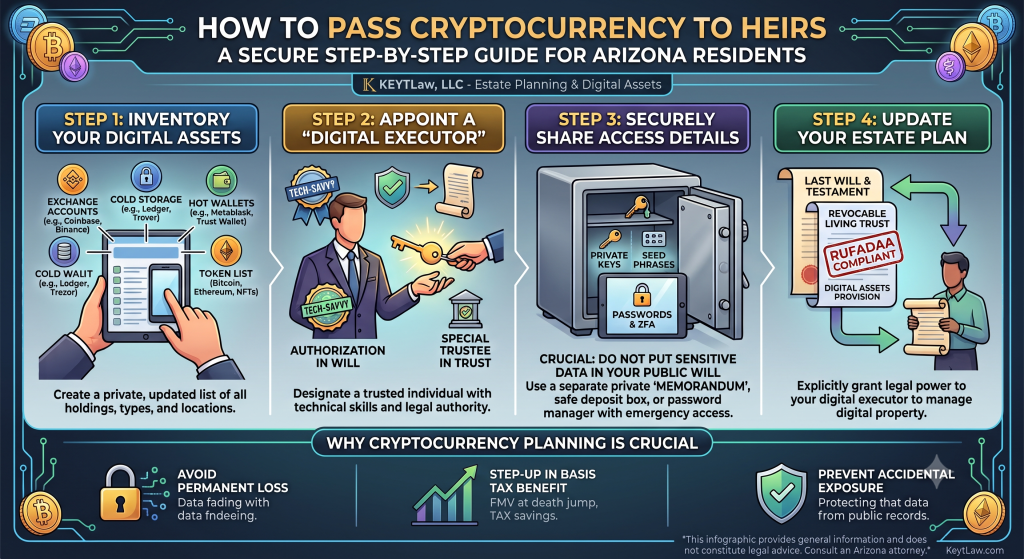
Protecting Your Digital Wealth: The Ultimate FAQ on Passing Cryptocurrency to Your Family
Frequently Asked Questions: Passing Cryptocurrency to Your Heirs
Why is cryptocurrency different from other assets when it comes to estate planning?
Traditional assets like bank accounts, brokerage accounts, and real estate are held by institutions or recorded in public registries. When you die, your heirs can contact the institution, present a death certificate and legal authority (such as letters testamentary or a trust certification), and the institution will transfer the assets. Cryptocurrency is fundamentally different. It is controlled by whoever possesses the private key or seed phrase associated with a wallet. There is no institution to call. There is no customer service department. There is no government override. If your heirs do not have the private key or seed phrase, your cryptocurrency is permanently and irrecoverably lost — forever. This unique characteristic makes proper estate planning for cryptocurrency not just advisable but critically necessary.
What is a private key and why does it matter for estate planning?
A private key is a cryptographic string of characters — essentially a very long password — that proves ownership of and gives control over the cryptocurrency in a wallet. Anyone who possesses your private key can access, move, or spend every coin in that wallet. For estate planning purposes, your private key is the equivalent of the combination to a safe that holds all of your cryptocurrency. If your heirs do not have this key after your death, they cannot access your crypto. If the wrong person gets the key while you are alive, they can steal everything instantly. The private key must be protected with the same seriousness as a combination to your most important safe — but it must also be accessible to the right people at the right time.
What is a seed phrase and how does it relate to my private keys?
A seed phrase (also called a recovery phrase or mnemonic phrase) is typically a sequence of 12, 18, or 24 ordinary English words generated by your cryptocurrency wallet when you first set it up. This sequence of words mathematically encodes your private keys and can be used to restore your entire wallet — including every account within it — on any compatible device. For estate planning purposes, the seed phrase is usually more important than any individual private key because a single seed phrase can recover all of the accounts in a hierarchical deterministic (HD) wallet. Your seed phrase must be recorded, stored securely, and made accessible to your trusted heirs or successor trustee after your death. It should never be stored only in digital form. It should be written on paper, stamped on metal, or stored in a secure physical location, and kept separate from the hardware wallet device itself.
What happens to my cryptocurrency if I die without leaving instructions for my heirs?
Your cryptocurrency will almost certainly be lost permanently. Your heirs may know you owned crypto. They may find your hardware wallet device or know the name of an exchange you used. But without the private key or seed phrase for self-custody wallets, or without your login credentials and access to any required two-factor authentication device for exchange accounts, they will be unable to access the assets. Courts cannot compel a blockchain to transfer assets. Police cannot seize crypto without a private key. Even the most sophisticated crypto recovery specialists rarely succeed without significant portions of the key material. The result is that assets worth thousands, hundreds of thousands, or even millions of dollars simply cease to exist for practical purposes at your death. This is one of the most common and most tragic errors in modern estate planning.
What is the difference between self-custody cryptocurrency and exchange-held cryptocurrency?
Self-custody cryptocurrency is held in a wallet that you control directly — meaning you hold the private keys. Examples include hardware wallets (physical devices like Ledger or Trezor), software wallets installed on your computer or phone, and paper wallets. With self-custody, only you (and whoever you share your keys with) controls the crypto. Exchange-held cryptocurrency is crypto that sits in an account at a centralized exchange such as Coinbase, Kraken, Gemini, or Binance. The exchange holds the private keys on your behalf, similar to how a brokerage holds your stocks. Both types require different estate planning approaches. Exchange-held crypto is generally easier for heirs to access because the exchange has a customer service process and account recovery procedures. Self-custody crypto requires that heirs have the private key or seed phrase.
How can my heirs access cryptocurrency I hold at an exchange like Coinbase after I die?
Major cryptocurrency exchanges have established procedures for transferring accounts to heirs or estates following the death of an account holder. The process typically requires your heirs or estate representative to submit a death certificate, government-issued identification, and legal documentation establishing authority to act — such as a court order appointing an executor, letters testamentary, or a trust certification if the account was held in trust. The exchange will then either transfer the crypto to an account designated by the estate or liquidate the holdings and send the proceeds. The specific requirements vary by exchange, so your estate planning documents should ideally reference which exchanges you use and the account information needed to initiate the claim process. Your executor or trustee will need to know the exchange name, your account username or email address, and any relevant account identification. They will not need your password — the exchange's recovery process does not require it — but they will need legal authority and the identifying information to locate the account.
How can my heirs access self-custody cryptocurrency — such as crypto on a hardware wallet — after I die?
For self-custody crypto, your heirs need either the private key itself or the seed phrase that generates it. Without one of these, access is impossible regardless of legal authority. Your estate plan must include a secure method for conveying this information to the right person at the right time. There are several approaches. You can write the seed phrase on paper or engrave it on metal and store it in a fireproof safe, a bank safe deposit box, or with your estate planning attorney. You can include it in a sealed envelope that is part of your estate planning documents. You can use a multi-signature arrangement where multiple trusted people must cooperate to access the wallet. You can also use a specialized crypto inheritance service. Whatever method you choose, the key information must be findable and usable by your heirs but not accessible to unauthorized persons during your lifetime. Simply texting the seed phrase to a family member or keeping it in an unencrypted note on your phone are not adequate solutions — the former creates theft risk, the latter creates loss risk.
Should I include my cryptocurrency in my revocable living trust?
Yes, in most cases a revocable living trust is the best legal vehicle for holding and passing cryptocurrency to your heirs. A well-drafted trust avoids the delays and costs of probate, allows your successor trustee to take control of assets quickly after your death, and can include detailed instructions about managing, valuing, and distributing digital assets. For exchange-held crypto, you can either transfer the account into the name of the trust (some exchanges allow this) or simply designate your trust as the beneficiary of the account. For self-custody crypto, the trust should contain clear written instructions — often in a separate memorandum — describing how to locate and use the seed phrase or private key. Arizona law expressly recognizes digital assets in trust administration under the Revised Uniform Fiduciary Access to Digital Assets Act, which gives your trustee legal authority to access your digital asset accounts.
What should a cryptocurrency memorandum of instructions contain?
A memorandum of instructions is a separate, private document — not filed with any court — that accompanies your trust or will and provides your successor trustee or executor with the practical information needed to manage your digital assets. For cryptocurrency, this memorandum should include a complete inventory of every cryptocurrency holding, identifying the type of crypto (Bitcoin, Ethereum, etc.), the approximate quantity, and whether it is self-custody or exchange-held. For exchange accounts, it should include the exchange name, the email address or username associated with the account, and where to find any saved two-factor authentication backup codes. For self-custody wallets, it should describe the type of wallet (hardware device, software wallet, paper wallet), the location of the physical device if applicable, and clear instructions for locating and using the seed phrase. The memorandum should be updated every time you acquire new crypto, move assets to a different wallet, or change exchange accounts. Because this document contains extraordinarily sensitive information, it must be stored with the same physical security as the seed phrase itself.
Can I designate a beneficiary for my cryptocurrency accounts the way I can with a retirement account or life insurance policy?
Some cryptocurrency exchanges allow you to designate a beneficiary, but the availability and legal effect of this feature varies significantly by exchange and by state. Coinbase, for example, offers a beneficiary designation feature for accounts in certain states. Where a valid beneficiary designation is in place and legally effective, the crypto can transfer directly to the designated beneficiary outside of probate, similar to a payable-on-death bank account. However, you should not rely solely on a beneficiary designation without verifying that your chosen exchange offers this feature, that the designation is legally valid under Arizona law, and that the beneficiary designation is coordinated with your overall estate plan. A beneficiary designation that conflicts with your trust or will can create complications. Your estate planning attorney should review any beneficiary designation as part of a comprehensive plan.
What is a multi-signature wallet and should I use one for estate planning?
A multi-signature (multisig) wallet requires a minimum number of private keys — out of a larger total — to authorize any transaction. For example, a 2-of-3 multisig wallet has three private keys and requires any two of them to approve a transfer. This structure has significant estate planning advantages. You can hold one key yourself, give a second key to your attorney or estate planning trustee in a sealed envelope to be opened only at your death or incapacity, and give a third key to a trusted family member. No single person can steal the assets during your lifetime because one key alone is insufficient, but your heirs can cooperate to access the funds after your death. Multisig arrangements are technically more complex to set up than a standard wallet, and they require that all key holders understand their role. However, for large cryptocurrency holdings, the security and estate planning benefits may justify the complexity. An attorney familiar with digital asset planning can help you structure a multisig arrangement appropriately.
What are the federal and Arizona income tax consequences when my heirs receive cryptocurrency?
Under current federal law, cryptocurrency inherited at death receives a step-up in tax basis to its fair market value on the date of death, exactly like stocks or real estate. This means your heirs do not owe income tax on the appreciation that occurred during your lifetime. If your heirs later sell the inherited crypto for more than its stepped-up value, only the gain above the stepped-up basis is taxable as a capital gain — and because the holding period for inherited assets is automatically treated as long-term, the favorable long-term capital gains tax rate applies. Arizona conforms to federal income tax treatment of capital gains, so the same favorable treatment applies for state income tax purposes. The step-up in basis can represent an enormous tax benefit for heirs of appreciated crypto. For example, if you purchased Bitcoin for $10,000 and it is worth $200,000 at your death, your heirs receive a $200,000 basis and owe no income tax on the $190,000 of gain that accrued during your lifetime. Federal estate tax may also apply if your total estate (including crypto) exceeds the federal estate tax exemption amount, which is $15,000,000 for people who die in 2026. This value increases each year based on inflation. Your estate planning attorney can help you evaluate whether estate tax planning is appropriate given the size of your crypto holdings.
What are the biggest mistakes cryptocurrency owners make in estate planning?
The most common and most serious mistake is failing to create any estate plan at all for cryptocurrency, leaving heirs with no way to locate or access the assets. A close second is storing the seed phrase only in digital form — on a computer, in a password manager, or in cloud storage — without any physical backup, so that if the digital storage is unavailable at death, the crypto is lost. Third is failing to tell a trusted person that cryptocurrency exists and roughly where to find the access information, so heirs do not even know to look. Fourth is storing the seed phrase in the same location as the hardware wallet device, so that a fire, flood, or theft destroys both simultaneously. Fifth is failing to update the memorandum of instructions when acquiring new crypto or moving assets to different wallets. Sixth is assuming a will alone is sufficient — a will must go through probate before a court grants authority to an executor, which takes months, during which time volatile crypto markets can dramatically affect value. A revocable living trust avoids this problem by granting the successor trustee immediate authority.
Do I need an Arizona estate planning attorney to plan for passing cryptocurrency to my heirs, or can I handle this myself?
You can take meaningful steps on your own — creating a memorandum of instructions, ensuring your seed phrase is physically recorded and securely stored, and informing a trusted person of your holdings. These steps are better than nothing and should be done immediately regardless of whether you have consulted an attorney. However, the legal framework surrounding your crypto — the trust or will that governs how it passes, the fiduciary authority granted to your trustee or executor, the coordination with beneficiary designations and other assets, and the tax planning considerations — requires a properly drafted legal document. A poorly drafted trust that does not address digital assets, or a will that must go through probate at a time of market volatility, can undermine even the most careful technical preparations. An Arizona estate planning attorney who understands digital assets can ensure that the legal structure and the practical access plan work together to protect your cryptocurrency and your heirs.
Protect Your Cryptocurrency and Your Loved Ones
Arizona estate planning attorneys Richard Keyt and his son, attorney and CPA Richard C. Keyt, have decades of combined experience helping Arizona families create estate plans that protect all of their assets — including cryptocurrency and other digital assets. If you own Bitcoin, Ethereum, or any other cryptocurrency and have not yet addressed it in your estate plan, we encourage you to contact us today. Every day without a plan is a day your digital assets are at risk of permanent loss.
Protect Your Most Valuable Assets — Your Loved Ones — & Get Peace of Mind
We invite you to schedule a free consultation with Richard Keyt or Richard C. Keyt to discuss your estate plan, including your cryptocurrency and digital asset holdings. We will help you create a plan that ensures your heirs can access and inherit everything you have worked to build.
Richard Keyt
Phone: 480-664-7478
Email: rk@keytlaw.com
Richard C. Keyt
Phone: 480-664-7472
Email: rck@keytlaw.com
Schedule a Free Office, Phone or Zoom Consultation
See the Contents of Our Estate Plan
To protect your most valuable assets—your loved ones— read our article that describes the 36 documents and services you will get if you hire us to prepare your comprehensive estate plan with a revocable living trust or watch our video about the documents and services.
Call, email or text Richard Keyt, father
Direct phone: 480-664-7478
Email: rk@keytlaw.com
Call, email or text Richard C. Keyt, son
Direct phone: 480-664-7472
Email: rck@keytlaw.com