
Arizona Certification of Trust
Frequently Asked Questions
By Richard Keyt and Richard C. Keyt, Arizona Estate Planning Attorneys
Richard Keyt (Rick, the father at 480-664-7478) and his son, former CPA Richard C. Keyt (Ricky at 480-664-7472), are Arizona wills, trusts and estate planning attorneys. They have 314 5-star Google reviews and 432 5-star Google, Facebook & Birdeye reviews. They want to prepare a custom estate plan for Arizona residents that protects their most valuable assets – their loved ones. Call, email, or book a free office, phone or Zoom video meeting.
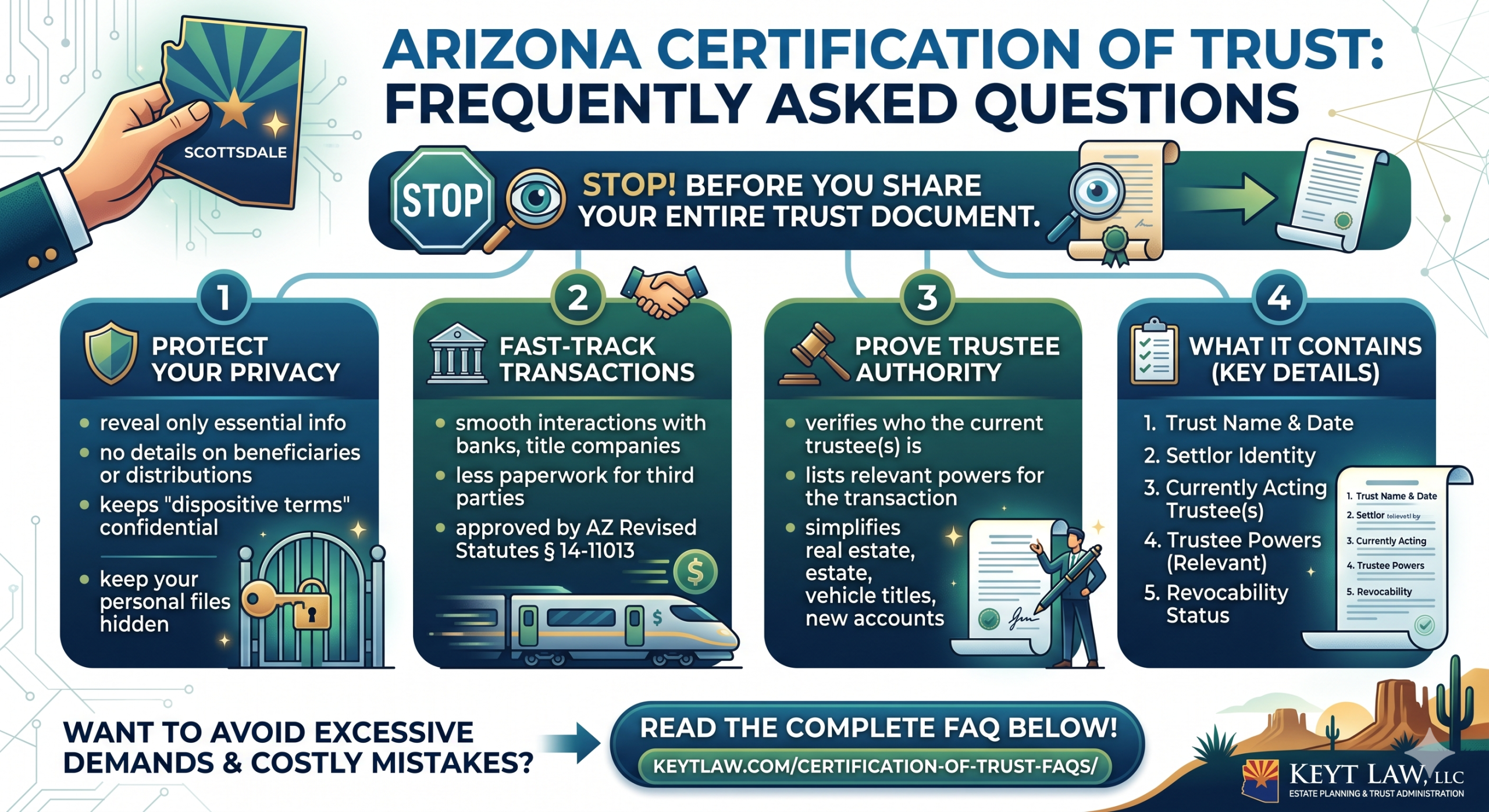
If you have a revocable living trust in Arizona, you will likely need to use a certification of trust at some point — when opening a bank or brokerage account in the name of your trust, refinancing your home, or completing a real estate transaction. Despite how important this document is, most trust owners have never heard of it until someone asks for it. This article answers the most frequently asked questions about Arizona certifications of trust.
Arizona Certification of Trusts Explained
1. What is a certification of trust?
A certification of trust is a short legal document that proves your trust exists and that you, as trustee, have the authority to act on behalf of the trust — without revealing the private details contained in your full trust agreement. Think of it as a “trust ID card.” It tells banks, title companies, brokers, and other third parties everything they need to know to do business with your trust, while keeping your beneficiaries, the amounts they will receive, and other sensitive personal information completely private.
2. What is the Arizona law that governs certifications of trust?
The governing statute is Arizona Revised Statutes § 14-11013, which is part of the Arizona Trust Code. Under this statute, instead of handing over a full copy of your trust agreement to a third party, you — as trustee — may instead provide a certification of trust that contains specific information about the trust.
3. What information must an Arizona certification of trust contain?
Under A.R.S. § 14-11013(A), a valid Arizona certification of trust must contain the following information:
- That the trust exists and the date the trust instrument was executed
- The identity of the settlor (the person who created the trust)
- The identity and address of the currently acting trustee
- The powers of the trustee
- Whether the trust is revocable or irrevocable, and the identity of any person holding a power to revoke the trust
- If there are co-trustees, whether all or less than all are required to exercise the trustee’s powers
- The manner in which title to trust property is to be taken
4. What is NOT required to be in a certification of trust?
This is the most important feature of the document. Under A.R.S. § 14-11013(D), a certification of trust does not need to contain the “dispositive terms” of the trust. The dispositive terms are the provisions that say who gets what when you die. That means the names of your beneficiaries, the percentage shares they receive, the conditions they must meet to inherit, and other sensitive provisions remain completely private and do not have to be disclosed to banks, title companies, or anyone else conducting business with the trust.
5. Why is privacy important when it comes to my trust?
One of the main reasons people create a revocable living trust instead of relying only on a will is privacy. A will goes through probate — a public court process — so everything in your will, including who you left your assets to and in what amounts, becomes a public record that anyone can look up. A trust avoids probate and stays private. The certification of trust preserves that privacy by allowing you to prove your trust’s existence and your authority as trustee without exposing your beneficiaries or your estate plan to the public.
6. Who signs an Arizona certification of trust?
Under A.R.S. § 14-11013(B), a certification of trust may be signed (or otherwise authenticated) by any trustee. If you and your spouse are co-trustees of your joint trust, either one of you can sign the certification.
7. Does the certification have to say the trust has not been changed?
Yes. Under A.R.S. § 14-11013(C), the certification of trust must include a statement that the trust has not been revoked, modified, or amended in any way that would make the statements in the certification incorrect. This gives the third party receiving the certification confidence that it accurately reflects the current state of the trust.
8. When will I need to use a certification of trust?
You will most commonly need a certification of trust in the following situations:
- Opening a bank or credit union account in the name of your trust
- Opening a brokerage or investment account in the name of your trust
- Buying or selling real estate held in the name of your trust
- Refinancing a mortgage on real property held in trust
- Transferring a vehicle title to your trust
- Conducting any financial transaction where a third party needs to verify your authority as trustee
Basically, any time you do business “as trustee” and the other party wants proof that you actually have the authority to act, you present the certification of trust.
9. Can a bank or title company demand to see my full trust agreement instead of accepting the certification?
Under A.R.S. § 14-11013(E), a recipient of a certification of trust acting in good faith may ask you to provide excerpts from the trust that designate you as trustee and confirm your power to act in the specific transaction at hand — but that is all they are permitted to ask for under normal circumstances. They cannot demand excerpts that contain the dispositive terms (who gets what) or provisions naming successor trustees unless they first provide you with a verified written statement explaining a reasonable basis for the request. This is a strong protection for your privacy.
10. What happens if a bank or title company improperly demands more than they are entitled to?
Arizona law has teeth on this issue. Under A.R.S. § 14-11013(H), if a person demands the full trust instrument or excerpts beyond what they are legally entitled to, and a court determines they did not act in good faith or did not comply with the statute, that person (or institution) can be held liable for damages, costs, expenses, and attorney fees. This means that banks, title companies, and brokers that unlawfully insist on seeing your full trust agreement can be financially penalized for doing so.
11. If a bank or title company relies on a certification of trust that turns out to have errors, are they protected?
Yes. Under A.R.S. § 14-11013(F), a person who acts in good faith reliance on a certification of trust — without actual knowledge that the information in it is incorrect — is not liable to anyone for doing so. They can assume everything in the certification is true. Additionally, under A.R.S. § 14-11013(G), a person who enters into a transaction in good faith reliance on a certification of trust may enforce the transaction against the trust property as if every representation in the certification were correct. This gives financial institutions and other third parties comfort in accepting certifications of trust.
12. Who is liable if a certification of trust contains false information?
The trustee who signs and delivers the certification of trust is the one who is liable for any false statements in it. The certification is a legal document signed under penalty of perjury, and the trustee is certifying that all of the information it contains is accurate and that the trust has not been revoked or amended in any way that makes the certification incorrect. Do not sign a certification of trust that contains any information you know to be inaccurate.
13. Does the certification of trust need to be notarized?
Arizona law does not specifically require a certification of trust to be notarized for it to be legally effective under A.R.S. § 14-11013. However, many banks, title companies, and recording offices require notarization as a matter of their own internal policies. As a practical matter, you should have your certification of trust notarized so it will be accepted in any transaction without dispute.
14. Does a certification of trust need to be recorded?
A certification of trust generally does not need to be recorded with the county recorder unless it is being used in connection with a real estate transaction or is being attached to or referenced in a recorded deed. In Arizona real estate transactions, a certification of trust may be recorded or submitted to the title company to confirm the trustee’s authority to sell, buy, or mortgage real property held in trust.
15. Does a certification of trust expire?
Arizona law does not set a specific expiration date for a certification of trust. However, if you amend your trust, change trustees, or make any change that would affect the accuracy of the information in the certification, you should prepare a new certification of trust. Many banks and title companies also prefer to receive a “fresh” certification of trust that was signed recently, rather than one that is several years old, even if the trust has not been changed. As a practical matter, it is a good idea to update your certification whenever you update your trust.
16. Does a certification of trust replace the full trust agreement?
No. The certification of trust is not a substitute for the full trust agreement. The trust agreement is the document that actually governs how your trust operates, names your beneficiaries, controls distributions, and dictates what happens to your assets when you die. The certification of trust is only a summary document used to prove the trust’s existence and the trustee’s authority when dealing with third parties. Both documents are important parts of your estate plan.
17. Can I use a certification of trust for an irrevocable trust?
Yes. The certification of trust requirements under A.R.S. § 14-11013 apply to all trusts — both revocable and irrevocable. The certification is simply required to accurately state whether the trust is revocable or irrevocable and identify any person who holds a power to revoke it.
18. Who prepares the certification of trust — the trustee or an attorney?
Although a trustee can technically prepare a certification of trust without an attorney, you should have your estate planning attorney prepare it. The certification is a legal document that must contain specific information required by Arizona law, must accurately describe the powers of the trustee, and must be worded carefully to be accepted by banks, title companies, and other institutions. An improperly prepared certification can cause delays in transactions, or worse, expose you to liability if it contains incorrect information.
At KEYTLaw, when we prepare your revocable living trust, we also prepare a certification of trust as part of your estate plan package. If you need a new or updated certification of trust after your trust has been amended, we can prepare one for you.
19. Do I need a separate certification of trust for every transaction?
Not necessarily, though some institutions will request an original or recently signed certification for each new transaction. In practice, you may use the same certification of trust for multiple transactions as long as it remains accurate. Once your trust is amended or any information in the certification changes, you need a new one.
20. What if I lost my certification of trust?
If you have lost your certification of trust, your estate planning attorney can prepare a new one for you. The new certification should accurately reflect the current state of your trust at the time it is signed.
Do You Need a Certification of Trust or a New Trust?
If you already have an Arizona revocable living trust and need a certification of trust prepared, or if you are ready to create a new trust and comprehensive estate plan, Arizona estate planning attorneys Richard Keyt (480-664-7478) and his son Richard C. Keyt (480-664-7472) are here to help. We have prepared estate plans for hundreds of Arizona families and can make the process simple, fast, and stress-free. Call us, email us, or book a free office, phone, or Zoom meeting today.
See our full article on Arizona Certification of Trust Keeps Your Estate Plan Private for additional information.
See the Contents of Our Estate Plan
To protect your most valuable assets—your loved ones— read our article that describes the 36 documents and services you will get if you hire us to prepare your comprehensive estate plan with a revocable living trust or watch this video about the documents and services. Our estate plans include a Certification of Trust.