
Arizona Certification of Trust
Keeps Your Estate Plan Private
By Richard Keyt and Richard C. Keyt, Arizona Estate Planning Attorneys
Richard Keyt (Rick, the father at 480-664-7478) and his son, former CPA Richard C. Keyt (Ricky at 480-664-7472), are Arizona estate planning attorneys with 316 5-star Google reviews and 433 5-star Google, Facebook & Birdeye reviews. They want to prepare a custom estate plan for Arizona residents that protects their most valuable assets – their loved ones. Call, email, or book a free office, phone or Zoom video meeting.
Our 5-Star Reviews
What Is a Certification of Trust — and Why Every Arizona Trustee Needs One
If you have a revocable living trust, a certification of trust is one of the most practical documents you can have. Here is what it is, when you will use it, and why not having one can create real problems.
You have done the right thing. You created a revocable living trust, transferred your assets into it, and thought your estate planning was complete. Then you try to open a bank account, refinance your home, or sell a piece of real estate — and the institution asks for a copy of your trust. That is when Arizona's certification of trust becomes invaluable.
What Is a Certification of Trust?
A certification of trust — sometimes called a certificate of trust or abstract of trust — is a short, legally recognized document that summarizes the key facts about your trust without revealing its private contents. Think of it as your trust's official identification card.
Instead of handing over your entire trust agreement — a document that may contain detailed provisions about who gets what, conditions on distributions, and your family's most sensitive financial information — you present the certification. It gives third parties exactly what they need to verify that your trust is real, that you are authorized to act as trustee, and that the transaction at hand falls within your authority.
That statute is critical. It means that once a bank, title company, or other institution accepts your certification of trust in good faith, they are legally protected — which is precisely why they are willing to accept it in the first place.
What Information Does a Certification of Trust Contain?
Under A.R.S. § 14-11013, a certification of trust must contain specific information to be legally sufficient in Arizona. A properly drafted certification will include all of the following:
- The existence of the trust and the date it was created
- The identity of the settlor (the person who created the trust)
- The identity and address of the currently acting trustee or co-trustees
- The powers of the trustee relevant to the transaction at hand
- The revocability or irrevocability of the trust, and who holds the power to revoke it
- When there are co-trustees, whether all must act together or one may act alone
- The trust's taxpayer identification number (for irrevocable trusts)
- The legal name in which trust property is to be held
- A statement that the trust has not been revoked, modified, or amended in any way that would affect the representations in the certification
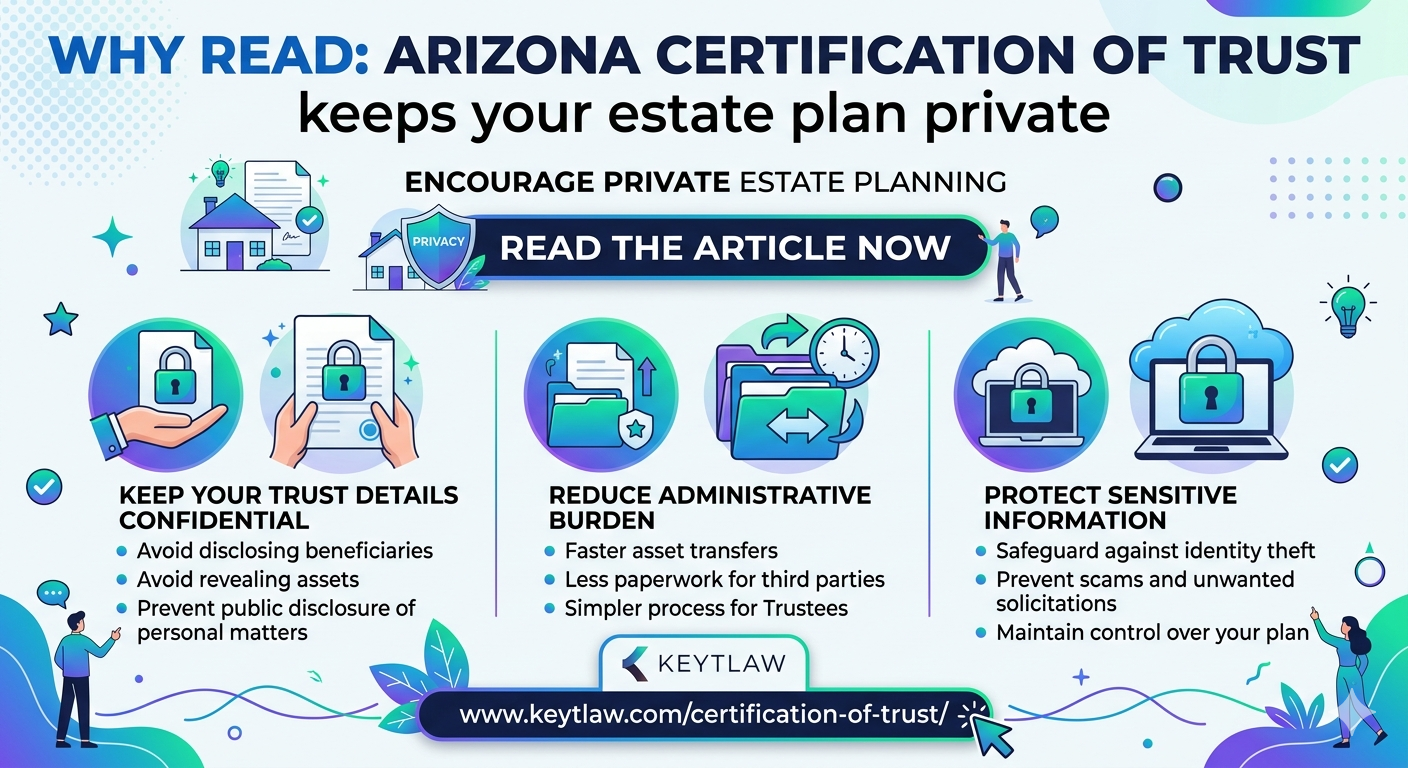
Critically, a certification of trust does not disclose the names of your beneficiaries, the distribution provisions of the trust, the value of trust assets, or any of the personal instructions you have left for your trustee. Your family's financial privacy remains protected.
When Will You Actually Use a Certification of Trust?
The certification of trust is not a document you file away and forget. It is a working document that you — or your successor trustee — will present regularly throughout the life of the trust. Here are the most common situations where it is needed:
🏦 Opening Bank & Investment Accounts
Financial institutions require proof that the trust exists and that the trustee has authority to open and manage the account. Banks will typically accept a certification rather than demanding the full trust document.
🏠 Real Estate Transactions
When buying, selling, or refinancing property held in a trust, the title company and lender will require documentation establishing the trustee's authority. A certification of trust is the standard way to satisfy this requirement in Arizona.
📈 Brokerage & Retirement Accounts
Transferring investment accounts into trust, or opening new accounts in the trust's name, requires the brokerage firm to confirm the trust's legal existence and the trustee's investment authority.
🚗 Transferring Vehicles & Personal Property
Registering a vehicle or transferring ownership of valuable personal property (boats, aircraft, collector items) in the name of the trust will require documentation of the trustee's authority.
🏢 Business Interests & LLCs
When a trust holds membership interests in a limited liability company or shares of a corporation, a certification may be required by other members or when the entity engages in transactions.
⚖️ After the Trustor's Death
When the trustor dies and a successor trustee takes over, institutions will need confirmation of the successor trustee's authority. The certification — updated if necessary — is how that authority is established.
Why Not Just Provide a Copy of the Full Trust?
Many Arizona residents assume they can simply hand over a copy of their trust agreement whenever an institution asks for documentation. Technically, you can — but there are compelling reasons not to.
Your Trust is a Private Document
Your revocable living trust contains a complete roadmap of your wealth and your wishes: who your beneficiaries are, what they will receive, at what age, under what conditions, and who will manage things if you become incapacitated or die. That information is deeply personal. Once you hand a copy to a bank, title company, or escrow officer, it becomes part of their file — potentially accessible to employees, clerks, and anyone who requests records.
It Creates Unnecessary Risk
Full trust documents are long, complex, and sometimes ambiguous to people who are not experienced in trust law. Sharing the full document invites misreading, misinterpretation, and unnecessary questions. A well-drafted certification of trust removes all ambiguity and gives the institution exactly what it needs — nothing more.
Institutions May Retain the Document
Financial institutions and title companies often keep copies of documents provided to them. Your complete trust agreement, with all its private provisions, may end up permanently in multiple companies' files. A certification preserves your privacy while still satisfying every legal requirement the institution has.
What Happens Without a Certification of Trust?
Failing to have a certification of trust prepared does not make your trust invalid. But it does create practical problems — sometimes at the worst possible moments.
- Delays in real estate closings. Title companies often will not close on a property held in trust without proper documentation. If a certification is not already prepared, you may be scrambling to have one drafted during a transaction.
- Banks refuse to open accounts. Financial institutions have compliance departments that will simply decline to open a trust account without the required documentation.
- Successor trustees cannot act. When you die or become incapacitated and your successor trustee steps in, they may face resistance from every institution they approach without a properly prepared certification of trust in hand.
- Privacy is unnecessarily sacrificed. Without a certification, your only option is to share the complete trust — giving away information that should remain confidential.
- Probate may not be avoided. If a successor trustee cannot access trust assets promptly due to documentation problems, beneficiaries may be forced to seek court intervention — undermining one of the primary purposes of having a trust in the first place.
Certification of Trust vs. The Full Trust Agreement: A Comparison
| Feature | Full Trust Agreement | Certification of Trust |
|---|---|---|
| Length | 20–60+ pages (typical) | 2–4 pages |
| Reveals beneficiaries | Yes — in detail | No — information omitted |
| Reveals distribution terms | Yes | No |
| Confirms trustee authority | Yes | Yes |
| Accepted by Arizona institutions | Yes | Yes (A.R.S. § 14-11013) |
| Protects your privacy | No | Yes |
| Notarized | Typically yes | Yes — notarization required |
Does Arizona Law Require Institutions to Accept It?
Yes — with important nuance. Arizona Revised Statutes § 14-11013 explicitly authorizes the use of a certification of trust in lieu of the full trust agreement. Under the statute, a person who relies on a certification of trust and acts in good faith is legally protected.
However, institutions are also permitted to require additional or different information, and may in some cases still request a copy of the relevant portions of the trust. In practice, most Arizona banks, title companies, and financial institutions are very familiar with certifications of trust and routinely accept them. Having a well-drafted, properly notarized certification prepared in advance will satisfy the vast majority of institutions you will encounter.
Who Should Sign the Certification of Trust?
The certification of trust must be signed by the trustee — or, if there are co-trustees, by all acting trustees unless the trust agreement permits fewer to act. It must also be acknowledged before a notary public. Your signature certifies that the statements in the document are true and correct, and the law provides that a trustee who makes a false statement in a certification is personally liable to any person who suffers loss as a result.
This is not a form document you should download from the internet and fill in yourself. An attorney who understands Arizona trust law should prepare it to ensure it is legally sufficient, properly tailored to your trust, and ready to be accepted without question.
When Should You Have a Certification of Trust Prepared?
The answer is simple: at the same time your trust is drafted. Waiting until you need it to scramble for one is an unnecessary problem. A properly prepared certification of trust should be considered a standard companion document to any revocable living trust in Arizona.
You should also have a new certification of trust prepared if:
- Your trust has been amended or restated since the original certification was prepared
- A trustee has changed (original trustee died, resigned, or was replaced by a successor)
- Co-trustees have been added or removed
- The trust was converted from revocable to irrevocable
- An institution specifically requests a certification reflecting current information
The Bottom Line for Arizona Trust Holders
A revocable living trust is one of the most powerful estate planning tools available to Arizona residents. It lets you avoid probate, maintain control of your assets during your lifetime, protect your beneficiaries, and ensure a smooth transition of your estate when you die. But a trust without a certification of trust is an incomplete plan.
Every trustee in Arizona should have a current, properly drafted, notarized certification of trust on hand — ready to present the moment any institution asks for documentation. It protects your privacy, confirms your authority, and ensures that your trust works exactly as you intended when it matters most.
Does Your Trust Include a Certification?
If you already have a revocable living trust in Arizona but have never had a certification of trust prepared — or if your trust has been amended and your certification is out of date — contact KeytLaw. We can review your situation, prepare a legally sufficient certification of trust, and make sure your entire estate plan is complete and ready to work when your family needs it most.
Schedule a ConsultationSee the Contents of Our Estate Plan
To protect your most valuable assets—your loved ones— read our article that describes the 36 documents and services you will get if you hire us to prepare your comprehensive estate plan with a revocable living trust or watch thie video about the documents and services. Our estate plan includes a Certification of Trust.