
Arizona Last Will & Testament
Frequently Asked Questions
By Richard Keyt and Richard C. Keyt, Arizona Estate Planning Attorneys
Richard Keyt (Rick, the father at 480-664-7478) and his son, former CPA Richard C. Keyt (Ricky at 480-664-7472), are Arizona wills, trusts and estate planning attorneys. They have 314 5-star Google reviews and 432 5-star Google, Facebook & Birdeye reviews. They want to prepare a custom estate plan for Arizona residents that protects their most valuable assets – their loved ones. Call, email, or book a free office, phone or Zoom video meeting.
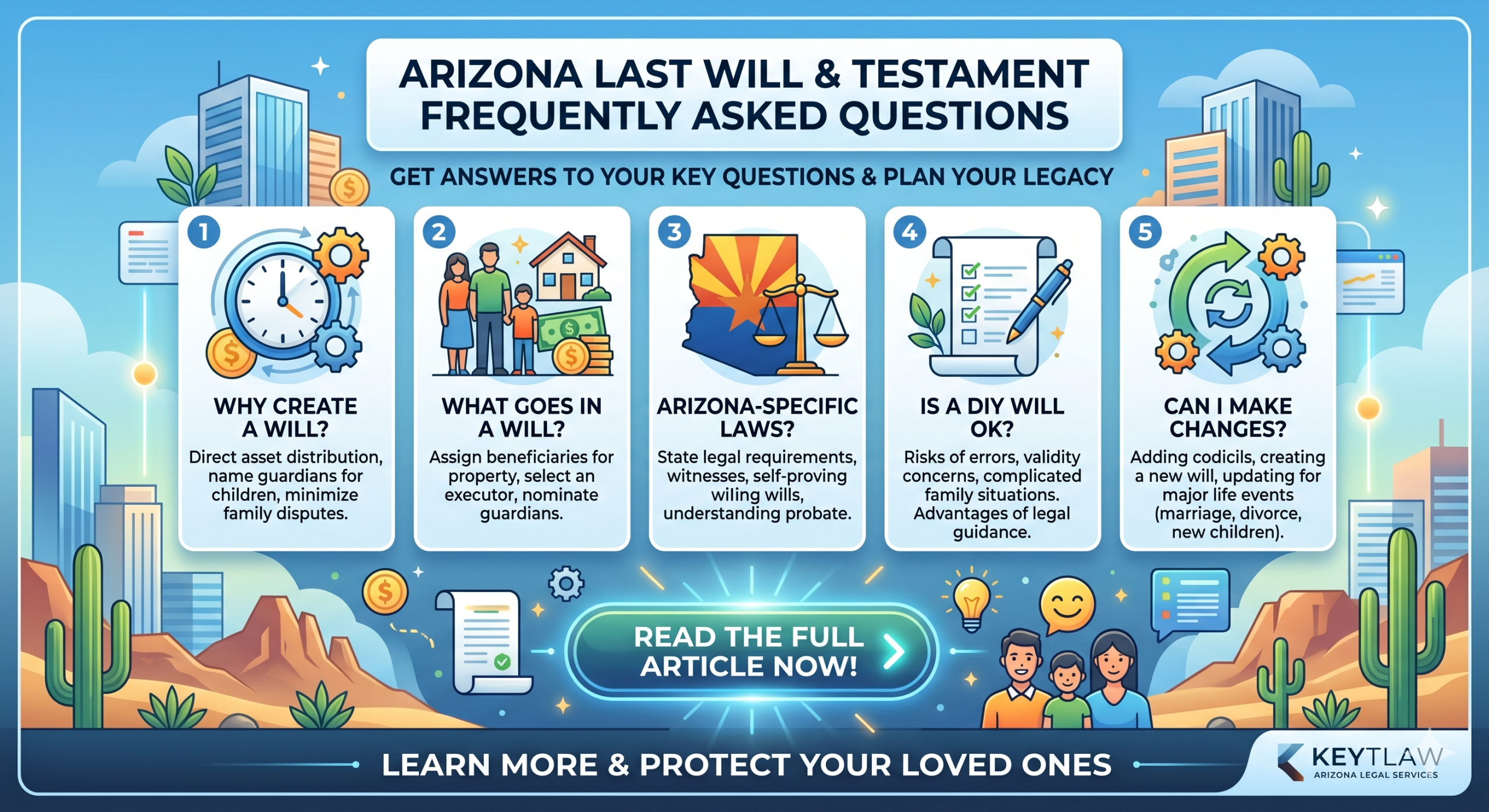
If you’ve been putting off creating a will — or wondering whether you even need one — you’re not alone. These are the questions we hear most often from Arizona residents, answered plainly and honestly. This article describes Arizona law. The law of other states may be different.
Arizona Will FAQs: Everything You
Need to Know to Protect Your Family
1. What is a Last Will & Testament?
A Last Will & Testament — most people just call it a “will” — is a written legal document in which you, the testator (the person making the will), state:
- Who receives your property that remains in your name after you die
- Who will raise your minor children if both parents are gone (called a guardian)
- Who manages and distributes your estate — called your personal representative (what other states call an “executor”)
- Any specific gifts of money, personal property, or real estate you want to leave to individuals or charities
A will only takes effect when you die. It has no legal effect while you are alive.
2. What makes a will legally valid in Arizona?
Under Arizona Revised Statutes Section 14-2502, a valid Arizona will must be:
- In writing
- Signed by you (the testator)
- Witnessed by at least two people who are both present and signing at the same time
Arizona also permits holographic wills — wills that are entirely handwritten and signed in your own handwriting, under Arizona Revised Statutes Section 14-2503. However, holographic wills are frequently contested, misinterpreted, or thrown out by courts. A professionally drafted will prepared by an attorney is always the better choice.
3. What happens if I die without a will in Arizona?
If you die without a valid will, you die intestate — and Arizona law takes over completely. The state has a rigid formula for distributing your assets, governed by Arizona Revised Statutes Sections 14-2101 through 14-2114. That formula does not care:
- That you wanted your daughter to have the house
- That you were estranged from a sibling for 30 years
- That your longtime partner — who was never legally married to you — was the most important person in your life
- That you wanted to leave something to your church, a favorite charity, or a scholarship fund
The law doesn’t know you. It distributes your estate to whoever the statute says should receive it. A distant relative you’ve never met could inherit everything you worked your entire life to build, while the people who mattered most to you receive nothing. And if you die with no living relatives at all, your entire estate escheats — meaning the State of Arizona inherits everything you own.
4. Who needs a will?
Every adult Arizona resident who has any of the following needs a will:
- A home or real estate
- Minor children
- A partner or spouse
- Retirement accounts, investment accounts, or a business interest
- Wishes about who should — or should not — inherit from them
A will is not just for the elderly or the wealthy. It is for every adult who has people they love, assets they’ve worked for, or wishes they want honored when they’re gone.
5. What are the real consequences of dying without a will?
Dying without a will causes serious, preventable harm to the people you leave behind:
A stranger picked by an Arizona Superior Court decides who raises your children. Without a will naming a guardian, a probate judge — someone who has never met your family — decides who will raise your minor children. That judge may select someone with completely different values or parenting philosophies than yours.
Your estate gets stuck in probate court. Even with a will, your estate goes through probate — a public, often lengthy, court-supervised process. Probate can take months or years, and court costs and attorney fees reduce what you leave behind. While probate drags on, your family may have no access to funds for bills, funeral costs, or keeping a business running.
Your unmarried partner inherits nothing. Arizona does not recognize common-law marriage. If you have lived with a partner for years — even decades — but were never legally married, that person has zero automatic inheritance rights under Arizona law. Your partner could be forced out of the home you shared while your relatives receive everything.
Estranged relatives could receive your estate. Arizona intestacy law distributes assets based on family relationships alone, not the quality of those relationships. A parent, sibling, or cousin you haven’t spoken to in years could inherit simply because the statute says so.
Your heirs’ inheritance is left unprotected. Even if your assets reach the right people, without proper planning an heir’s inheritance can be seized by their creditors, lost in a divorce, or wiped out in a bankruptcy proceeding.
Family conflict tears your loved ones apart. No plan means no clear direction. No clear direction means disagreements. Disagreements during grief become permanent rifts. Families have been destroyed by battles that erupted when a loved one died without a will.
6. Doesn’t my spouse automatically get everything when I die?
This is one of the most dangerous myths in estate planning. In blended families, in situations involving children from prior relationships, or with separate property, Arizona’s intestacy laws can produce results that are shocking — and completely contrary to your wishes. Never assume your spouse automatically inherits everything. A proper estate plan removes all doubt.
7. I have beneficiary designations on my accounts. Isn’t that enough?
No. Beneficiary designations only cover specific accounts — typically retirement accounts and life insurance policies. They do not govern your home, your personal property, your business interests, or your debts. They also do not protect your beneficiaries from creditors, divorcing spouses, or bankruptcy courts. Relying solely on beneficiary designations leaves major gaps in your plan.
8. I’m young and healthy. Do I really need a will now?
Yes. Tragedies do not wait until your affairs are in order. People of every age die unexpectedly. An estate plan also does much more than direct who gets your assets when you die — it designates who raises your minor children, who manages your finances if you become incapacitated, and who makes your medical decisions. Those issues affect young, healthy adults just as much as anyone else. The time to plan is when you are healthy and thinking clearly, not after a crisis forces the issue.
9. Is a will alone a complete estate plan?
No — and this is something most Arizona residents don’t know. Even with a valid will, your estate will still go through an expensive, time-consuming public Superior court probate. A will is a set of instructions to a probate judge — it does not avoid probate. It simply tells the court what to do after it gets involved.
Probate is public, slow, and expensive. Anyone can look up your probate case — your assets, your debts, and who received what all become a matter of public record. A simple uncontested probate at KEYTLaw starts at $5,000.
10. What does a complete Arizona estate plan look like?
The cornerstone of proper Arizona estate planning is a Revocable Living Trust. When your assets are held in a properly funded trust, they pass directly to your beneficiaries after your death — completely outside of probate court. No court. No delays. No public record. No unnecessary expense.
The most comprehensive estate plans also protect your beneficiaries by placing their inheritance inside an irrevocable asset-protected trust. This means that what you leave your children or other loved ones cannot be seized by their creditors, cannot be taken by a divorcing spouse, and cannot be swept away in a bankruptcy proceeding. Your hard-earned legacy stays in the family — exactly where you intended it to go.
A complete KEYTLaw estate plan includes all of the following:
- Revocable Living Trust
- Certification of Trust
- Last Will & Testament
- Healthcare Power of Attorney
- HIPAA Authorization
- Financial Power of Attorney
- Living Will (Advance Directive)
- Deed transferring your home to the trust
- Designation of Guardian for Minor Children
- Assignment of Personal Property to the Trust
- Personal Property Memorandum (lets you gift specific personal property to named individuals — and can be updated without changing the trust)
11. What is joint tenancy, and is it a substitute for an estate plan?
Joint tenancy is a form of property ownership where two or more people own property together with a right of survivorship — meaning when one owner dies, the surviving owner automatically receives the deceased owner’s share. While joint tenancy does avoid probate for that specific asset, it is not a substitute for a full estate plan. It only covers jointly held assets, creates no protection for beneficiaries, and can have unintended tax and creditor consequences. It also does nothing for your healthcare decisions or financial management if you become incapacitated.
12. How do I get started?
Call, email, or book a free office, phone, or Zoom consultation with Richard Keyt (rhe father at 480-664-7478) or Richard C. Keyt (the son at 480-664-7472). We don’t charge to talk to people about wills, trusts and estate planning. We serve clients in Scottsdale, Paradise Valley, Phoenix, Mesa, Tempe, Chandler, Queen Creek, and throughout Arizona.
You can also read about the 36 documents and services in our custom estate plan at keytlaw.com/ep-contents.
You have worked too hard and loved too much to leave your legacy to chance. Let’s make sure it is protected.
See the Contents of Our Estate Plan
To protect your most valuable assets—your loved ones— read our article that describes the 36 documents and services you will get if you hire us to prepare your comprehensive estate plan with a revocable living trust or watch thie video about the documents and services.