
Arizona Financial Power of Attorney
Frequently Asked Questions
By Richard Keyt and Richard C. Keyt, Arizona Estate Planning Attorneys
Richard Keyt (Rick, the father at 480-664-7478) and his son, former CPA Richard C. Keyt (Ricky at 480-664-7472), are Arizona wills, trusts and estate planning attorneys. They have 316 5-star Google reviews and 433 5-star Google, Facebook & Birdeye reviews. They want to prepare a custom estate plan for Arizona residents that protects their most valuable assets – their loved ones. Call, email, or book a free office, phone or Zoom video meeting.
A financial power of attorney is one of the most important documents any Arizona adult can sign — and one of the least understood. Below, we answer more than 30 of the most common questions we get from Arizona clients and families about Financial Powers of Attorney.
Arizona Financial Power of Attorney
Frequently Asked Questions
The Basics
Q 1. What is an Arizona financial power of attorney?
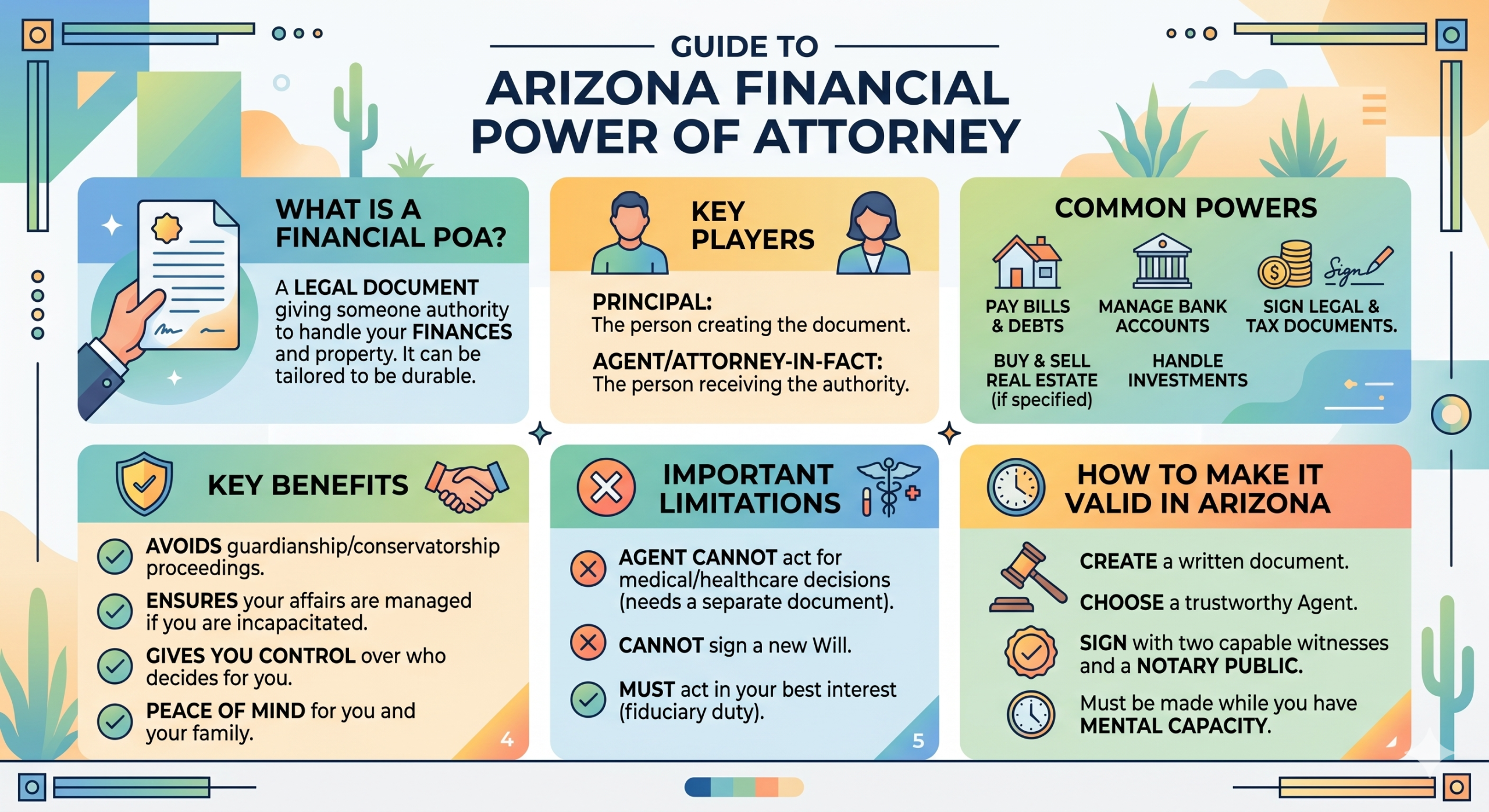
An Arizona financial power of attorney (also called a durable power of attorney for finances, or DPOA) is a legal document in which you — the principal — authorize one or more trusted people to manage your financial affairs on your behalf. The person you authorize is called your agent (or attorney-in-fact). The agent can pay your bills, manage your bank accounts, file your tax returns, manage real estate, and handle dozens of other financial tasks — either immediately upon signing or only if you become incapacitated, depending on how the document is drafted.
Q 2. What does “durable” mean?
The word durable means the power of attorney stays valid even if you later become mentally incapacitated. That is the whole point. A non-durable power of attorney automatically expires the moment you can no longer make decisions for yourself — exactly when you need it most. In Arizona, under A.R.S. § 14-5502, a power of attorney is presumed durable unless the document specifically states otherwise. Always make sure your document states it is durable.
Q 3. Is a financial power of attorney the same as a healthcare power of attorney?
No. These are two separate documents. A financial power of attorney covers your financial and business affairs. A healthcare power of attorney (also called a healthcare proxy or durable power of attorney for healthcare) covers medical decisions — who can speak with your doctors, consent to surgery, or make end-of-life choices. Every complete Arizona estate plan should include both. At KEYTLaw, every estate plan we prepare includes both a financial power of attorney and a healthcare power of attorney.
Q 4. Is a financial power of attorney the same as a will?
No — they serve completely different purposes at completely different times. A financial power of attorney operates while you are alive. The moment you die, it expires instantly. A will (or a revocable living trust) takes over at death and governs how your assets are distributed. You need both. Neither one alone is a complete plan.
Q 5. Does a financial power of attorney replace a trust?
No. A revocable living trust and a financial power of attorney serve different functions. A trust owns and manages assets during your lifetime and passes them to beneficiaries at death without probate.
A financial power of attorney covers assets that are not in your trust, manages tasks like filing your taxes, and handles financial matters in general. A complete Arizona estate plan includes both — a trust as the foundational document plus a financial power of attorney as a critical companion document.
Arizona Law & Requirements
Q 6. What law governs financial powers of attorney in Arizona?
Arizona adopted the Uniform Power of Attorney Act, codified at Arizona Revised Statutes Sections 14-5501 through 14-5602. This law governs the creation of powers of attorney, the duties of agents, the authority that can be granted, and the revocation of the document. Arizona’s version includes important consumer protections that were not in older Arizona law, including stronger rules about agent accountability.
Q 7. What are the formal requirements for a valid Arizona financial power of attorney?
Under Arizona law, a financial power of attorney must be: (1) in writing; (2) signed by the principal — that is, you — while you have mental capacity; and (3) acknowledged before a notary public. Witnesses are not required under Arizona law for a financial power of attorney (unlike some other states), but some financial institutions prefer or require witnesses anyway. The document does not need to be filed with any court or government office to be valid.
Q 8. What mental capacity is required to sign a financial power of attorney?
You must have legal mental capacity at the time you sign the document. In general, this means you understand what a power of attorney is, who you are naming as your agent, what authority you are granting, and the general nature of your assets and relationships. You do not need to have perfect memory or full cognitive ability — but you must understand the basic nature and consequences of the document you are signing.
Q 9. Does a financial power of attorney need to be recorded with the county recorder?
Generally, no — the document is valid without recording. However, if your agent will be handling real estate transactions on your behalf (buying, selling, mortgaging, or transferring property), it is strongly advisable to record a copy of the power of attorney with the county recorder in the county where the property is located. Most title companies and lenders require a recorded copy before they will allow an agent to act on real estate transactions.
Q 10. Can I use a fill-in-the-blank or online power of attorney form I found on the internet?
We strongly advise against it. Many online forms are either from other states (and may not comply with Arizona law), are out of date, use vague language that financial institutions will reject, or omit critical powers your agent will need. A document that is technically defective or that your bank refuses to honor is worthless — often discovered at the worst possible moment. The cost of having an experienced Arizona estate planning attorney draft this document correctly is small compared to the cost and chaos of having it fail when your family needs it.
What Your Agent Can (and Cannot) Do
Q 11. What financial powers can I give my agent in an Arizona DPOA?
A well-drafted Arizona financial power of attorney can authorize your agent to handle virtually every financial task in your life, including:
- Pay bills and living expenses
- Manage bank, brokerage, and investment accounts
- File federal and state income tax returns
- Buy, sell, mortgage, or manage real estate
- Operate your business interests and LLCs
- Apply for and collect government benefits (Social Security, Medicare, VA benefits)
- Make gifts on your behalf (subject to limits)
- Manage retirement accounts and IRAs
- Handle insurance policies and claims
- Settle debts and negotiate with creditors
- Access safe deposit boxes
- Manage digital assets, online accounts, and cryptocurrency
- Fund or manage your revocable living trust
The scope of authority is entirely up to you. You can grant broad, general powers or limit your agent to specific tasks only.
Q 12. Are there things my agent cannot do under an Arizona DPOA?
Yes. Even with a broad financial power of attorney, your agent generally cannot: (1) make or change your will; (2) vote in elections on your behalf; (3) make decisions about your personal care, housing, or medical treatment (those require a healthcare power of attorney or guardianship); (4) act in ways that violate the fiduciary duty to act in your best interests; or (5) make gifts to themselves beyond what you have specifically authorized in the document.
Q 13. Can my agent make gifts to family members or to themselves?
Only if the document specifically authorizes it — and it must do so clearly. Under Arizona’s Uniform Power of Attorney Act, the authority to make gifts (including self-gifts by the agent) is a “hot power” that requires explicit authorization in the document. Without that specific grant of authority, gifts are not permitted. This is an important protection against financial elder abuse. If you want your agent to be able to make annual exclusion gifts to your children or grandchildren for estate planning purposes, we can include that authority in your document.
Q 14. What are “hot powers” under Arizona law?
Arizona law requires that certain unusually significant powers be explicitly granted in the document rather than being implied by general language. These “hot powers” include: making gifts, creating or amending trusts, modifying beneficiary designations, delegating authority to another agent, waiving the principal’s right to be a beneficiary of a joint tenancy, and exercising fiduciary powers if the principal holds a fiduciary role. If you want your agent to have any of these powers, your attorney must include specific language in the document granting them.
Q 15. Can my agent change my beneficiary designations on my life insurance or retirement accounts?
Only if the document specifically authorizes it — this is one of the “hot powers” under Arizona law. Because changing a beneficiary designation can dramatically affect who inherits your estate, Arizona law requires explicit authorization. If Medicaid planning or other important reasons make this power important for your situation, we can include it in your DPOA.
Choosing Your Agent
Q 16. Who should I name as my agent?
This is the most important decision you will make in drafting a financial power of attorney. Your agent will have access to your bank accounts, real estate, investments, and potentially your business. Name someone who is: (1) completely trustworthy with your financial life; (2) financially responsible and organized; (3) willing and able to serve — acting as an agent takes real time and effort; (4) geographically accessible, ideally local; and (5) someone who understands your values and financial goals. Commonly named agents include a spouse, an adult child, a sibling, a close friend, or a professional fiduciary.
Q 17. Can I name more than one agent?
Yes. You can name co-agents (who must act together or can act independently, depending on how you draft the document) or you can name a primary agent and one or more successor agents who step in only if the primary agent is unable or unwilling to serve. I generally recommend naming a primary agent and at least one successor agent. Co-agents can create logistical complications if they must act jointly, so discuss this with your attorney before choosing that structure.
Q 18. What duties does my agent owe me under Arizona law?
Your agent owes you a fiduciary duty — the highest duty of loyalty and care that Arizona law recognizes. Specifically, your agent must: act in your best interests; act in accordance with your known wishes and values; keep your assets separate from their own; keep records of all transactions; avoid conflicts of interest; and not use your assets for their own benefit unless specifically authorized. An agent who violates these duties can be held personally liable for losses.
Q 20. What if I cannot find anyone I fully trust to be my agent?
If you have no family member or close friend you fully trust, you can name a professional fiduciary. Arizona licenses professional fiduciaries who are bonded, regulated by the state, and required to act in your best interests. This is particularly common for single individuals without close family, or for those whose family members have conflicts of interest. I can refer you to reputable Arizona professional fiduciaries.
Immediate vs. Springing Powers of Attorney
Q 21. What is the difference between an “immediate” and a “springing” DPOA?
An immediate DPOA takes effect the moment you sign it. Your agent can act on your behalf right away, even while you are fully capable. An springing DPOA “springs” into effect only when you become incapacitated, as certified by one or more licensed physicians. Many clients feel more comfortable with a springing DPOA because it limits the agent’s authority until it’s actually needed. However, the springing mechanism can cause practical delays at exactly the worst moment — when your family is trying to act urgently and physicians must be contacted for certifications.
Q 22. Which type of DPOA do you recommend — immediate or springing?
Most experienced Arizona estate planning attorneys, including myself, recommend the immediate DPOA paired with a trustworthy agent. Here is why: the springing mechanism adds procedural complexity at precisely the moment your family needs to act quickly. By the time physicians certify incapacity and the document is activated, critical financial decisions may already be overdue. If you genuinely trust your agent — and you should, because they have enormous authority — the immediate DPOA is the more practical choice.
Banks, Financial Institutions & Third Parties
Q 23. Will banks and financial institutions honor an Arizona financial power of attorney?
Generally, yes — Arizona law provides strong protections for third parties who rely on a properly executed power of attorney in good faith. However, some financial institutions have their own internal policies and may initially push back, ask for additional documentation, or request that the document be recorded. A well-drafted document by an experienced Arizona estate planning attorney will meet all of the statutory requirements and most institutional requirements. Using an online form increases the risk of rejection.
Q 24. Can a bank or institution refuse to honor my power of attorney?
Under Arizona law, a person who refuses to accept an acknowledged power of attorney can be ordered by a court to honor it and can be held liable for attorney fees and damages. However, there are limited exceptions: an institution may refuse if (1) the document is defective on its face, (2) the institution has actual knowledge of fraud, (3) the institution has actual knowledge of the principal’s death or revocation, or (4) the document was more than a certain number of years old and the institution has policies around aging documents. If a bank refuses your agent’s proper request, consulting an attorney quickly is advisable.
Q 25. Can my agent access my IRA or 401(k) using a financial power of attorney?
Retirement accounts are governed by federal law and plan documents, and many IRA custodians and 401(k) plan administrators have their own requirements for accepting powers of attorney — including the requirement to complete the institution’s own power of attorney form, or to show specific language in the document authorizing retirement account management. This should be discussed in detail with your estate planning attorney when drafting your DPOA, and you should notify your retirement account custodians in advance about your agent.
Revoking and Terminating a DPOA
Q 26. Can I revoke a financial power of attorney?
Yes — as long as you have mental capacity, you can revoke a financial power of attorney at any time, for any reason or no reason at all. A revocation should be done in writing and delivered to your agent and to any financial institution or third party who has received a copy of the original document. If the original DPOA was recorded with the county recorder, the revocation should also be recorded.
Q 27. Does a financial power of attorney automatically expire?
A durable financial power of attorney does not expire on its own — it remains valid until you revoke it, you die, or a court revokes it. Some documents include a stated expiration date, but most properly drafted Arizona DPOAs do not. Importantly, the DPOA terminates automatically at your death — at that point, your will or trust takes over.
Q 28. Does divorce automatically revoke a financial power of attorney naming my spouse as agent?
Yes. Under Arizona law, if you named your spouse as your agent and you later divorce (or have your marriage annulled), the authority granted to your former spouse is automatically revoked as of the date the divorce or annulment is finalized. However, it is still a best practice to formally revoke the old document and create a new one naming a different agent after a divorce — do not rely solely on the automatic statutory revocation.
Q 29. What happens if my agent dies or becomes incapacitated?
If your primary agent dies, becomes incapacitated, or resigns and you have not named a successor agent, your DPOA may be rendered ineffective. This is one reason I always recommend naming at least one successor agent in the document — someone who steps in automatically if your primary agent is unable to serve. Review your document regularly and update it when life circumstances change.
What Happens if I Don't Have a FPOA?
Q 30. What happens if I become incapacitated without a financial power of attorney?
Without a DPOA, Arizona law provides only one remedy: a court-supervised conservatorship proceeding in Arizona Superior Court. A conservatorship is the court process by which a judge appoints someone to manage your financial affairs. This process typically takes three to six months (or longer), costs $5,000 to $15,000 or more in legal fees, requires ongoing annual court accountings, and makes your financial details part of a public court record. And all of that burden falls on your family during an already devastating period of their lives.
Q 31. Can my spouse manage our joint accounts without a power of attorney?
Your spouse can generally manage accounts titled jointly with right of survivorship. But many accounts are titled in only one spouse’s name — particularly investment accounts, retirement accounts, and business accounts. Also, your spouse cannot make decisions about accounts, real estate, or business interests that are solely in your name without legal authority. A financial power of attorney provides that authority clearly and without the need for court involvement.
Q 32. My adult child is over age 17. Do I have legal authority over their finances?
No. Once your child turns 18 in Arizona, they are a legal adult. You have zero legal authority over their finances, their medical care, or any other aspect of their life — even as their parent. If your adult child is in an accident or becomes seriously ill, you cannot access their bank account, pay their rent, or manage their student loans without a power of attorney. Every adult child — at college, just starting their career, or living at home — should have a financial power of attorney naming a parent or trusted person as agent.
Q 33. I’m young and healthy. Do I really need a financial power of attorney now?
Yes — and arguably more urgently than older people realize. Car accidents, sports injuries, brain injuries, and sudden serious illness do not discriminate by age. Young, healthy adults are among the most exposed to this risk because they typically have no estate plan at all. The three scenarios I see most often in younger clients: a 28-year-old in a coma whose parents can’t pay their rent; a 32-year-old business owner hospitalized with no one authorized to sign contracts; and a 25-year-old college student whose parents find out they have no legal authority at all. A financial power of attorney is not just for the elderly — it is for every adult.
The KEYTLaw Estate Plan
Q 34. Is a financial power of attorney included in a KEYTLaw estate plan?
Yes. Every KEYTLaw estate plan includes a durable financial power of attorney as a standard component — along with a revocable living trust, certification of trust, healthcare power of attorney, HIPAA authorization, living will (advance directive), a deed transferring your home to your trust, designation of guardian for minor children, assignment of personal property to the trust, and a personal property memorandum. We prepare all of these documents together as a coordinated, complete estate plan — because each document serves a specific purpose and they are designed to work together.
Q 35. Can I hire KEYTLaw to prepare just a financial power of attorney?
Yes. If you already have an estate plan but are missing a financial power of attorney, or if you need to update an existing document, we can prepare a standalone financial power of attorney for you. That said, I always encourage clients to review their entire estate plan at the same time — because if your DPOA needs updating, it is very likely that other documents do too. Call or book a free consultation and I will review your situation at no charge.
Q 36. Do you offer free consultations about financial powers of attorney?
Yes. We do not charge to speak with people. You can book a free office, phone, or Zoom video meeting with me at keytlaw.com/calendar, or call me directly at 480-664-7478, or call my Arizona estate planning attorney son Ricky at 480-664-7472. We serve clients throughout Arizona, including Scottsdale, Paradise Valley, Phoenix, Mesa, Tempe, Chandler, and Queen Creek — and we can meet by Zoom with Arizona residents anywhere in the state.
Q 37. How long does it take to prepare an Arizona financial power of attorney?
For a standalone financial power of attorney, we typically complete the document within a few business days of receiving your information and payment. If you are having us prepare a complete estate plan that includes a DPOA, the process usually takes one to two weeks from the time we receive your completed questionnaire. We work efficiently because we understand that estate planning should not take months to complete.
See the Contents of Our Estate Plan
To protect your most valuable assets—your loved ones— read our article that describes the 36 documents and services you will get if you hire us to prepare your comprehensive estate plan with a revocable living trust or watch thie video about the documents and services.