
FAQ: Can a Child Under 18 Own an
Interest in an Arizona LLC?
By Arizona LLC attorneys Richard Keyt (480-664-7478 & rk@keytlaw.com) and his son Richard C. Keyt (480-664-7472 & rck@keytlaw.com). We have formed over 10,000 LLCs and have 432 five-star reviews on Google, Facebook & Birdeye. Book a free office, phone or Zoom consultation.
FAQ Summary
Arizona law sets no minimum age for LLC membership, so a child under 18 can technically hold a membership interest in an Arizona LLC — but direct ownership is legally dangerous. Under A.R.S. § 44-131, minors lack full contractual capacity and may disaffirm any contract, including an LLC operating agreement, at any time before turning 18 or within a reasonable time afterward. That right to disaffirm can unwind the entire ownership arrangement. Banks, title companies, and third parties routinely refuse to deal with a minor member, and a minor cannot sign documents or manage the LLC.
The four practical solutions — ranked from most to least recommended — are:
(1) a revocable living trust, where a trustee holds the membership interest for the minor’s benefit until an age you choose;
(2) an Arizona Uniform Transfers to Minors Act (UTMA) custodianship under A.R.S. §§ 14-7651 through 14-7671, which requires no court involvement and ends when the minor turns 21;
(3) an irrevocable trust such as a Section 2503(c) minor’s trust, which offers greater asset protection and distribution flexibility; and
(4) a court-appointed conservator under A.R.S. § 14-5401, which is expensive, court-supervised, and a last resort.
Regardless of which vehicle is used, the LLC’s operating agreement must be reviewed and likely amended before the transfer is made. Transfers of LLC membership interests to minors also carry gift tax and income tax consequences — including potential application of the “kiddie tax” — that require attention from a tax advisor. Arizona LLC attorneys Richard Keyt and Richard C. Keyt of KEYTLaw in Scottsdale have formed 10,000+ Arizona LLCs and can help you structure LLC ownership for a child or grandchild correctly from the start.
Read our 40+ LLC Frequently Asked Questions Articles.
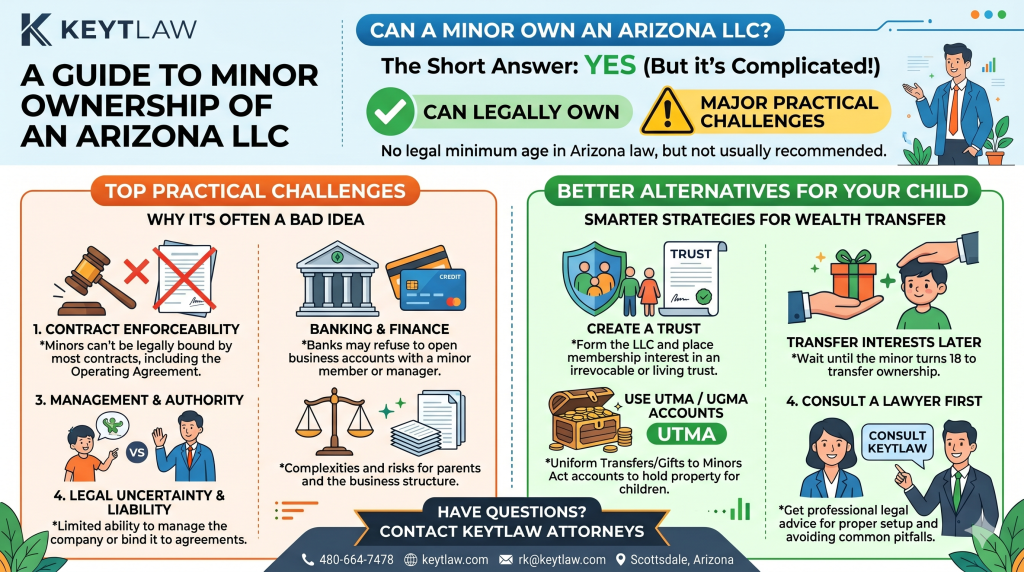
Can a Minor Own an Arizona LLC Membership Interest?
The short answer is yes—Arizona law does not set a minimum age for LLC membership. But legal ownership and practical ownership are two very different things. Read on to learn why direct ownership by a child under 18 creates serious legal risks, and what you should do instead.
Parents and grandparents sometimes want to give a child a piece of a family LLC—perhaps a rental property LLC, a family business entity, or a new business venture. The intention is generous and forward-thinking. The problem is that the law of contracts creates a trap that can unravel the entire arrangement. This article explains exactly what the trap is and gives you four practical ways around it.
The Legal Framework: No Age Requirement in the Arizona LLC Act
The Arizona Limited Liability Company Act (A.R.S. Title 29, Chapter 7) does not establish any minimum age to own a membership interest in an LLC. There is no statute that says “you must be 18 to be a member.” So from a purely technical standpoint, a child can be listed as a member on an operating agreement and on the LLC’s records.
That’s where the good news ends.
The Core Problem: Minors Cannot Enter Binding Contracts
Under Arizona law, persons under the age of 18 lack full legal capacity to enter into binding contracts. A.R.S. § 44-131 establishes that minors may disaffirm—that is, void—their contracts. This single fact creates a cascade of practical problems for any LLC that includes a minor member:
The minor can disaffirm the operating agreement. An LLC operating agreement is a contract. A minor who signs one, or whose parent signs on their behalf, may disaffirm it at any time before turning 18 or within a reasonable time after turning 18. This can unwind the membership arrangement entirely.
The minor cannot sign contracts on behalf of the LLC. If the LLC ever needs the minor member to execute documents—a deed, a loan agreement, a lease, or any other instrument requiring member consent—no third party is legally required to treat that signature as binding.
Banks and title companies will refuse to deal with the minor. Financial institutions and title companies encounter this issue regularly. They will almost universally decline to open accounts, process loans, or handle real estate transactions involving a minor member without a court-appointed conservator or another protective arrangement.
The minor cannot manage the LLC. Even in a member-managed LLC, a minor lacks the legal capacity to act as an agent and bind the company to contracts with third parties.
Important: Do not let the absence of an age requirement in the LLC Act lull you into thinking direct minor ownership is safe. The contractual incapacity problem is real and can surface at the worst possible time—such as when you are trying to sell or refinance a property the LLC owns.
Four Ways to Properly Vest LLC Ownership for a Minor
The solution is to interpose a legal vehicle between the minor and the LLC membership interest. An adult or institution holds and manages the interest for the minor’s benefit until the child reaches adulthood. Here are the four main options, ranked from most commonly recommended to least:
Option 1: Revocable Living Trust Most Flexible
A parent or grandparent’s revocable living trust holds the LLC membership interest, with the minor named as a beneficiary who will receive the interest at a specific age (which you choose—it does not have to be 18). The trustee manages the membership interest during the minor’s childhood.
This is usually the cleanest and most flexible solution because:
The trust can specify exactly when and how the minor receives the membership interest (age 25, age 30, or in stages). The trustee has full legal capacity to vote the membership interest, sign documents, and deal with third parties. The arrangement integrates seamlessly with the family’s overall estate plan. If the minor dies before receiving the interest, the trust can redirect it to other beneficiaries.
A revocable living trust is the vehicle KEYTLaw most commonly recommends for families who want to pass LLC ownership to the next generation.
Option 2: Arizona Uniform Transfers to Minors Act (UTMA) Custodianship Simple & Inexpensive
Under the Arizona Uniform Transfers to Minors Act (A.R.S. §§ 14-7651 through 14-7671), an adult custodian holds the LLC membership interest for the minor’s benefit. No court involvement is required. The custodianship terminates when the minor turns 21 (unless the transfer instrument specifies a younger age, but not younger than 18).
To transfer an LLC membership interest under the Arizona UTMA, the membership interest would be transferred to the custodian with a designation reading substantially as follows:
“[Name of Custodian], as custodian for [Name of Minor] under the Arizona Uniform Transfers to Minors Act”
The custodian has broad powers to manage, invest, and use the custodial property for the minor’s benefit. The downside is that the minor automatically receives the interest at age 21 with no ability to defer—unlike a trust, which lets you control the distribution age.
Arizona UTMA Statute: A.R.S. §§ 14-7651 through 14-7671
The Arizona Uniform Transfers to Minors Act is codified at Arizona Revised Statutes Title 14, Chapter 7, Article 7. The key sections are:
- A.R.S. § 14-7651 – Definitions (including “minor” = person under age 21 for UTMA purposes; “custodian”; “custodial property”)
- A.R.S. § 14-7652 – Scope and jurisdiction (applies when transferor, minor, or custodian is an Arizona resident, or property is in Arizona)
- A.R.S. § 14-7653 – Nomination of custodian
- A.R.S. § 14-7654 – Transfer by gift or exercise of power of appointment
- A.R.S. § 14-7655 – Transfer authorized by will or trust
- A.R.S. § 14-7656 – Other transfer by fiduciary
- A.R.S. § 14-7657 – Transfer by obligor
- A.R.S. § 14-7658 – Receipt for custodial property
- A.R.S. § 14-7659 – Manner of creating custodial property and effecting transfer; designation of initial custodian; control (includes the required transfer form language)
- A.R.S. § 14-7660 – Single custodianship
- A.R.S. § 14-7661 – Validity and effect of transfer
- A.R.S. § 14-7662 – Care of custodial property; duties of custodian
- A.R.S. § 14-7663 – Powers of custodian
- A.R.S. § 14-7664 – Use of custodial property
- A.R.S. § 14-7665 – Custodian’s expenses, compensation and bond
- A.R.S. § 14-7666 – Exemption of third person from liability
- A.R.S. § 14-7667 – Liability to third persons
- A.R.S. § 14-7668 – Renunciation, resignation, death or removal of custodian; designation of successor
- A.R.S. § 14-7669 – Accounting by and determination of liability of custodian
- A.R.S. § 14-7670 – Termination of custodianship
- A.R.S. § 14-7671 – Applicability (validates transfers previously made under the Arizona Uniform Gifts to Minors Act)
→ Read the full text of Arizona Title 14 at the Arizona Legislature’s official website
→ A.R.S. § 14-7651 Definitions (azleg.gov)
→ A.R.S. § 14-7659 Manner of Creating Custodial Property & Transfer Form (azleg.gov)
Important UTMA note for LLC interests: Unlike a bank account, an LLC membership interest is not a standard financial asset. The operating agreement must permit transfers to a custodian, and all other members (if any) must agree. Be sure the LLC’s operating agreement is reviewed before relying on a UTMA custodianship for an LLC membership interest.
Option 3: Irrevocable Trust for the Minor
An irrevocable trust—such as a Section 2503(c) minor’s trust or a discretionary irrevocable trust—holds the LLC membership interest for the minor’s benefit. The trustee manages the interest under the terms of the trust.
Advantages over a UTMA custodianship include the ability to extend the distribution age beyond 21, more sophisticated asset protection for the trust assets, potential gift tax advantages when properly structured, and full trustee control over distributions. An irrevocable trust requires an attorney to draft it and involves more setup cost than a UTMA arrangement, but for significant LLC interests it is often worth the investment.
Option 4: Court-Appointed Conservator Last Resort
Under A.R.S. § 14-5401 et seq., a court can appoint a conservator to hold and manage property on behalf of a minor. The conservator has legal authority to act on the minor’s behalf with respect to the LLC membership interest.
This option is expensive, time-consuming, and requires ongoing court supervision and annual accountings. It should be used only when the minor has already received an LLC membership interest (or other property) without a proper protective arrangement in place and no other option exists. In virtually every planned situation, one of the first three options above is far preferable.
Comparison at a Glance
| Method | Court Involvement | Custodian/Manager | Minor Receives Interest At | Best For |
|---|---|---|---|---|
| Revocable Living Trust | None | Trustee (parent or professional) | Age you specify in the trust | Most families; integrates with estate plan |
| UTMA Custodianship | None | Custodian (parent, relative, or trust company) | Age 21 (or 18 if specified) | Simple, smaller transfers; quick setup |
| Irrevocable Trust | None | Trustee | Age specified in trust (can exceed 21) | Significant assets; gift tax planning; asset protection |
| Court Conservatorship | Required | Court-appointed conservator | Age 18 | Last resort when no plan was in place |
What About the LLC’s Operating Agreement?
Regardless of which protective vehicle you choose, the LLC’s operating agreement must be reviewed and likely amended before adding a minor’s custodian, trustee, or conservator as a member. Most operating agreements contain transfer restrictions that require the consent of existing members before any membership interest can be transferred. The operating agreement should also expressly address how the membership interest will be voted and managed when held by a fiduciary on behalf of a minor.
Failing to update the operating agreement can create disputes among members and potentially invalidate the transfer. This is one of the key reasons to involve an experienced Arizona LLC attorney before implementing any of these strategies.
Tax Considerations
Transferring an LLC membership interest to a minor—directly or through a protective vehicle—has gift tax and income tax consequences that deserve careful attention:
Gift tax. A transfer of an LLC membership interest to a minor (or to a trust or custodian for the minor’s benefit) is generally a taxable gift. The annual gift tax exclusion ($18,000 per donor per recipient in 2024) may cover small transfers, but larger ones will require a gift tax return and may use lifetime exemption. UTMA custodianships and Section 2503(c) trusts have special rules that qualify transfers for the annual exclusion even though the minor cannot access the property immediately.
Income tax. LLC income allocable to the minor’s membership interest will flow through to the minor’s tax return (or, in the case of a trust, to the trust). If the minor has significant unearned income, the “kiddie tax” rules may cause that income to be taxed at the parents’ rate until the child reaches a specified age. Consult a tax advisor before structuring a transfer.
Need Help Structuring LLC Ownership for a Minor?
KEYTLaw attorney Richard Keyt has formed over 10,000 Arizona LLCs and completed 1,000+ estate plans. He can advise you on the right vehicle to hold an LLC membership interest for your child or grandchild—and make sure the operating agreement, trust, or custodian arrangement is properly documented.
Schedule a ConsultationFrequently Asked Questions
No. The Arizona Limited Liability Company Act (A.R.S. Title 29, Chapter 7) does not set a minimum age for LLC membership. A person of any age can technically hold a membership interest. However, persons under 18 lack full legal capacity to enter into binding contracts, which creates significant practical problems for direct ownership by a minor.
Under A.R.S. § 44-131 and related Arizona common law, a minor has the right to void (disaffirm) a contract they entered into while under age 18. Disaffirmance can occur at any time before the minor turns 18, or within a reasonable period after turning 18. An LLC operating agreement is a contract, so a minor member could potentially disaffirm it, unraveling their membership. This is the core reason direct ownership by a minor is risky.
A UTMA custodian is an adult (or trust company) who holds and manages custodial property for a minor under the Arizona Uniform Transfers to Minors Act. Under A.R.S. § 14-7663, the custodian has broad powers over the custodial property, including the power to collect, hold, manage, invest and reinvest it with the care of a prudent investor. For an LLC membership interest, this means the custodian can vote the interest, receive distributions, and act as a member on the minor’s behalf. The custodian must use or apply custodial property for the minor’s benefit under A.R.S. § 14-7664 and must distribute all custodial property to the minor when the custodianship ends.
Under A.R.S. § 14-7670, a UTMA custodianship terminates when the minor turns 21, unless the transfer instrument specifies an earlier age (but not younger than 18). This is one important difference from a trust—a trust can hold assets for the minor well beyond age 21, while a UTMA custodianship cannot. Once the custodianship ends, the custodian must transfer the property to the now-adult former minor outright.
This informal arrangement creates its own problems. If the parent is the legal member but intends the child to be the beneficial owner, there may be gift tax issues, creditor exposure, and questions about who truly owns the interest. More importantly, there is nothing legally documenting the child’s ownership, so the child has no enforceable rights. A properly documented UTMA custodianship or trust is far superior to an undocumented informal arrangement.
Yes. The Arizona UTMA defines “custodial property” broadly to include any interest in property transferred to a custodian, including LLC membership interests. Under A.R.S. § 14-7659, an interest in property that does not fall into a specific enumerated category (such as securities, money, or real property) is transferred to the custodian by a written instrument in the form provided by the statute. An LLC membership interest would be transferred using this general written instrument form, properly designating the recipient as custodian for the minor under the Arizona UTMA.
Almost certainly yes. Most LLC operating agreements restrict membership transfers and require existing member consent. Transferring a membership interest to a UTMA custodian or trust may trigger these restrictions. In addition, the operating agreement should be updated to address how the fiduciary member votes, receives distributions, and participates in major LLC decisions. An Arizona LLC attorney should review and amend the operating agreement before the transfer is made.
A UTMA custodianship is simpler and less expensive to set up, requires no separate legal document beyond a transfer instrument, and is governed entirely by Arizona statute. However, it ends automatically at age 21 and provides limited flexibility in how distributions are made. A trust requires a formal trust document drafted by an attorney but offers far more flexibility—you can specify any distribution age, create conditions on distributions, provide asset protection for the trust assets, and address what happens if the minor dies. For larger or more complex transfers, a trust is usually the better choice.
Call KEYTLaw at 480-664-7478 or schedule a consultation online at keytlaw.com/calendar. KEYTLaw is located at 7373 E. Doubletree Ranch Road, Suite 135, Scottsdale, Arizona 85258. Attorney Richard Keyt has practiced Arizona law since 1979, formed over 10,000 Arizona LLCs, and completed over 1,000 estate plans. His son and law partner Richard C. Keyt (“Ricky”) is also a licensed CPA and can be reached directly at 480-664-7472.
This article was written by Richard Keyt, an Arizona attorney who has practiced law since 1979. Richard has formed over 10,000 Arizona LLCs, completed over 1,000 Arizona estate plans, and is the founder of KEYTLaw, LLC. His son and law partner Richard C. Keyt is also a licensed CPA. KEYTLaw is located at 7373 E. Doubletree Ranch Road, Suite 135, Scottsdale, Arizona 85258. Phone: 480-664-7478.
We want to form your Arizona LLC or PLLC
- To get free answers to your questions call Arizona LLC attorneys Richard Keyt (480-664-7478 & rk@keytlaw.com) or his son Richard C. Keyt (480-664-7472 & rck@keytlaw.com).
- More articles about Forming & Operating Arizona LLCs
- Book a free office, phone or Zoom video meeting to get answers to your LLC questions
- See the contents & prices of our 3 LLC formation packages
- Submit our online formation questionnaire to hire us to form your AZ LLC today
See the Contents of Our Estate Plan
To protect your most valuable assets—your loved ones— read our article that describes the 36 documents and services you will get if you hire us to prepare your comprehensive estate plan with a revocable living trust or watch our video about the documents and services.
Questions? Book a free meeting or call or email one of our Arizona estate planning attorneys. We don't charge to talk to people.
Call, email or text Richard Keyt, father
Direct phone: 480-664-7478
Email: rk@keytlaw.com
Call, email or text Richard C. Keyt, son
Direct phone: 480-664-7472
Email: rck@keytlaw.com