
Arizona Revocable Living Trust
Frequently Asked Questions
By Richard Keyt and Richard C. Keyt, Arizona Estate Planning Attorneys
Richard Keyt (Rick, the father at 480-664-7478) and his son, former CPA Richard C. Keyt (Ricky at 480-664-7472), are Arizona wills, trusts and estate planning attorneys. They have 316 5-star Google reviews and 433 5-star Google, Facebook & Birdeye reviews. They want to prepare a custom estate plan for Arizona residents that protects their most valuable assets – their loved ones. Call, email, or book a free office, phone or Zoom video meeting.
Updated August 14, 2026
After decades of helping Arizona families protect their loved ones, we’ve heard the same questions over and over about revocable living trusts. Good questions. Important questions. The kind that deserve straight answers — not legal jargon.
Here are the most frequently asked questions about revocable living trusts, answered in plain English.
Arizona Living Trust FAQ
Everything You Need to Know
The Basics
1. What is a revocable living trust?
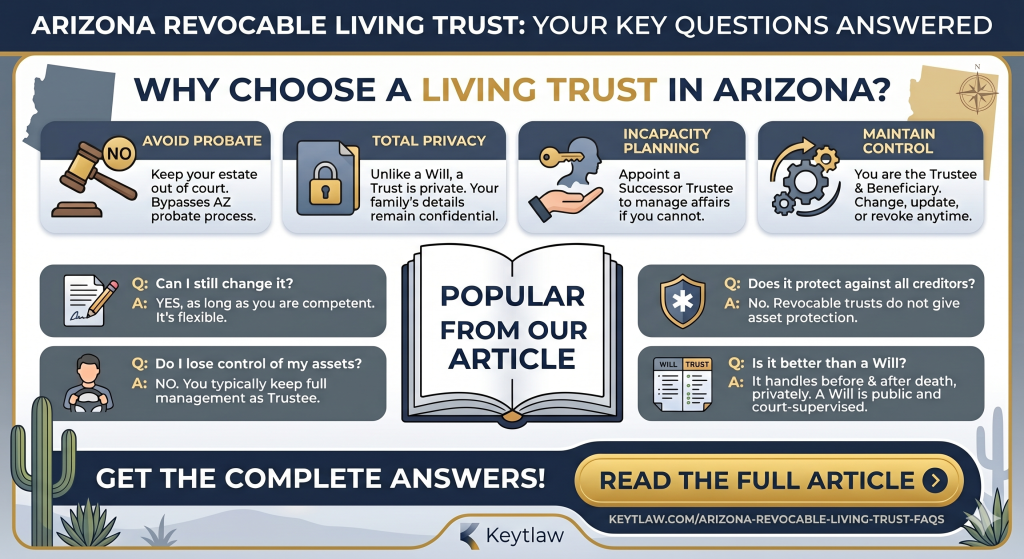
A revocable living trust is a legal document you create during your lifetime that holds your assets — your home, bank accounts, investments, and more — and controls what happens to them when you die or become incapacitated. It passes your estate to your loved ones completely outside of probate court, quickly and privately, exactly according to your instructions.
The word revocable means you’re in charge. You can change it, update it, or cancel it entirely at any time while you’re alive.
2. What’s the difference between a will and a revocable living trust?
A will is a document that says what you want to happen to your assets after you die. But here’s the catch — a will does not avoid probate. In fact, a will guarantees probate. Your family must go to Arizona probate court to get the will approved, and the entire process plays out in public, on a court schedule, at significant cost.
A revocable living trust, by contrast, works outside the court system entirely. When you die, your successor trustee follows the instructions you left inside the trust and distributes your assets to your future beneficiaries — no court, no judge, no waiting, no public record.
A will alone is not a complete estate plan. A trust is.
3. What does “living” mean in “living trust”?
It simply means you created the trust while you’re alive. That’s all. It distinguishes it from a testamentary trust, which is created inside a will and only goes into effect after you die — and only after going through probate first.
4. What does “revocable” mean?
It means you retain full control. You can amend, modify, or revoke your trust entirely at any time while you are alive and mentally competent. Nothing is permanent. If your life changes — a divorce, a new grandchild, a change of heart about who gets what — you can update the trust to reflect your new wishes.
5. Is a revocable living trust the same as a “family trust” or a “living trust”?
Yes. Those are all names for the same thing. You may also hear it called a “revocable trust,” “inter vivos trust,” or “grantor trust.” They all refer to the same core legal tool: a trust you create during your lifetime that you control and that avoids probate of your assets at your death.
How It Works
6. Who are the key people in a revocable living trust?
When you create a revocable living trust, you typically wear three hats at once:
- Trustmaker (also called Grantor or Settlor): You created the trust. It belongs to you.
- Trustee: You manage all the assets inside the trust. You sign checks, sell property, and make decisions — exactly as you do today.
- Current Beneficiary: You benefit from the trust assets while you’re alive.
You also name:
- Successor Trustee: The person (or institution) who takes over managing the trust if you become incapacitated or when you die. This person carries out your instructions in your trust agreement without ever going to court.
- Future Beneficiaries: The people (or organizations) who receive your assets after you die.
7. Does a revocable living trust become irrevocable when I die?
Yes. At the moment of your death, your revocable living trust locks in permanently — it becomes irrevocable. Your successor trustee then has a clear set of instructions stated in your trust agreement to follow and the legal authority to distribute your assets to your beneficiaries according to the trust agreement. At that point, no one can change the terms of the trust.
8. What is a successor trustee?
Your successor trustee is the person you name in your trust agreement to step in and manage your affairs if you become incapacitated — or to distribute your assets after you die. While you’re alive and capable, you serve as your own trustee. The successor trustee has no power until you can no longer serve.
Choose someone you trust completely: a spouse, an adult child, a sibling, or a close friend. You can also name a professional trustee or a bank trust department.
9. Can I be my own trustee?
Absolutely. In fact, that is the norm. You create the trust, you serve as trustee, and you manage everything in it just as you do today. There is no loss of control. You simply have a legal structure — the trust — holding title to your assets while you remain in complete command.
10. What is a certification of trust?
A certification of trust is a short summary document that confirms your trust exists and identifies the trustee’s authority — without revealing the private details of your trust. When you open a bank account in the name of your trust, refinance your home, or deal with a title company, they often want proof the trust exists. You give them the certification of trust instead of your entire trust document. It protects your privacy while giving the institution what it needs.
Superior Court Probate
11. What is probate and why should I avoid it?
Probate is a court-supervised legal process that validates your will, pays your debts, and distributes what’s left to your heirs. It sounds orderly. In practice, it is slow, expensive, and public.
In Arizona, probate typically takes 5 to 12 months — sometimes longer. Attorney fees, court costs, and executor fees can consume 3% to 7% of your estate’s value. On a $500,000 estate, that’s up to $35,000 that should have gone to your children but didn’t.
Worse, every document filed in probate is a public record. Anyone can walk into the courthouse or go online and find out what you owned and who got it. A revocable living trust eliminates all of that.
12. Does a revocable living trust completely avoid probate?
Yes — but only for assets that have been properly transferred into the trust. A trust that holds your home, your bank accounts, and your investment accounts will pass all of those assets to your beneficiaries without probate.
Assets you own in your personal name — outside the trust — at the time of your death may still go through probate. This is why “funding” your trust (actually transferring your assets into it) is just as important as creating it.
13. What is an “unfunded” trust and why is it a problem?
An unfunded trust is one that was properly drafted but never actually received your assets. Your home was never transferred into it. Your bank accounts were never retitled. The trust exists on paper but owns nothing.
If you die with an unfunded trust, your estate will likely go through probate anyway — because your assets are still in your personal name. An unfunded trust is like building a safe and leaving all the gold on the floor next to it.
At KEYTLaw, every estate plan we prepare includes a deed transferring your home into the trust. We don’t let you leave with an unfunded trust.
14. What if I own real estate in another state? Do I still avoid probate?
Yes — that’s one of the most powerful advantages of a revocable living trust. Without a trust, real estate you own in another state triggers a separate probate proceeding in that state (called “ancillary probate”) in addition to the Arizona probate. Each one costs money and time.
If your Arizona trust holds title to your Arizona home and your Colorado cabin, both pass to your beneficiaries without any court involvement in either state.
Protecting Your Family
15. What happens to my trust if I become mentally incapacitated?
This is one of the most underappreciated benefits of a revocable living trust. If you suffer a stroke, develop dementia, or are seriously injured and can no longer manage your own affairs, your successor trustee steps in immediately and manages your trust assets for your benefit.
No court. No conservatorship proceeding. No judge deciding who controls your life. You chose that person. You made the plan. It executes quietly.
Without a trust (and without a financial power of attorney), your family may have to petition the Arizona Superior Court to become your legal conservator — a proceeding that costs thousands of dollars, takes months, requires ongoing court reporting, and is entirely public.
16. Does a revocable living trust protect my beneficiaries’ inheritance from their creditors or a divorcing spouse?
A basic revocable living trust does not. But here’s what’s possible: for an additional fee we can include text in your trust agreement that creates an irrevocable asset-protected trust for each of your beneficiaries. When you die and your assets flow to your children or other heirs, their inheritance goes into their individual asset-protected trusts — shielded from their creditors, their divorcing spouses, and their bankruptcy courts, potentially for the rest of their lives.
This is one of the most powerful tools we build into estate plans for clients who want to truly protect what they’re leaving behind.
17. Can my trust include instructions for how and when my beneficiaries receive their inheritance?
Yes. That’s one of the great strengths of a trust over a simple beneficiary designation. You can instruct your trustee to:
- Hold a grandchild’s inheritance until they turn 25 (or 30, or 35)
- Distribute an inheritance in stages — one-third at 25, one-third at 30, the balance at 35
- Provide for a special-needs family member without disqualifying them from government benefits like Medicaid or SSI
- Make distributions for health, education, and living expenses but not a lump sum
A revocable living trust lets you control assets from beyond the grave — with love and wisdom.
18. Can a revocable living trust protect a special-needs beneficiary?
Yes, with proper planning. A standard inheritance given directly to a person receiving government benefits (like Supplemental Security Income or Medicaid) can disqualify them from those benefits. A special needs trust — also called a supplemental needs trust — is structured to provide additional support without counting as a resource for purposes of those benefit programs. This is a critically important planning technique for families with a disabled child, sibling, or other loved one.
Our trust agreements provide that if a beneficiary is or ever becomes a special needs person his or her trust will automatically become a special needs trust so the beneficiary will not lose any government benefits.
Taxes and Finances
19. Will a revocable living trust save me money on income taxes?
No. While you’re alive, a revocable living trust is ignored for income tax purposes. It does not file any tax returns. All income from trust assets is reported on your personal income tax return, exactly as before. Your tax ID number stays the same. Nothing changes on your tax return.
20. Does a revocable living trust help with estate taxes?
A basic revocable living trust does not reduce estate taxes on its own. However, for married couples with larger estates, a trust can be structured with tax planning provisions — such as a bypass trust or credit shelter trust — that maximizes the use of both spouses’ estate tax exemptions and potentially reduces estate tax exposure. This requires specific planning and is not part of every estate plan.
For most Arizona families, the federal estate tax exemption (currently $15,000,000 per person) means estate tax is not a concern for most Americans. But it’s worth discussing with your attorney.
21. Does putting my home in a trust affect my property taxes?
No. Transferring your home into a revocable living trust in Arizona does not trigger a property tax reassessment or affect your property taxes. It also does not affect your homestead exemption. This is a common concern, and the answer is reassuring: the transfer is invisible to the county assessor for property tax purposes.
22. Does a revocable living trust protect my assets from my own creditors?
No. Because you retain full control over a revocable trust, your creditors can still reach trust assets. A revocable living trust is not a creditor-protection tool for the person who created it. If asset protection for yourself is a goal, there are other planning structures (such as an Arizona LLC or an irrevocable trust) that may be appropriate.
Common Misconceptions
23. I just have a will — isn’t that enough?
For most Arizona homeowners, a will alone is not enough. A will does not avoid probate. It guarantees it. If you own a home, have children, or have any significant assets, a will-only plan will put your family through the time, expense, and public exposure of probate court when you die — when a trust could have prevented all of it.
24. Can’t I just add my kids to the deed to avoid probate?
This feels like a shortcut, but it’s a trap. When you add an adult child to the title of your home as a joint tenant, you’ve made an irrevocable gift of a partial ownership interest — and you’ve exposed your home to that child’s creditors, their divorcing spouse, and their potential bankruptcy judgment. If your child is sued and loses, his or her creditor may be able to reach and take your child’s interest in your house — the house you’re still living in.
Joint tenancy is not estate planning.
25. Don’t my beneficiary designations on my IRA and life insurance take care of everything?
Beneficiary designations are important, but they are not a substitute for a complete estate plan. They only cover the specific accounts that carry them. They say nothing about your home, your car, your jewelry, your bank accounts, or your business. More importantly, if you name a child directly as your IRA beneficiary and that child is involved in a lawsuit, a divorce, or a bankruptcy when you die, that inherited IRA may be vulnerable — exactly when your child needs it most.
A properly designed trust, with an asset-protected beneficiary trust for each heir, addresses all of this.
26. I’m not wealthy. Do I really need a trust?
This is the most common misconception we encounter. A revocable living trust is not a tool for the wealthy. It’s a tool for anyone who owns a home, loves their family, and wants to protect both.
If you own a home in Arizona, your estate will almost certainly go through full probate without a trust. If you have children, you want to name a guardian and protect their inheritance. If you have a retirement account, you want to control how and when those funds are distributed. If you’ve been married more than once, a trust is essential.
You don’t need a mansion and a yacht to deserve a real estate plan. You just need to love someone.
27. Can I use an online service to create a trust?
You can. But consider the risk. A revocable living trust is a legal document that must be properly drafted, properly executed (signed with specific legal formalities), and properly funded (assets actually transferred into it). An online form that gets any one of those three things wrong can fail completely when your family needs it most.
The most common failure we see is the unfunded trust — a document that was created online but never had the home transferred into it. That trust offers exactly zero protection from probate.
We know what works, what fails, and what Arizona courts do to DIY documents. Done correctly, your trust will protect your family during the worst moment of their lives. Done incorrectly, it won’t.
The KEYTLaw Estate Plan
28. What’s included in a KEYTLaw estate plan?
Every KEYTLaw estate plan is a complete, coordinated system — not just a trust document. You receive all of the following:
- Revocable Living Trust — the cornerstone; avoids probate
- Certification of Trust — for banks, title companies, and financial institutions
- Healthcare Power of Attorney — names someone to make medical decisions for you if you can’t
- HIPAA Authorization — allows your named person to receive your medical information
- Financial Power of Attorney — authorizes someone to manage your finances if you’re incapacitated
- Living Will (Advance Healthcare Directive) — documents your end-of-life wishes
- Deed transferring your home into the trust — so your home avoids probate
- Designation of Guardian for Minor Children — names who will raise your children if you cannot
- Assignment of Personal Property to the Trust — moves your personal belongings into the trust
- Personal Property Memorandum — a flexible document you can update at any time to direct specific items to specific people, without changing your trust
See the 36 documents and services contained in our estate plan with a revocable living trust.
We prepare complete estate plans. Not a template. A real, custom-drafted legal plan built around your life, your family, and your goals.
29. How much does a KEYTLaw estate plan cost?
We keep our fees fair and accessible because we believe every Arizona family deserves a proper estate plan. The cost of a complete estate plan is almost always a small fraction of what your family would spend on probate if you died without one.
Book a free consultation to discuss your situation and get exact pricing.
No obligation. No pressure. Just an honest conversation.
30. How do I get started?
The first step is to book a free consultation — by phone, Zoom, or in person at our Scottsdale office. There is no charge. We will talk about your family, your assets, and your goals, and we’ll tell you exactly what we recommend and what it will cost.
📅 Book your free meeting here:
https://www.keytlaw.com/calendar
🌐 Learn more about Arizona estate planning:
https://www.keytlaw.com/arizona-wills-trusts-articles/
31. Still Have Questions?
Call or email us directly — we don’t charge to talk to people.
Richard Keyt (the father) Direct: 480-664-7478
Richard C. Keyt (the son, former CPA) Direct: 480-664-7472
We serve clients throughout Arizona, including Scottsdale, Paradise Valley, Phoenix, Mesa, Tempe, Chandler, Gilbert, Glendale, Peoria and Queen Creek.
See the Contents of Our Estate Plan
To protect your most valuable assets—your loved ones— read our article that describes the 36 documents and services you will get if you hire us to prepare your comprehensive estate plan with a revocable living trust or watch this video about the documents and services.