
Guide to Naming a Guardian of
Minor Children
Richard Keyt (Rick, the father at 480-664-7478) and his son, former CPA Richard C. Keyt (Ricky at 480-664-7472), are Arizona estate planning attorneys with 314 5-star Google reviews and 432 5-star Google, Facebook & Birdeye reviews. They want to prepare a custom estate plan for Arizona residents that protects their most valuable assets – their loved ones. Call, email, or book a free office, phone or Zoom video meeting.
Our 5-Star Reviews
If you have minor children and you don’t have a will that names a guardian for them, you have left one of the most important decisions of your life entirely in the hands of a judge who has never met you, your children, or your family. That is a risk no Arizona parent should take.
This article explains exactly how Arizona law works when it comes to naming a guardian for your minor children, what happens if you die without naming one, and why a proper estate plan — not just a will — is the right way to protect your family.
Arizona Parent’s Guide to Naming Guardians in a Last Will & Testament
What Is a Guardian of a Minor Child?
A guardian is the person who steps in to care for your child if both parents die or are legally unable to act as parents. The guardian has the legal authority to make decisions about your child’s health, education, and day-to-day life — everything you do as a parent right now.
This is different from a trustee, who manages the money you leave for your child. A guardian raises your child. A trustee manages the inheritance. Both roles matter, and both should be named in your estate plan.
What Happens in Arizona If You Die Without Naming a Guardian?
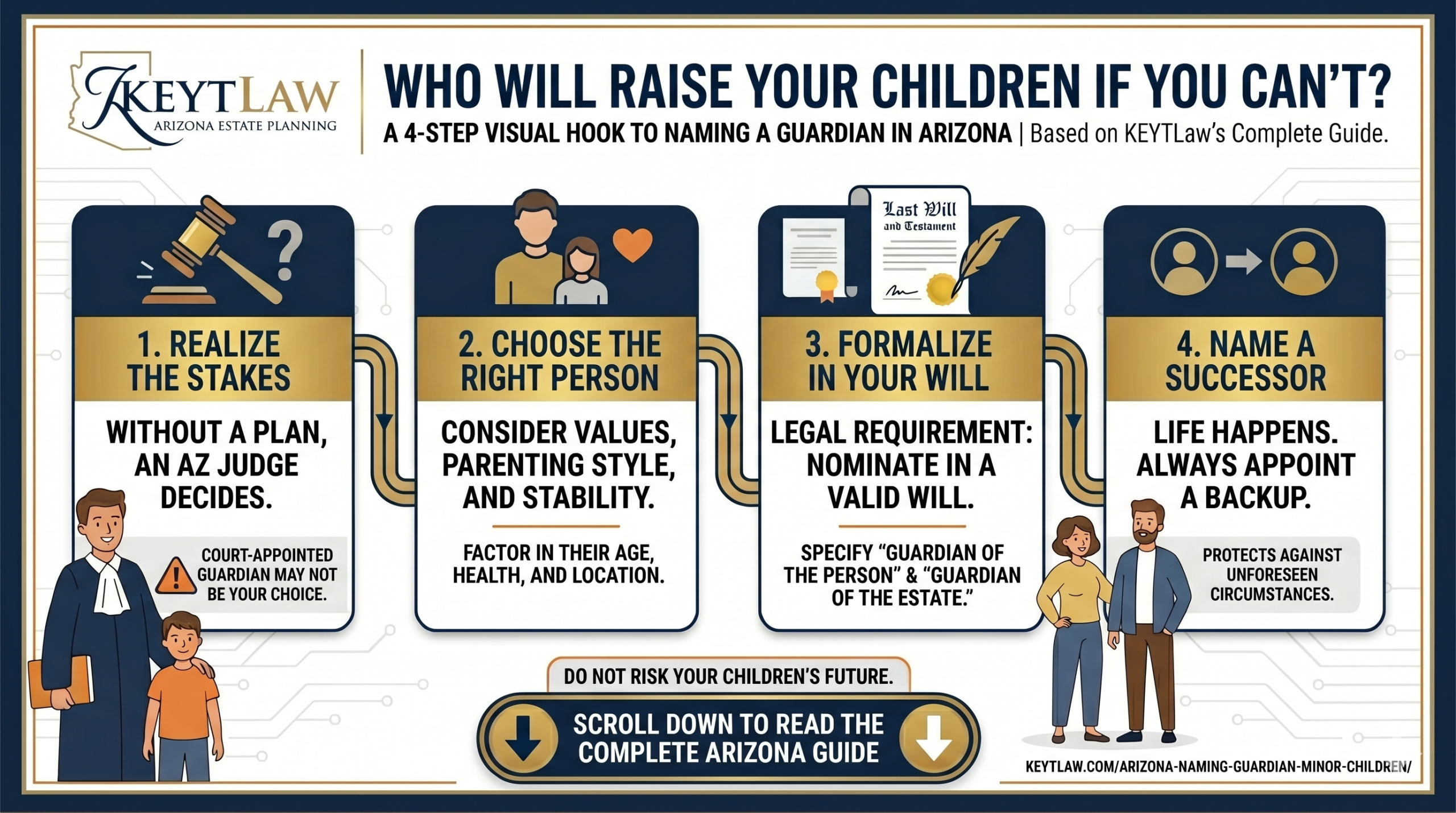
If you die without naming a guardian for your minor children, a judge decides who raises them. That decision may not reflect your wishes, your values, or your family’s best interests.
Here is what actually unfolds in Arizona when both parents die and there is no guardian named in a will:
1. The Court Opens a Guardianship Proceeding
Arizona’s probate court takes jurisdiction over your minor children. Anyone — a grandparent, a sibling, an aunt or uncle, even a family friend — can petition the court to be appointed as guardian. If multiple people want to raise your children, the result can be a painful, expensive legal fight within your own family at the worst possible time.
2. A Judge Applies a Legal Standard, Not Your Wishes
The court applies a “best interests of the child” standard. That sounds reasonable, but the judge has no idea what you would have wanted, what your values are, what your faith is, or who you trusted most to love your children the way you did. Without a written nomination from you, the judge is guessing.
3. Your Children May Be Placed Temporarily With Strangers
While the court sorts things out — and court proceedings take time — your children may be placed in temporary care. That transition can be traumatic for children who have just lost their parents. Naming a guardian in advance means the people you trust can step in quickly, minimizing disruption for your kids.
4. Your Children Have No Say Until Age 14
Under Arizona law, a minor who is at least 14 years old can file a written objection with the court to block or end a guardian appointment. Children younger than 14 have no formal say at all. The time to protect them is now, while you are here to make that decision.
How Arizona Law Lets You Name a Guardian: A.R.S. § 14-5202
Under Arizona law, a parent may appoint a guardian for an unmarried minor child in a Last Will and Testament. This is called a testamentary appointment of a guardian, and it is the primary legal tool available to Arizona parents who want to control who raises their children.
Here are the four key things you need to understand about how this works:
Triggering Events: When Does the Appointment Take Effect?
The appointment only becomes effective if both parents are deceased or if the surviving parent has been adjudged incapacitated by a court. As long as one parent is alive and legally able to act, they continue to have parental rights. The guardian nomination kicks in only when it is truly needed.
Priority of Nominations: What If Both Parents Named Different Guardians?
If both parents had wills naming different guardians, Arizona law gives priority to the appointment made by the parent who died last. This is a good reason for both parents to agree on a guardian and name the same person in their respective estate plans.
Effective Date: Is the Appointment Automatic After Death?
No. The appointment does not happen automatically. It becomes effective when the named guardian files a written acceptance with the court where the will is probated. This is another reason your chosen guardian should know about their nomination in advance and be willing to serve.
Right to Object: Can the Child Refuse? (A.R.S. § 14-5203)
Yes — but only if the child is 14 or older. Under A.R.S. § 14-5203, a minor who is at least 14 years of age may prevent an appointment or cause it to terminate by filing a written objection with the court. This gives older teenagers a meaningful voice in the process.
A Will Names a Guardian — But a Will Alone Is Not Enough
A Last Will and Testament names the guardian of minor children, but it still must go through Arizona probate court before it has any legal effect. A will alone does not avoid probate — and probate takes time, costs money, and delays the care and support your children need.
At KEYTLaw, we believe that the cornerstone of proper Arizona estate planning is a revocable living trust — not a will standing alone. A revocable living trust allows your estate to pass to your beneficiaries without going through probate court, which means faster access to funds, lower costs, and greater privacy for your family.
A complete KEYTLaw estate plan includes both a trust and a will, so your guardian nomination is legally documented and your assets transfer efficiently to the people and structures you have designated.
What a Complete KEYTLaw Estate Plan Includes
Every KEYTLaw estate plan is designed to give your family comprehensive protection. Here is exactly what is included in every plan we prepare:
- Revocable Living Trust
- Certification of Trust
- Healthcare Power of Attorney
- HIPAA Authorization
- Financial Power of Attorney
- Living Will (Advance Directive)
- Deed to Transfer Your Home to the Trust
- Designation of Guardian for Minor Children
- Assignment of Personal Property to the Trust
- Personal Property Memorandum
The Designation of Guardian for Minor Children is a standalone document included in every estate plan that formally records your guardian nomination — separate from, and in addition to, the nomination in your will. We leave nothing to chance.
We also recommend that your children’s inheritance be protected by an irrevocable asset-protected trust inside the estate plan. This shields whatever you leave your children from creditors, future ex-spouses, and bankruptcy courts. You worked hard to build something worth leaving behind. Let’s make sure it actually stays with the people you love.
Choosing the Right Guardian: Practical Guidance
The legal mechanics matter, but choosing the right guardian is deeply personal. Here are a few things to think about:
Share Your Values, Not Just Your Assets
Choose someone who will raise your children in alignment with your values — your faith, your parenting philosophy, your hopes for who your children will become. The most financially stable candidate is not always the right choice if they don’t share what matters most to you.
Consider the Practical Realities
Would your chosen guardian have the capacity to add your children to their family? Do they live close enough to minimize disruption to your children’s schools and friendships? Are they healthy enough to take on the responsibility? These are hard questions, but they are the right ones to ask.
Talk to Your Nominee in Advance
Never surprise someone with this responsibility. Have the conversation. Make sure they are willing to serve and understand what you would want for your children. Your guardian should also know where your will and trust documents are located.
Name an Alternate Guardian
Life changes. The person you name today may predecease you, become incapacitated, or simply not be in a position to serve when the time comes. Always name a primary guardian and at least one alternate.
Don’t Leave This Decision to a Judge
Your children deserve to be raised by someone you chose — not someone a court assigns. The good news is that naming a guardian is straightforward when it is part of a properly prepared estate plan.
Estate planning attorneys Richard Keyt and his son Richard C. Keyt help Arizona families protect what matters most since 1979. Every KEYTLaw estate plan is custom-prepared and includes a complete designation of Guardian for Minor Children so your wishes are documented, legally sound, and ready if they are ever needed.
Book a free office, phone, or Zoom consultation at keytlaw.com/calendar — or learn more about Arizona estate planning at keytlaw.com.
This article is for general educational purposes only and does not constitute legal advice. For advice specific to your situation, please consult a licensed Arizona attorney.
See the Contents of Our Estate Plan
To protect your most valuable assets—your loved ones— read our article that describes the 36 documents and services you will get if you hire us to prepare your comprehensive estate plan with a revocable living trust or watch this video about the documents and services. Our estate plan includes a Last Will & Testament that names guardians.