by Gary Retterbush, USAF Fighter Pilot
My First MiG-21, 12 Sep 72
On September 12, 1972, I was a Major in the United States Air Force and the pilot of Finch 3, an F-4E Phantom II. Finch flight was a flight of four Phantoms led by Lt. Col. Lyle Beckers, the squadron commander of the 35th Tactical Fighter Squadron. The 35th TFS was permanently based at Kunsan Air Base, Korea, but was on temporary duty (TDY) at Korat Royal Thai Air Base, Thailand, to assist in Operation Linebacker I .
Finch flight was part of a large strike package of aircraft flying in the general area of Hanoi, in Route Pack VI, North Vietnam. The strike force consisted of:
- F-4 fighter bombers carrying bombs
- F-4 strike escorts whose job was to prevent the MiGs from attacking the strike force
- F-4 chaff bombers whose job was to drop small pieces of tin foil along the route to the target to degrade the enemy’s radar
- F-105 wild weasels whose job was to troll for SA-2 Guideline surface to air missiles (SAMs, which were 32 foot long flying telephone polls with a speed 3 times the speed of sound) and destroy the SAM sites, and
- F-4 hunter killers, who flew with the wild weasels and whose job was drop general purpose bombs and cluster bomb units (CBUs) on the SAM site.
While we were heading to the target, several North Vietnamese MiG-21s jumped the strike force. The MiG’s came from high and behind my flight and dove down through us firing their missiles as they came. It was a rather chaotic time!
During the maneuvering that followed, our flight broke apart and we ended up as two elements of two F-4s. I maneuvered to the six o’clock position behind a MiG-21 and Dan Autrey, my backseater, got a good radar lock on the MiG. Conditions were excellent; almost text book. I fired two AIM-7 Sparrow radar guided missiles, which did not guide. They simply went ballistic and did nothing except alert the MiG pilot to his impending peril.
I had a lot of overtake and continued to close on the MiG. I changed my armament switches from the AIM-7 to the AIM-9 Sidewinder heat-seeking infrared missile. As soon as I was within AIM-9 range (approximately 9,000 feet), I got a good audio tone for the AIM-9’s. I fired three Sidewinders at the MiG, but they either did not guide or their proximity fuses did not work.
The last missile went close by the cockpit and got the MiG pilot’s attention! He broke hard and I followed and continued to close on him. I got in position to use my 20mm canon (a six barreled Gatling gun in the nose that was capable of firing 6,000 rounds/minute) so I fired a couple of short bursts at the MiG. Some of the bullets hit the MiG’s left wing near where it joined the fuselage. The MiG started burning immediately. I was now closing way too fast. I did a high speed yo-yo. The maneuver once again put me in position to fire another burst from my gun. These bullets hit in and around the cockpit and the aircraft pitched up. I saw the pilot slumped forward in the cockpit. The aircraft then stalled and snapped down as I flew past it. I watched the burning MiG until it hit the ground and exploded in a cloud of smoke and fire.
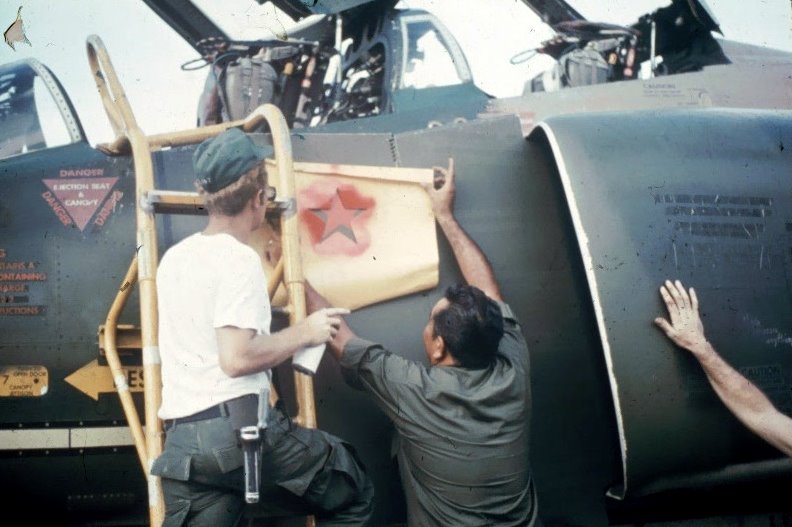
Ground Crew Paints a Red Star on the Side of this F-4 that Killed a MiG
My Second MiG-21, 8 Oct 72
On October 8, 1972, I was the leader of Lark flight, a flight of four F-4E Phantoms flying cover for a flight of four F-4Ds on a bombing mission near Yen Bai Airfield in North Vietnam. I was also the mission leader of this very small strike package.
My backseater, Captain Bob Jasperson, had a problem getting his canopy to lock just prior to takeoff. Bob cycled his canopy several times. He finally pulled it down on the rails and got it to lock. Bob told me later that he knew this would be his last Southeast Asia flight and he didn’t want to abort on the ground. Thanks, Bob!
After we refueled from the KC-135 tankers on the ingress route, one of my F-4s in my flight had a mechanical problem. I sent that airplane and a wingman home. Under the rules of engagement at that time, I should have aborted the mission since I only had two fighters in my flight, but I chose to continue the mission.
As we approached the border of North Vietnam, “Disco” (the USAF airborne EC-121 warning aircraft orbiting in Laos) warned us that a MiG was scrambling and that we were probably its target. As we continued inbound, Disco gave us frequent warnings of the MiG’s progress and location. It was indeed coming our way.
The engagement was almost like a GCI (ground controlled intercept) in reverse. Disco announced the MiG was at our 10:30 high. Sure enough, my backseater, Bob Jasperson, pointed out a silver glint in the sun as the MiG turned down on us. I called a “hijack” and had the fighters jettison their external fuel tanks and light afterburners as we turned into the MiG. A few seconds later I had the F-4 bomber flight break as the MiG came closer to the bombers.
The MiG dove down trying to attack the breaking bombers. I was on his tail, but at a very high angle off. Angle off is the angle between the attacking airplane and the target if you extended a line straight back from the target’s tail and then measured the angle between the attacker and the extended line. The book said that the AIM-9 Sidewinder would not guide to the target if the angle off at the time of firing was greater than 45 degrees.
I fired two AIM-9 heat seeking missiles at the diving MiG. I did not expect either of them to guide because the angle off was far beyond the limits. Both missiles went ballistic as I anticipated. I then tried to jettison the rest of my missiles including the three AIM-7 Sparrow radar guided missiles. I was yelling for Bob to give me a caged gun sight because the reticle was completely off of the windscreen due to the high angle off and the high Gs we were pulling. Bob got the gun sight locked. I very quickly did a little Kentucky windage estimate, pulled the pipper way out in front of the MiG and high and fired a short burst from my 20mm Gatling gun.
To my pleasant surprise the bullets hit the MiG in the fuselage near the left wing and it immediately burst into flames. The pilot did not hesitate and ejected immediately. Then came an even bigger surprise; he had a beautiful pastel pink parachute! I circled him one time and then regrouped the flight for our trip home.
The entire engagement was visible from the Yen Bai, North Vietnam airfield tower, if anyone was in it at that time. The engagement lasted only a minute or two from start to finish. When I landed, I checked the gun and found that I had fired only 96 rounds, including the exciter burst that was probably about the half bullets fired.
I was extremely pleased that I had a gun camera for this mission (not all birds had them) and it had checked out good going in. When I removed the film pack it looked like it had functioned correctly. I gave the film to the gun camera guys and told then to really take care in developing it. About an hour later they came to me with the results and a great film, but all of it was flying straight and level after the refueling. I tested the gun after leaving the tanker and the camera apparently continued to run after the test firing. All of the film was used long before the dogfight began. So, unfortunately, I did not have the great MiG kill camera film that I had hoped for!
Check six, Busch.
Simulated Video of Busch’s first MiG Kill
This vidoe is pretty cool. The text under the video on Youtube says: “In game video of a YAP2 mission loosely based on an actual gun kill by an F-4E Phantom piloted by Gary Retterbush over N. Vietnam on September 12 1972. He later went on to earned a second gun kill just a month later.”

What an amazing read! By the way, I am an avid diecast model collector and would love to propose this idea to a company who makes 1/72 scale F-4 Phamtoms. I have actually been doing a little bit of research of your F-4E but I can’t seem to find sufficient and conclusive information of your aircraft. Could we maybe connect and aid me in my research from the pilot himself, it’d be very helpful and I’d greatly appreciate it Maj. Retterbush. Thank you for sharing!
Send your name and email address to me at [email protected]. Include what you want to say to Gary. I’ll forward the message to Gary Retterbush.