After graduating from USAF Officer Training School (OTS) at Lackland Air Force Base, Texas, I was commissioned as a brown bar Second Lieutenant in December of 1970. I spent a year earning my wings. I finished high enough in my class to pick the F-4 Phantom as the airplane I would fly for the next five years. After a two week romp in the beautiful mountains of Washington state where I attended survival school followed by a couple of weeks at water survival school outside of Miami, Florida, I reported in November of 1971 to Luke Air Force Base, Arizona, for six months of F-4 RTU.
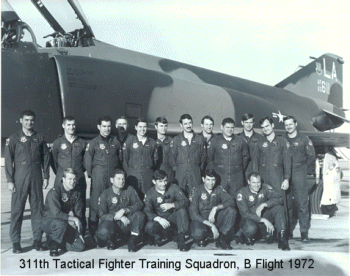
2nd Lt. Richard Keyt is in the back row, 6th guy from the left.
Capt. Buddy Mizel, 1st guy on left in the back row.
Capt. Kenny Boone (Instructor Pilot) kneeling 3rd from the left.
RTU stood for “replacement training unit.” It was called RTU because we were being trained to replace other F-4 guys in Vietnam after they finished their one year tour of duty. Since I was young pup, I had dreamed of flying a jet fighter. When I drove onto Luke AFB for the first time and saw the sleek Phantoms lining the ramp, it was a dream come true. It gave me a chill to see row after row of camouflaged F-4s.
It was a very exciting time. I was 23 years old, single and ready for adventure. I got an apartment at the Oakwood Garden Apartments at 40th Street and Camelback Street in Phoenix, Arizona. Although it was a 45 minute drive one way to the base, my apartment complex was well worth the long commute. I picked Oakwood for several reasons: a lot of Luke F-4 pilots lived there and recommended it, the apartments were far from the base so I could live like a civilian, it was close to the night life, and the amenities were great.
Oakwood at the time was singles only. It was and still is a large apartment complex. It had a beautiful large pool, tennis court and tennis pro, sand volleyball courts, six pool tables in a big recreation center, live bands on Friday nights, an activities director and a lot of young adults. I roomed with two other F-4 students in a two bedroom apartment. We had black lights and liked to play music with the black light on at night and talk and talk and talk.
I was assigned to the 311th Tactical Fighter Training Squadron, which consisted of approximately 10 – 15 F-4 instructor pilots and about 40 students. The course lasted six months and included three primary phases. We generally spent half the day in an academic class and the other half of the day flying. We also squeezed in about twenty 1.5 hour missions in the F-4 simulator.
The classes were just like college, except we weren’t studying political science, English or chemistry. We had text books for each subject and nightly reading assignments. The F-4 instructors taught classes in aircraft general, formation flying, basic fighter maneuvers, aerial combat maneuvering (dog fighting), bombing theory, weapons delivery, nuclear weapons, combat mission planning, electronic warfare and countermeasures, and weapons computer delivery system. From time to time in each course we had tests, including final exams. Anybody who flunked an exam risked losing their wings.
We spent a lot of time learning and studying about the F-4 and its systems. We were issued a large book about an inch thick called a dash one, which is the equivalent of the owners manual for the airplane. It was filled with page after page of information about all the unclassified systems of the Phantom. We studied the dash one religiously and were constantly being quizzed on F-4 trivia. The Phantom is a complex machine with a lot of systems and it demands your full attention.
Before we could fly, we had to learn about the Martin Baker ejection seat and the finer points of surviving emergency air and ground egress. The Martin Baker ejection seat is a rocket propelled ejection seat that had an excellent record of saving lives. It is known as a “zero, zero” seat, which means that it is supposed to safely eject a man when the airplane has zero altitude and zero airspeed. In theory, if a man was strapped into the ejection seat in the F-4 sitting still on the ground and the ejection seat fired, the man and seat would be blown 300 feet in the air, the parachute would open and the man would parachute back to earth safely. The nice thing about flying with an ejection seat is that you can always leave the airplane if you don’t like what is happening. It gives you a false sense of security.
The ejection seat, however, was a very dangerous device that required the utmost care. There were a number of accidents, usually involving maintenance personnel who were working inside the cockpit and accidentally fired the seat. Most seat accidents were fatal. I was very careful to check my ejection seat from top to bottom before getting in the cockpit. The seat had seven safety pins stuck in various parts, all of which had to be removed for the seat to fire. The seven pins were all attached to a long nylon cord. Normally when the airplane was not in use, all seven safety pins were in the seat. Just before a scheduled flight, the crew chief would remove six of the safety pins and put them in the safety pin bag and lay it on the top of the seat.
My first flight in the F-4 was a blast, literally and figuratively. Standard USAF procedure before flying the F-4 was for all the crewmembers in a flight to have a mission briefing two hours before scheduled takeoff. F-4s usually flew in flights of two or four. The briefings lasted an hour during which the flight leader would follow a briefing checklist and discuss the mission from A to Z. He briefed us on the weather, time to start engines, radio procedures, flight check in time, taxi procedures, arming area procedures, type of take off such as single ship or formation, departure procedure, route to the restricted flying area, how to perform the mission such as dive bombing, strafing, intercepts, dog fighting, return to base, ground emergency procedures and emergency air fields.

Leave A Comment